
.svg)
.svg)
%201.svg)
%201.svg)
.svg)

.svg)
.svg)
Liang Choon Wang

Choon Wang is Associate Professor of economics at Monash University. He obtained his Ph.D. in Economics from the University of California, San Diego. Prior to joining Monash University, he worked at the World Bank’s Development Research Group. His research interests include behavioural economics, development economics, economics of education, health economics, labour economics, and public economics.
.svg)


भेदभाव में लिंग-जाति अंतर्विरोध: क्या मरीज़ डॉक्टर की सामाजिक पहचान की परवाह करते हैं?
भारत में सामाजिक पहचान पर आधारित भेदभाव व्यापक रूप में फैला होने की वजह से, भेदभाव में जाति-लिंग अंतर्विरोध के अध्ययन हेतु एक अनूठी सेटिंग उपलब्ध होती है। यह लेख, उत्तर प्रदेश में किये गए एक क्षेत्रीय प्रयोग के आधार पर दर्शाता है कि मरीज द्वारा महिला डॉक्टरों की तुलना में पुरुष डॉक्टरों को पसंद किये जाने के कारण जाति-संबंधी पूर्वाग्रह इस लिंग संबंधी भेदभाव को और बढ़ा सकते हैं। भारत में निम्न-जाति के पेशेवरों की बढ़ती हिस्सेदारी को देखते हुए, यह लिंग-जाति अंतर्विरोध पेशेवरों के बीच लैंगिक असमानताओं को बढ़ा सकता है।


Gender-caste intersectionality in discrimination: Do patients care about doctor’s social identity?
Due to widespread prevalence of discrimination based on social identity, India provides a unique setting for studying caste-gender intersectionality in discrimination. Based on a field experiment in Uttar Pradesh, this article shows that when patients prefer male doctors over female doctors, caste-related prejudices can worsen this gender discrimination. Given the increasing share of low-caste professionals in India, this gender-caste intersectionality can exacerbate gender disparities among professionals.
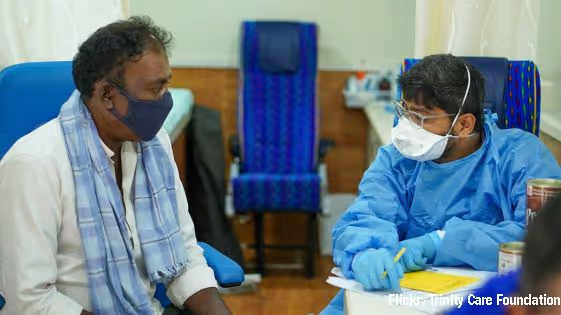
Covid-19: Addressing stigma and misconceptions
Throughout the Covid-19 pandemic in India, there has been stigmatisation of patients and their families, and discriminatory attitudes towards marginalised groups as well as frontline workers. Based on an experiment conducted in Uttar Pradesh during June-August 2020, this article shows that providing reliable and focussed information on the transmission of the Virus can play an important role in addressing associated misconceptions, stress, and stigma.