
.svg)
.svg)
%201.svg)
%201.svg)
.svg)

.svg)
.svg)
Manini Ojha

Manini Ojha is an Associate Professor at the Jindal School of Government and Public Policy of O.P. Jindal Global University. She completed her PhD in Economics from Southern Methodist University, Dallas, Texas in 2018. Before joining SMU, she was an Assistant Professor in the Department of Economics at Lady Shri Ram College for Women, Delhi University for three years. She received an MA in Economics from Jawaharlal Nehru University, New Delhi and a BA from Shri Ram College of Commerce, Delhi University.
Her areas of research interest lie in the fields of applied microeconometrics, empirical development economics, economics of households, education, gender, and labour economics. Her current research focuses on household dynamics and child health, women's reproductive and menstrual health, domestic violence, and education. She is also interested in addressing questions relating to how government policies affect household and individual behaviour. She teaches courses on statistics, econometrics, applied econometrics and empirical development economics.
.svg)


Contraception as a pathway to better child nutrition and health
India is home to one-third of the world’s stunted children, and half of all under-five mortality can be attributed to undernutrition. Existing literature has shown an association between larger families and poorer child health outcomes. Based on analysis of data from the National Family Health Survey, 2019-2021, this article finds that reducing fertility through increased use of contraception can lead to significant improvements in child health and malnutrition indicators.


Home-based learning through low-cost mobile teaching: Findings from Odisha
Evaluating the effectiveness of a low-cost Home-Based Learning programme implemented during the Covid-19 school closures in Odisha, this article finds that it improved the mathematics and language learning outcomes of children in under-resourced communities. With a rise in hybrid teaching and learning, the findings suggest that such technology-based learning interventions have the ability to provide a safety net in the event of sudden school closures and cushion against a decline in learning levels.
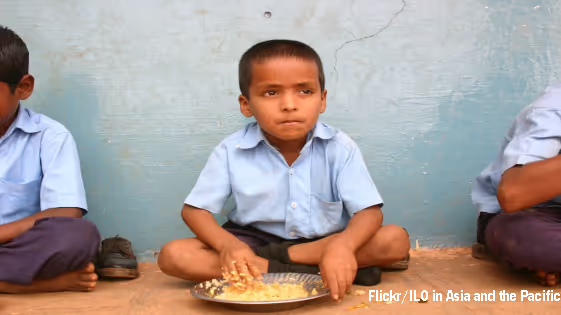
Food insecurity and child malnutrition: New empirical evidence from India
Child malnutrition is among the most pressing public health issues in India today. Equally alarming is the country’s food security crisis. Analysing ‘Young Lives Survey’ data from the states of Andhra Pradesh and Telangana, this article shows that there are sizeable negative effects of food insecurity on children’s nutrition – particularly among those towards the upper end of the health distribution.
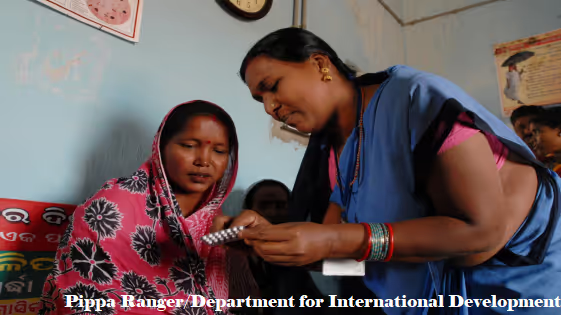
गर्भनिरोधक संबंधी निर्णयों के घरेलू हिंसा पर प्रभाव : निर्णय और गतिशीलता
महिलाओं की परिवार में अपनी बात रखने की शक्ति और रोज़गार व शिक्षा के रूप में उनके सशक्तीकरण को, अन्तरंग-साथी द्वारा उनके प्रति हिंसा (इंटिमेट पार्टनर वायलेंस- आईपीवी) की घटनाओं के कम होने और बढ़ जाने, दोनों के सन्दर्भ में दर्ज किया गया है। राष्ट्रीय परिवार स्वास्थ्य सर्वेक्षण (एनएफएचएस-5) के नवीनतम सर्वे के डेटा का उपयोग करते हुए, इस लेख में यह जाँच की गई है कि किसी महिला के गर्भनिरोधक उपयोग के फैसले अन्तरंग-साथी द्वारा उसके प्रति हिंसा (आईपीवी) को कैसे प्रभावित करते हैं। यह लेख दर्शाता है कि गर्भनिरोधकों के उपयोग का स्वतंत्र रूप से निर्णय लेने पर महिला को शारीरिक, यौन और भावनात्मक हिंसा का अधिक खतरा होता है।
Decisions and dynamics: Unpacking the impact of contraceptive decisions on domestic violence
Women’s empowerment in the form of intra-household bargaining power, employment, and education have been documented to both reduce and increase the prevalence of intimate partner violence (IPV). Using data from the latest wave of the National Family Health Survey (NFHS-5), this article investigates how a woman’s contraceptive use decisions could affect IPV, and shows that independently deciding to use contraceptives puts her at a greater risk of physical, sexual, and emotional violence.