
.svg)
.svg)
%201.svg)
%201.svg)
.svg)

.svg)
.svg)
Naom Angrist et al. (View all)

The authors for this article are:
Noam Angrist (Senior Fellow, University of Oxford; Co-Founder, Youth Impact)
Micheal Ainomugisha (Learning Coordinator, Building Tomorrow)
Sai Pramod Bathena (Founder, Alokit)
Peter Bergman (Associate Professor in Economics, UT-Austin)
Colin Crossley (Program Manager, Youth Impact)
Claire Cullen (Research Fellow, University Of Oxford; Research Manager, Youth Impact)
Thato Letsomo (Senior Manager, Content and Training, Youth Impact)
Moitshepi Matsheng (Co-founder & Managing Director, Youth Impact)
Rene Marlon Panti (Research Manager, Innovations for Poverty Action)
Shwetlena Sabarwal (Lead Economist, World Bank Education Global Practice)
Tim Sullivan (Chief Academic Officer, NewGlobe)
.svg)

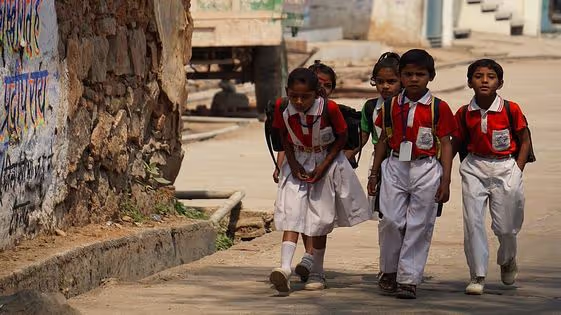
लचीली शिक्षा प्रणालियों की स्थापना : पाँच देशों से प्राप्त साक्ष्य
देश के पहले शिक्षा मंत्री मौलाना अबुल कलाम आज़ाद की जन्मतिथि के अवसर पर प्रति वर्ष 11 नवम्बर को मनाए जाने वाले राष्ट्रिय शिक्षा दिवस के उपलक्ष्य में यह आलेख प्रस्तुत है जिसमें कोविड-19 महामारी के कारण दुनिया भर में एक अरब से अधिक बच्चों की शिक्षा बाधित होने की स्थिति को देखते हुए, एक ऐसी शिक्षा प्रणाली स्थापित किए जाने की आवश्यकता पर ज़ोर दिया गया है, जो लचीली हो और ऐसे झटकों के बावजूद शिक्षा की निरंतरता को बनाए रखने में कारगर साबित हो। इस लेख में मोबाइल फोन जैसी कम लागत वाली पारिवारिक स्वामित्व वाली संपत्ति का लाभ उठाने के लिए पाँच विकासशील देशों में किए गए हस्तक्षेप का वर्णन किया गया है और बच्चों के अधिगम प्रतिफल और उनके कल्याण पर इसके प्रभाव का सारांश प्रस्तुत किया गया है। इससे पता चलता है कि कैसे बड़े पैमाने पर कार्यों के कम रिटर्न प्राप्त करने की अपेक्षा, मूल प्रमाण-अवधारणा यानी प्रूफ-ऑफ-कॉन्सेप्ट को विभिन्न देशों के सन्दर्भों में सफलतापूर्वक बढ़ाया जा सकता है।


Building resilient education systems: Evidence from five countries
With education disrupted due to the Covid-19 pandemic for over a billion children worldwide, this article emphasises the need to create an education system that is resilient and maintains continuity despite such shocks. It describes an intervention conducted across five developing countries to leverage existing, low-cost family-owned assets – mobile phones – and summarises its effect on children's learning outcomes and wellbeing. It reveals how the original proof-of-concept can be successfully scaled across various country contexts, without showing diminishing returns.