
.svg)
.svg)
%201.svg)
%201.svg)
.svg)

.svg)
.svg)
Niranjan Rajadhyaksha

Niranjan Rajadhyaksha is Research Director and Senior Fellow at IDFC Institute. He provides direction to the Institute’s research programmes.
Previously, he was Executive Editor of Mint, a financial daily, where he managed the opinion section, wrote the daily editorials and the award-winning Café Economics column. He also helped launch the data journalism initiative at the newspaper. Before joining Mint, he was Deputy Editor of Business World, a financial magazine.
Niranjan was awarded the Jefferson Fellowship by the East-West Center in Hawaii in 1998. He received the Society of Publishers in Asia Awards for excellence in opinion writing two years in a row (2010 and 2011). He won the Ramnath Goenka Award for Excellence in Journalism in 2012, and the B.R. Shenoy Award for Economics in 2017. Niranjan is a member of the academic advisory board of the Meghnad Desai Academy of Economics and the board of trustees of the Centre for Civil Society. He was also a member of the advisory committee on the fifth volume of the official history of the Reserve Bank of India (RBI), written by Tirthankar Roy. He has served on the economics curriculum advisory committees of the Mumbai School of Economics and Public Policy, Ramnarain Ruia College, and Welingkar Institute of Management.
Niranjan holds a B.A. and M.A. in economics from Mumbai University and a Ph.D. from the Mumbai School of Economics and Public Policy.
.svg)


Budget 2021-22: A macroeconomic overview
Providing a macroeconomic overview of the Union Budget 2021-22, Niranjan Rajadhyaksha and Sharmadha Srinivasan contend that it is based on realistic assumptions of nominal GDP growth, is reasonably aimed at fiscal expansion rather than premature austerity, makes fiscal policy more transparent, and has a welcome focus on capital spending. However, they believe that it also sets the stage for higher public debt ratios that will complicate the management of the economy.



केंद्रीय-बजट 2020: बुनियादी ढांचे हेतु खर्च, हिस्सेदारी बेचना तथा संसाधनों को मध्यमवर्ग की ओर निर्देशन को प्राथमिकता
वित्त मंत्री सीतारमण ने 1 फरवरी को 2020-21 का केंद्रीय बजट पेश किया – यह उस समय आया है जब अर्थव्यवस्था आर्थिक मंदी का सामना कर रही है। इस पोस्ट में, निरंजन राजध्यक्ष ने कहा कि भले ही इस बार की कर-संबंधी धारणाएं जुलाई 2019 के बजट की तुलना में कम आक्रामक हों, लेकिन बहुत कुछ आर्थिक सुधार की ताकत और सरकार की अपनी हिस्सेदारी बेचने की महत्वाकांक्षी योजना बनाने की क्षमता पर निर्भर करता है।

Union Budget 2020: Preference for infra spending, divestment, and directing resources to middle class
Finance Minister Nirmala Sitharaman presented the Union Budget for 2020-21 on 1st February – at a time when economy is facing an economic slowdown. In this post, Niranjan Rajadhyaksha contends that even though the tax assumptions are less aggressive this time than those in the July 2019 Budget, a lot depends on the strength of the economic recovery and the ability of the government to pull off an ambitious divestment plan.
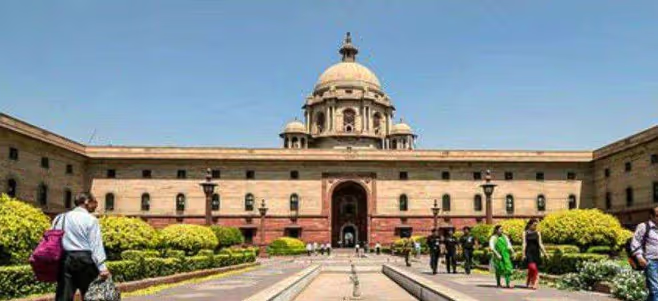
Union Budget 2019: An attempt to address the economy’s stress points
In this post, Niranjan Rajadhyaksha contends that in the first Budget of the second Narendra Modi administration, Finance Minister Nirmala Sitharaman has made an honest attempt to address some of the stress points in the Indian economy – but a lot depends on the sanctity of her Budget numbers.

‘न्याय’ विचार-गोष्ठी: न्याय का संभावित मैक्रोइकोनॉमिक प्रभाव
आईडीएफसी इंस्टिट्यूट के रिसर्च डायरेक्टर और सीनियर फेलो निरंजन राजाध्यक्ष का तर्क है कि न्याय की अनुमानित लागत काफी है और योजना के राजकोषीय बोझ के बारे में चिंतित होने के पर्याप्त कारण हैं। इसके अलावा, अर्थव्यवस्था में नकद प्रवाह के कारण मध्यावधि में मुद्रास्फीति बढ़ सकती है और उसके कारण अंतरण के वास्तविक आय संबंधी लाभ कम हो सकते हैं।
NYAY e-Symposium: The potential macroeconomic impact of NYAY
Niranjan Rajadhyaksha (Research Director and Senior Fellow at IDFC Institute) contends that the estimated cost of NYAY is substantial and there is ample reason to worry about the fiscal burden of the scheme. Further, the cash infusion in the economy may lead to inflation in the middle term and hence, the real income benefits of the transfer would be reduced.