
.svg)
.svg)
%201.svg)
%201.svg)
.svg)

.svg)
.svg)
Prabhat Barnwal

Prabhat Barnwal is an assistant professor of economics at Michigan State University since 2015. During 2016-17, he is a visiting assistant professor of economics at the University of Chicago. Born and raised in eastern Uttar Pradesh in India, he earned B.E. in electrical engineering from the National Institute of Technology in Gujarat, an M.A. in international development from the International University of Japan, and a Ph.D. in sustainable development from the School of International and Public Affairs at Columbia University. He is a fellow at the Center for Development Economics and Policy, and a research affiliate at the International Growth Centre.
Prof. Barnwal’s primary research interests include development, public and environmental and energy economics.
.svg)

Is electrification in India fiscally sustainable?
In the first article in the Ideas@IPF2023 series, Barnwal and Ryan describe the completion of household electrification in India as a fiscal feat, notwithstanding the persistent losses recorded by electricity distribution companies. They outline the extent of government investments in and bailouts of discoms, losses of revenue and electricity subsidies over the last decades, and propose Direct Benefit Transfers for Electricity as a policy solution based on the preliminary results of a pilot study carried out in the agricultural sector in Rajasthan and Punjab.


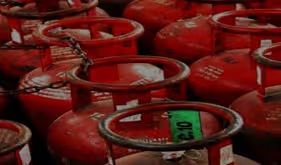
Curbing leakage in public programmes: Evidence from Direct Benefit Transfer policy for LPG subsidies
Many developing countries subsidise access to essential commodities with in-kind transfer programmes, where beneficiaries receive goods at subsidised prices while non-beneficiaries have to pay the market price. The resulting ‘dual pricing’ provides incentives to intermediaries to divert subsidised goods to non-beneficiaries. This article studies a policy reform in India to transfer fuel subsidies directly to the programme beneficiaries’ bank accounts and finds a significant reduction in the subsidy leakage.

Impact of direct benefit transfer on leakage in cooking fuel subsidy
In many developing countries, pervasive corruption and evasion often undermine the provision of public programmes. This project focusses on India where a large universal programme provides US$ 8 billion in fuel subsidies for domestic cooking.
Demand for environmental quality information and household response to information: Evidence from Bihar
Groundwater contaminated with arsenic is a serious public health threat in rural India. This column presents results from a field experiment conducted in Bihar to assess the demand for fee-based testing of wells for arsenic, and to study the behavioural responses of households to well-specific arsenic information.