
.svg)
.svg)
%201.svg)
%201.svg)
.svg)

.svg)
.svg)
Pushkar Maitra

Professor Pushkar Maitra’s primary research areas are Development Economics, Population Economics, Experimental Economics and Applied Econometrics. A large part of his research has tried to quantify the impact of institutions on both individuals and households. His current research focuses on evaluating alternative methods of providing credit to the rural poor and the effects of labour market training programmes. His current research is often experimental in nature and/or involves the rigorous econometric analysis of large data sets. Professor Maitra has also been involved in survey work: he was the chief investigator for a survey of migrants and networks in Cape Town South Africa and currently for a survey of agricultural productivity in West Bengal, India and on labour market outcomes of women in New Delhi, India.
.svg)


Financial inclusion for agricultural growth: An alternative approach
Traditional, group-based microcredit has had limited success at enabling farmers to expand the cultivation of risky but profitable cash crops. Evidence suggests that this is mainly because of its mechanisms for borrower selection and enforcement of repayment. This column proposes a new approach that leverages local intermediaries and aligns their incentives with farmer profits, to generate better outcomes for agricultural production and incomes.


Choosing to be trained: Behavioural restrictions on participation decisions
Widespread unemployment has prompted policymakers to consider introduction of various training programmes that can help workers accumulate additional skills to obtain new jobs and/ or retain current ones. However, these programmes can only help if targeted individuals take up such opportunities. This column argues that participation in short-term skill-building courses is not just limited by economic factors but is also influenced by intrinsic characteristics such as attitudes towards risk and competition.

कोयला आधारित बिजली इकाइयों से प्रदूषण और बच्चों एवं महिलाओं की एनीमिक स्थिति
स्वास्थ्य पर वायु प्रदूषण के प्रभाव को व्यापक रूप से शोध-साहित्य में जगह मिली है। जहां अन्य अध्ययनों में मुख्य रूप से सामान्य रुग्णता और मृत्यु दर जैसे परिणामों पर ध्यान केंद्रित किया गया है, यह लेख भारत में छोटे बच्चों और प्रौढ़ उम्र की महिलाओं की एनीमिक स्थिति पर कोयला आधारित बिजली इकाइयों द्वारा पड़ने वाले प्रदूषण के प्रभाव का मूल्यांकन प्रस्तुत करता है। इन अतिरिक्त लागतों के जुड़ जाने से नवीकरणीय ऊर्जा की ओर प्रगतिशील बदलाव और कोयले पर निर्भरता कम करने का मामला मजबूत होता है।
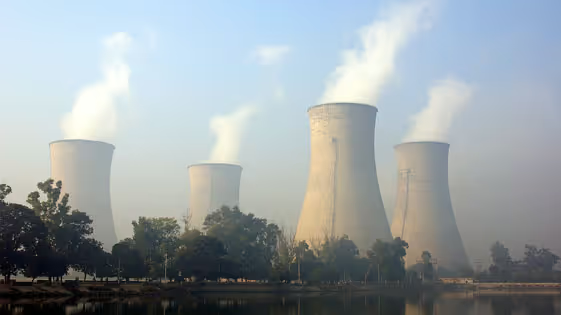
Pollution from coal-based power units and anaemic status of children and women
An extensive literature has considered the impact of air pollution on health. While studies have mainly focussed on outcomes such as general morbidity and mortality, this article evaluates the impact of pollution caused by coal-based power units on the anaemic status of young children and prime-age women in India. Factoring in these additional costs strengthens the case for a progressive shift to renewable energy and reduced reliance on coal.
Whither female disadvantage? An analysis of private school enrolment in India
Given the poor condition of government schools and the perceived efficiency of private schools, Indian parents are increasingly choosing to send their children to private schools. This column examines private school enrolment among 7-18 year olds during 2005-2012 and finds a systematic and pervasive female disadvantage.

The growing problem of excess weight in India
The Indian population is increasingly becoming overweight or obese, and this phenomenon is likely to impose a considerable health burden in the future. Analysing data from the Indian Human Development Survey, this column finds that obesity is more evident among affluent, well-educated, urban groups, especially adult women. Increasing incomes and sedentary lifestyles are key contributing factors.
Vocational education: A means to an end?
Youth underemployment, especially among less educated populations perpetuates poverty. Despite the importance of youth unemployment, there is little knowledge on how to create smooth school-to-work transition and or how to improve the human capital of those who can no longer be sent back to school. This column presents evidence supporting positive returns from having access to and completing a vocational training course for women residing in low-income households in New Delhi.
Child malnutrition in India and what can be done about it
While many things are getting better in India, the disturbing levels of child malnutrition are hardly changing. This column explores why and asks what can be done. It calls for more conditional cash transfers to poor rural families and better education on how to feed their children.
Learning and Earning: Evidence from a Randomized Evaluation in India
This project estimates the short-and-medium-run effects of participating in a subsidised vocational training programme aimed at improving labour market outcomes of women residing in low-income households in a developing country.
राजनीतिक पद का समय और बेईमानी में लैंगिक अंतर: स्थानीय राजनीति से प्राप्त साक्ष्य
राजनीति में महिलाओं की हिस्सेदारी अधिक होना वर्तमान साहित्य में कम भ्रष्टाचार का संकेत माना गया है | ईमानदारी को एक अंतर्निहित या स्थिर चरित्र विशेषता के रूप में देखा जाता है। हालाँकि, पश्चिम बंगाल में निर्वाचित 400 ग्राम पंचायत सदस्यों से एकत्रित की गई जानकारी का उपयोग करते हुए किये गए इस अध्ययन से पता चलता है कि किसी राजनीतिक पद धारण करने की स्थिति में यह बदल जाता है – राजनीति में अनुभवहीन महिला राजनेताओं के पुरुषों की तुलना में बेईमान होने की संभावना कम होती है, लेकिन अनुभवी राजनेताओं के संदर्भ में यह 'लैंगिक अंतर' समाप्त हो जाता है। इस अध्ययन में इसका कारण अनुभव के साथ मजबूत राजनीतिक नेटवर्क तथा कम जोखिम की संभावना माना गया है।
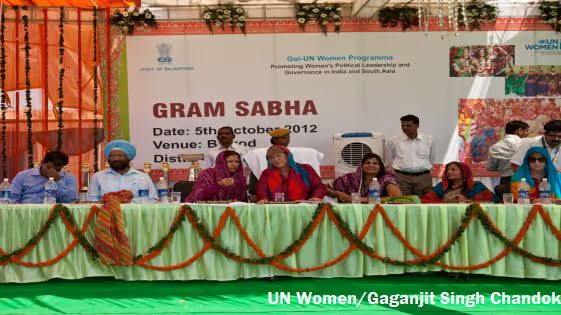
Time in office and gender gap in dishonesty: Evidence from local politics
Existing literature associates a higher share of women in politics with lower corruption; honesty is viewed as an inherent or static character trait. However, using information collected from 400 elected gram panchayat members in West Bengal, this study finds that spending time in office changes this – inexperienced women politicians are less likely to be dishonest than men, but this ‘gender gap’ disappears among experienced politicians. The study attributes this to reduced risk aversion and stronger political networks with experience.
2021 पश्चिम बंगाल विधानसभा चुनाव: क्या कोविड-19 के बढ़ने से प्रभाव पड़ा?
पश्चिम बंगाल राज्य में हुए हाल के विधानसभा चुनावों में सत्तारूढ़ तृणमूल कांग्रेस विजयी हुई है। इस लेख में घटक और मैत्रा ने 2016, 2019, तथा 2021 के चुनावी आंकड़ों का उपयोग करते हुए, चुनाव लड़ने वाले दलों के वोट शेयरों में बदलाव – सत्ता-समर्थक और सत्ता-विरोधी लहरों के सापेक्ष संतुलन, लैंगिक और धार्मिक ध्रुवीकरण के पहलुओं के साथ-साथ कोविड-19 के बढ़ने से हुए प्रभाव का विश्लेषण किया है।
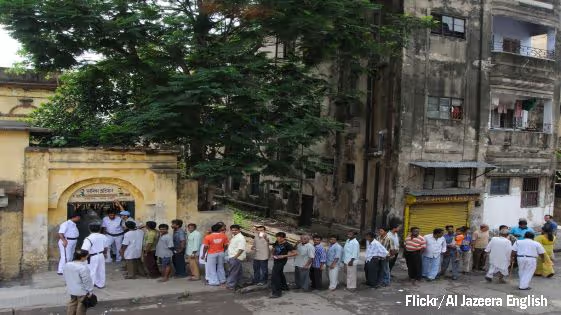
2021 West Bengal Assembly election: Did the Covid-19 surge matter?
In the recent Assembly elections in the state of West Bengal, the ruling Trinamool Congress bucked an anti-incumbency headwind to secure victory. Using electoral data from 2016, 2019, and 2021, Ghatak and Maitra analyse the change in vote shares of the contesting parties, examining the relative balance of pro- and anti-incumbency forces at work, aspects of gender and religious polarisation, as well as the impact of the Covid-19 surge.

Impact of Elite Capture on the Provision of Public Services
The Bihar Rural Livelihoods Project commonly called JEEViKA, is a community-driven poverty reduction programme with the key aim of improving the social and economic empowerment of the rural poor.

Citizens' trust in local politicians and implications for good governance
The new state of Telangana was carved out of Andhra Pradesh in June 2014, after a prolonged movement by the people of Telangana region for a separate state. Based on field experiments among citizens in the two successor states, this column finds greater trust in politicians in Andhra relative to Telangana, which may facilitate effective functioning of the State and signal citizens’ expectations from the government.
Impact of Elite Capture on the Provision of Public Services
This project studies the effectiveness of major Government programmes in JEEViKA (Bihar Rural Livelihoods Project) villages versus others to see whether the presence of self-help groups leads to improved delivery of public services. By comparing the extent of elite capture in JEEViKA and non-JEEViKA blocks, the findings of the project contributes to the understanding of the effectiveness of community driven development (CDD) projects on elite capture and public service delivery.

Potato Traders in West Bengal: A Survey of Contractual Relations and Market Structure
This study consists of a pilot survey of a random subset of phorias (middlemen) and larger traders who operate in 72 villages of West Medinipur and Hugli districts in West Bengal and their corresponding potato markets.
Middleman Margins, Credit and Information Constraints: Potato Markets in West Bengal, India
This project investigates how potato farmers in West Bengal sell their crop to local traders, the determinants of farm-gate prices and margins earned by traders. Specifically, it examines the role of asymmetric information regarding prices in neighbouring wholesale markets where local traders resell these potatoes.