
.svg)
.svg)
%201.svg)
%201.svg)
.svg)

.svg)
.svg)
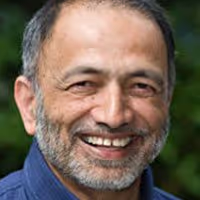
Rohini Somanathan

Rohini Somanathan is Professor of Economics at the Delhi School of Economics. She received her Ph.D. in 1996 from Boston University and has held faculty positions at Emory University, the University of Michigan and the Indian Statistical Institute before joining the Delhi School of Economics in 2005. Much of her research focuses on how social institutions interact with public policies to determine patterns of economic and social inequality. She has also worked on a variety of questions related to development policy in the Indian context. These include studies on the effects of economic liberalisation on productivity and wage inequality, access to microfinance, the impact of school nutrition programs on child outcomes and the assessment of alternative policies to counter urban environmental problems such as solid waste and air pollution.
.svg)


The Effects of Food Policy on Cropping Patterns and Income Distribution in Rural Bihar
Bihar is unusual among the Indian states in the extent to which it remains a rural economy; government food policy can have profound effects on the level and distribution of income in Bihar. The objective of the project is to understand and estimate the combined effects of two state policies related to production and distribution of food: the sharply rising minimum support prices offered to farmers to procure agricultural products, and the subsidized distribution of food grains through public distribution system. It theoretically examined the different impact of these policies on the distribution of income.


Nobel insights: When it comes to contracts, what's obvious may not be optimal
In a tribute to Oliver Hart and Bengt Holmström, recipients of this year’s Nobel prize in Economics, Rohini Somanathan, Professor of Economics at Delhi School of Economics, outlines their contributions.
Malnutrition and the National Food Security Act
The National Food Security Act aims to remove hunger and reduce malnutrition by providing subsidised foodgrains to two-thirds of the population. Using nationally representative data, this column finds that the Act is unlikely to greatly affect food consumption and malnutrition. However, a fully implemented Act can still benefit the poor through the income transfers implicit in food subsidies.
Cognitive Effects of Supplementary School Feeding Programme
This project uses the exogenous policy shock of the extension of provision of school meals to upper primary grades in public schools in Delhi to study the effects of school meal intake on the cognitive effort of students within the classroom.
Information Provision and the Quality of Education in Rural India
This study analyses whether providing information on the absolute and relative quality of schooling to the stakeholders affects the behaviour of service providers in both the public and the private sector.

Religion and relief in Muzzafarnagar
The communal riots that broke out in Muzzafarnagar in the state of Uttar Pradesh in September last year took several lives and left hundreds homeless. In this Note from the Field, Rohini Somanathan shares her experience of visiting two of the largest relief camps in the region. While state relief was lacking, local Muslim communities were found to be providing a great deal of support to the refugees.

Covid-19: A tailor’s tale
This note presents a narrative that is based on an interview conducted on 15 April with a tailor who walked most of the way from Jaipur to his home in Farrukhabad district in Uttar Pradesh, after the announcement of the national lockdown
Evaluating the Effects of Targeted Transfers to 'Mahadalits' in Bihar
The aim of this project is to examine how the transfer of assets to ultra-poor households under different Mahadalit inititatives influences their sense of well-being and their notions of identity. The study investigates the efficacy of targeting of the transfers to the Mahadalits and its welfare impacts.
Incorporating Public Good Availability into the Measure of Poverty
This project makes an attempt to incorporate benefits from unpaid public services into consumption decisions to arrive at more accurate measures of poverty and inequality. The project considered three types of public services: schooling, health care and subsidised food grains through the Public Distribution System (PDS). The findings showed that accounting for the use of these services leads to a narrowing of the consumer expenditure distribution and lower inequality in Bihar because the poor utilise public facilities more intensively than other households.
Improving Urban Air Quality in India: Lessons from the Kolkata Clean Air Regulations of 2009
This paper analyses the change in the economic returns of auto-rickshaw drivers in Kolkata (formerly Calcutta), roughly one year after they were required to shift to using liquefied petroleum gas (LPG) in 2009 as per the Kolkata clean air regulations.
Socially disadvantaged groups and microfinance in India
The benefits of microfinance are in the details. This column takes a look at lending by commercial banks in India to self-help groups – smaller, informal community-based groups – as a new and successful microfinance initiative. Different ways of thinking about getting credit to the poorest and most marginalised in society can work, but only if the institutions are properly geared up for their customers
Prof. Rohini Somanathan remembers Prof. Ashok Kotwal
Prof Rohini Somanathan pens a heartfelt tribute to our founder Editor-in-Chief Ashok Kotwal.

T.N., fondly remembered
Prof. T.N. Srinivasan, an acclaimed Indian economist and Professor Emeritus at Yale University, passed away on 11 November in Chennai. In this post, Prof. Rohini Somanathan of the Delhi School of Economics pays a tribute to Prof. Srinivasan.