
.svg)
.svg)
%201.svg)
%201.svg)
.svg)

.svg)
.svg)
Rukmini Banerji

Dr. Rukmini Banerji is the CEO of Pratham Education Foundation. Trained as an economist, Dr. Banerji completed her B.A. at St. Stephen’s College and attended the Delhi School of Economics (DSE). She was a Rhodes Scholar at Oxford University and earned her Ph.D. at the University of Chicago.
Dr. Banerji worked as a programme officer at the Spencer Foundation in Chicago for several years before returning to India in 1996 to join Pratham as part of the leadership team. There, she led the organisation’s research and assessment efforts, which have included the internationally acknowledged Annual Status of Education Report (ASER) since 2005, and served as director of the ASER Centre in New Delhi for 10 years.
In 2008, she was the inaugural recipient of the Maulana Abul Kalam Shiksha Puraskar Award conferred by the Government of Bihar, India. Over the years, she has represented Pratham and ASER Centre in various national and international forums and is a member of committees both in India and abroad. She writes frequently on education in India and enjoys creating books and stories for children.
Originally from Bihar, she now lives in New Delhi.
.svg)

Tracking learning outcomes: ASER’s work through the pandemic
With the onset of the Covid-19 pandemic and the associated lockdowns, schools quickly pivoted to online learning. However, there was limited information about whether children had access to learning materials, and what was actually taking place within households. In this edition of I4I Conversations, Rukmini Banerji and Wilima Wadhwa discuss the role that the Annual Status of Education Report (ASER) played in remedying this gap in the data. They discuss a few major findings from the survey on learning outcomes during the pandemic. Although the proportion of children not enrolled in schools went up, the proportion of children enrolled in government schools increased, and most of them had access to digital learning materials due to an increase in smartphone coverage. They discuss the challenges they faced while conducting ASER during the pandemic, including being limited to phone surveys and rallying volunteers amidst uncertainty. However, after the lack of data during the first ...


Tracking learning outcomes: ASER’s work through the pandemic
With the onset of the Covid-19 pandemic and the associated lockdowns, schools quickly pivoted to online learning. However, there was limited information about whether children had access to learning materials, and what was actually taking place within households. In this edition of I4I Conversations, Rukmini Banerji and Wilima Wadhwa discuss the role that the Annual Status of Education Report (ASER) played in remedying this gap in the data. They discuss a few major findings from the survey on learning outcomes during the pandemic. Although the proportion of children not enrolled in schools went up, the proportion of children enrolled in government schools increased, and most of them had access to digital learning materials due to an increase in smartphone coverage. They discuss the challenges they faced while conducting ASER during the pandemic, including being limited to phone surveys and rallying volunteers amidst uncertainty. However, after the lack of data during the first ...
Covid-19 and schooling: 2020 experience and way forward
The onset of the Covid-19 pandemic brought with it significant challenges for the education sector. On the one hand, closing schools meant imposing a heavy cost on a whole generation of students, and on the other hand, keeping schools open was a health hazard. India and several other developing countries – reluctantly at first – adopted online teaching. However, this was riddled with problems given the weak access to digital connectivity and devices. So how was the schooling experience in 2020, and are there any lessons for the future? To explore these crucial questions, I4I Editor-in-Chief Ashok Kotwal speaks with Rukmini Banerji (CEO of Pratham; India’s largest education non-profit) and Wilima Wadhwa (Director, Annual Status of Education Report (ASER) Centre). Banerji and Wadhwa discuss the mechanics of the ASER 2020 phone survey; availability of educational materials and learning activities in rural homes; how families, communities, and schools came together to keep up children’s le

बुनियाद की मज़बूती: प्राथमिक शिक्षा की चुनौती
रुक्मिणी बनर्जी बताती हैं कि नई शिक्षा नीति का प्रारूप एक सही कदम के रूप में बच्चों की शुरुआती देख-रेख और शिक्षा के महत्व पर ज़ोर देता है। साथ ही, यह प्राथमिक स्तर पर बुनियादी साक्षरता व गणितीय क्षमता को अविलम्ब दुरुस्त करने की ज़रूरत को रेखांकित करता है – वह स्तर जो आज सीखने के संकट से जूझ रहा है।
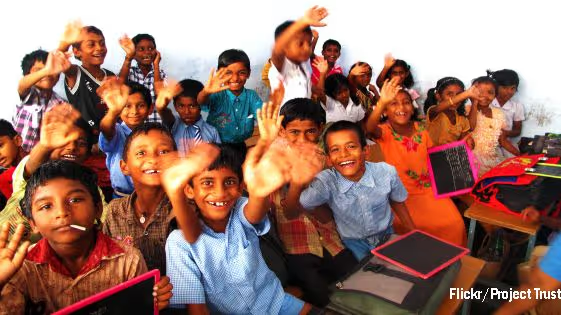
Building foundations well: The challenge for primary education
Rukmini Banerji contends that the draft New Education Policy gets it right in emphasising the importance of Early Childhood Care and Education and the need to urgently work on establishing foundational literacy and numeracy at the primary stage, where there is currently a learning crisis.

ASER 2018: Behind the headlines
Thanks to more than a decade of Annual Status of Education Reports (ASER), the main headlines from the surveys are widely known – the learning levels of Indian school going children are worryingly low. In this article, Rukmini Banerji takes a closer look at the recently released ASER 2018 data to see what else it can tell us, and discusses actionable steps to bring forward children who are falling behind
Teaching at the right level: Solutions for low learning levels in India
At least half of all children in India have not acquired basic literacy and arithmetic skills by the end of primary school. In this article, Rukmini Banerji of Pratham and J-PAL Director Esther Duflo present evidence that shows that significant gains in learning outcomes can be achieved by reorganising and grouping children by their learning level rather than the usual grouping by age or grade.
Introduction to e-Symposium: Ideas for reforms in education policy in India
A New Education Policy is being formulated in India based on a time-bound grassroots consultative process. As a contribution to the discussions, Rukmini Banerji of the education NGO Pratham and Ashok Kotwal, Editor-in-Chief, I4I, are hosting an e-symposium on ideas for reforms in education policy. Over the next few days, the e-symposium will bring together key findings from recent research in education and experience-based insights by stakeholders from academia and civil society.
Building a movement, assessment to action
While citizen-led assessments of children’s learning have been applauded for building awareness around the issue, observers have pointed out that information does not automatically galvanise action. In this article, Rukmini Banerji, of the education NGO Pratham, contends that citizen-led assessments can lead to citizen-led action for improving learning by making the problem visible, engaging with people, and demonstrating how change can be brought about.
Taking education beyond educationists
ASER – Annual Status of Education Report – has been tracking learning outcomes of children in rural India for the past 10 years. In this note, Rukmini Banerji, Director of the ASER Centre/Pratham, highlights how this model of measurement is different from the traditional models of student assessments seen in India or elsewhere. She also points out key policy changes that have taken place in education in India, at least partly in response to ASER findings.
Choice and cost: The role of household decision making and spending on secondary education in rural Bihar
This project attempts to understand the educational choices that households make and expenditures they undertake for children going from upper primary school to secondary school in Bihar. It is designed to capture household choices on education and money they spent; understand the magnitude of private tuition; the costs associated with private tuition; and tuition practices and tutor background.
Improving children's learning: Challenges and priorities for the new government
Over the last 15 years, continued effort to universalise access to elementary education in India has resulted in high enrolment rates in schools. Now that most children are in school, policy and planning efforts are beginning to focus on improving their learning levels. This note contends that it is imperative for the new government to maintain, monitor and strengthen this priority and improve mechanisms for achieving learning goals.
Searching for the 'silver bullet': What works in improving children's learning outcomes?
Children’s learning outcomes in primary schools in India are far from satisfactory. In this article, Rukmini Banerji explores the various theories of change and associated implementation strategies that are currently at work for improving the status of learning in schools. She discusses the challenges of balancing and prioritising the different theories of change, and translating them into practice on scale.
The invisible and urgent challenge of learning
While almost all six to fourteen year olds in India are enrolled in school, their performance is far below expected levels. The common view is that the problem can be addressed by filling gaps in the system such as inadequate infrastructure or teacher shortage. This column argues that these inputs can ensure “schooling for all” but not “learning for all”, and suggests teaching by level rather than by grade to improve learning outcomes.
Why Indian education needs to get back to reality
What is the best advice to give an Indian education department official? This column argues that the best thing officials can do is drop the assumptions and stick to reality – otherwise many children will be missed out and left behind.