
.svg)
.svg)
%201.svg)
%201.svg)
.svg)

.svg)
.svg)
Sangita Vyas

Sangita Vyas is an applied microeconomist specializing in development economics and demography. She teaches an undergraduate course in statistics and a PhD course in demographic methods. She was previously the Associate Director of Sanitation at Rice Institute where she conducted experimental and observational research on sanitation and advocated for better sanitation policies in India. Prior to Rice, Sangita worked with the Centre for Microfinance, where she oversaw a randomised evaluation of a rainfall insurance programme implemented by the Self-Employed Women’s Association in Gujarat. She is a co-author of a systematic review of index-based micro-insurance for managing weather-related risk.
Sangita holds a BS with a concentration in Finance from the Wharton School at the University of Pennsylvania, an MPA from Princeton University’s Woodrow Wilson School, and a PhD in Economics from the University of Texas at Austin.
.svg)

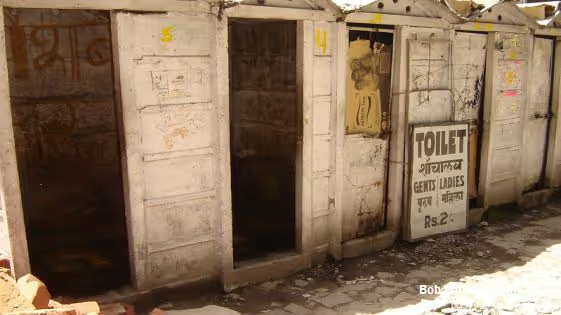
क्या ग्रामीण उत्तर भारत में अभी भी खुले में शौच प्रचलित है?
स्वच्छ भारत मिशन के बाद चार फोकस वाले राज्यों में प्रचलित खुले में शौच को समझने की कोशिश में, व्यास और गुप्ता एनएफएचएस-5 के निष्कर्षों का मूल्यांकन करते हैं। वे पाते हैं कि पारिवारिक स्तर पर एकत्र किए गए डेटा के उपयोग और प्रतिक्रिया पूर्वाग्रह की संभावना के चलते खुले में शौच की दर को एनएफएचएस द्वारा कम आंके जाने की संभावना है। अनुमानों को समायोजित करने के पश्चात वे पाते हैं कि वर्ष 2019-21 के दौरान फोकस वाले राज्यों में लगभग आधे ग्रामीण भारतियों ने खुले में शौच किया।


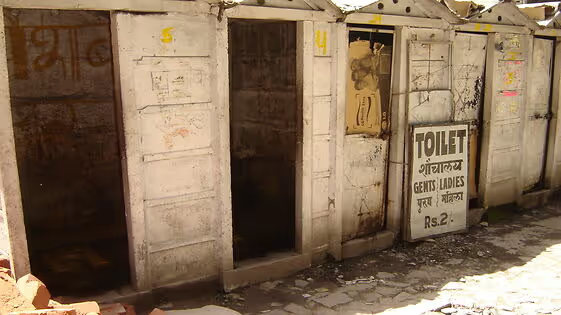
Is open defecation still prevalent in rural north India?
In an attempt to understand open defecation in four focus states in the aftermath of the Swachh Bharat Mission, Vyas and Gupta evaluate the findings of the NFHS-5. They note that the NFHS is likely to underestimate open defection rates due to their use of data collected at the household level, and the possibility of response bias. After adjusting the estimates, they find that about half of rural Indians in the focus states defecated in the open in 2019-21.

How serious is the government about Swachh Bharat Mission?
The recently announced Union budget 2015-16 has reduced the central government allocation for Swachh Bharat Mission – the flagship sanitation programme of the government. In this article, Sangita Vyas, Managing Director for Sanitation at r.i.c.e., questions the commitment of the government to eliminating open defecation in India by 2019.
Why are children in India so short?
Several scholars across disciplines provide converging evidence of the key role of open defecation in explaining child stunting in India. This column summarises the key themes of a recent conference at the Delhi School of Economics on child height in India.
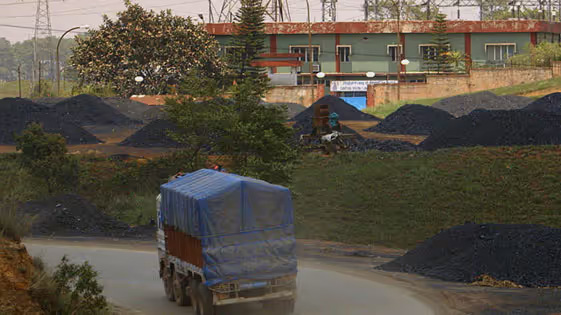
बच्चों के स्वास्थ्य पर कोयले का प्रभाव: भारत के कोयला विस्तार से साक्ष्य
हाल के वर्षों में, भारत में कोयले से हो रहे बिजली उत्पादन में बड़ी तेजी से बढ़ोतरी हुई है। यह लेख भारत में कोयले से होने वाले बिजली उत्पादन से बच्चों के स्वास्थ्य और मानव संसाधन पर पड़ने वाले प्रभावों की पड़ताल करता है। यह ज्ञात होता है कि जो बच्चे मध्यम आकार के कोयला प्लांट के संपर्क वाले क्षेत्रों में जन्म लेते हैं उनकी लंबाई ऐसे बच्चों की तुलना में कम होती है जो कोयला प्लांट से संपर्क से दूर स्थित क्षेत्रों में पैदा होते हैं। वायु प्रदूषण का प्रभाव कोयला प्लांटों के करीब रहने वाले बच्चों में अधिक होते हैं।

The child health impacts of coal: Evidence from India’s coal expansion
In recent years, electricity generation from coal has rapidly increased in India. This article explores the consequences of India’s large and ongoing coal plant expansion on child health and human capital. It finds that children who are born exposed to a median-sized coal plant are shorter than those who are born with no coal plant exposure. Supporting air pollution as a channel, effects are larger among children living closer to coal plants.