
.svg)
.svg)
%201.svg)
%201.svg)
.svg)

.svg)
.svg)
Saswata Ghosh

Dr. Saswata Ghosh is Associate Professor at the Institute of Development Studies Kolkata (IDSK). He completed his Ph.D. in Population Studies from the Jawaharlal Nehru University (JNU). He obtained the Sir Ratan Tata Postdoctoral Fellowship from the Asia Research Centre of the London School of Economics (LSE) during 2014-15. He also received the International Fellowship for Young Bio-Medical Scientists from the Indian Council of Medical Research (ICMR) during 2012-13. He
served as a Visiting Fellow at the LSE and at Bangladesh Institute of Development tudies (BIDS). Previously, he has worked with the Qatar Statistics Authority (QSA), Centre for Health Policy (CHP), ADRI, Population Council, and Council for Social Development in various capacities. He has co-edited (with Dr. Aparajita Chattopadhyay) the book Population Dynamics in Eastern India and Bangladesh: Demographic, Health and Development Issues. Currently, he serves as a member in the International Advisory Board of Asian Population Studies Journal published by Routledge. He has been published extensively in peer-reviewed journals of international standing. His areas of interest include religious demography, fertility, Family planning and son preference, family demography, field survey methods,demographic estimations, and econometric methods.
.svg)

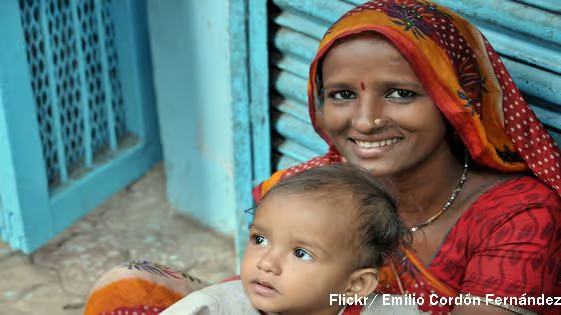
Herself, and her child: Are they worse off due to Covid-19?
Lockdowns imposed to contain the spread of Covid-19 led to loss of employment and income. They also created greater food insecurity, with women and children being more vulnerable to such shocks. In this context, based on surveys in rural Bihar, Husain et al. discuss the impact of the lockdown on the dietary practices of women and children, and how these were impacted by their access to government welfare programmes during this period.


भारत में हिंदू-मुस्लिम प्रजनन दर में अंतर: 2011 की जनगणना के अनुसार जिला-स्तरीय अनुमान
2011 की भारतीय जनगणना के आंकड़े हिंदू आबादी की तुलना में मुस्लिम आबादी की उच्च वृद्धि दर दिखाते हैं। इस लेख में जिला स्तर पर हिंदू-मुस्लिम प्रजनन में अंतर और राज्य स्तर पर उनकी प्रवृत्तियों का एक सटीक विवरण प्रस्तुत किया गया है। यह दर्शाता है कि पिछले दशक के दौरान प्रजनन परिवर्तन स्थिर रहा है; और हिंदुओं तथा मुस्लिमों के बीच प्रजनन दर को एक स्तर पर लाने का कार्य चल रहा है, तथापि महत्वपूर्ण क्षेत्रीय भिन्नताएं बनी हुई हैं।
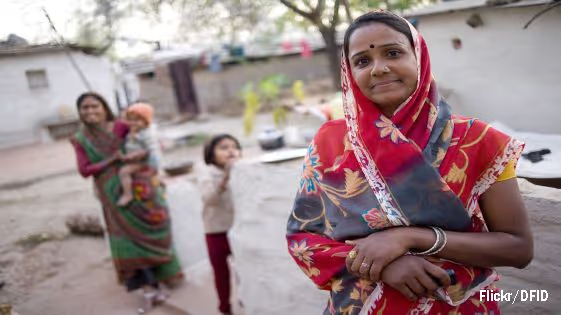
Saas, bahu, and ASHA: Information diffusion in rural Bihar
India has made significant progress in improving maternal and child health outcomes, and the contribution of ASHAs – female community health workers – in promoting healthcare-seeking behaviour is widely acknowledged. In this context, Dutta et al. discuss findings from their study in rural Bihar and highlight two key issues: mothers-in-law acting as mediators in the interaction between ASHAs and women of reproductive age, and the limited success in influencing educated women from affluent families.
Hindu-Muslim fertility differentials in India: District-level estimates from Census 2011
The 2011 Indian Census data show a higher growth rate of Muslim population compared to the Hindu population. This article provides an in-depth picture of Hindu-Muslim fertility differentials at the district level and their trends at the state level. It shows that fertility transition has been steady during the last decade; overall convergence of fertility rates between Hindus and Muslims has been underway but significant regional variations persist.
भारत में हिंदुओं और मुसलमानों के प्रजनन दर में अंतर: एक अपडेट
पिछले शोध के आधार पर सास्वत घोष और पल्लबी दास एनएफएचएस के नवीनतम दौर के आंकड़ों का उपयोग करते हुए हिंदुओं और मुसलमानों के बीच के राज्य और जिला स्तर की प्रजनन क्षमता में अंतर का अनुमान लगाते हैं। वे दर्शाते हैं कि भले पिछले दशक के दौरान अधिकांश राज्यों में प्रजनन परिवर्तन में प्रगति हुई है और हिंदुओं और मुसलमानों के बीच की प्रजनन दर में भी अभिसरण हुआ है, फिर भी कुछ क्षेत्रीय भिन्नताएं अभी भी बनी हुई हैं।
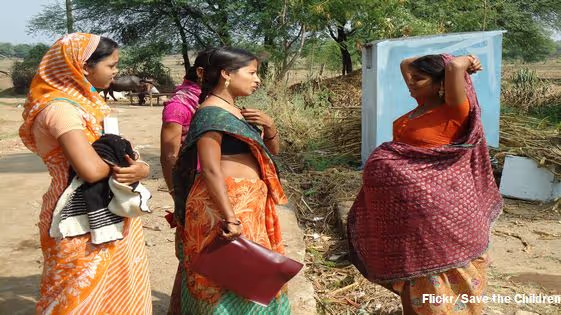
Hindu-Muslim fertility differentials in India: An update
Building on past research, Saswata Ghosh and Pallabi Das estimate the state- and district-level fertility differentials between Hindus and Muslims using data from the latest round of the NFHS. They show that although the fertility transition has advanced further in most states during the last decade, and fertility rates between Hindus and Muslims have also converged, some regional variations persist.