
.svg)
.svg)
%201.svg)
%201.svg)
.svg)

.svg)
.svg)
Tarun Jain

Tarun Jain is an Associate Professor of Economics at the Indian Institute of Management (IIM) Ahmedabad. Before joining IIM Ahmedabad, he was on the faculty at the Indian School of Business (ISB). His research focuses on understanding causes and consequences of human capital formation (for instance, with education and health), especially in the context of fast-growing developing countries. Gender is a topic of special research interest given that women face persistent barriers in economic advancement. His research has received funding from the Bill and Melinda Gates Foundation, the International Growth Centre (IGC), and the International Initiative for Impact Evaluation, and been published in peer-reviewed journals suchas the Review of Economics and Statistics, Journal of Public Economics, and Journal of Economic History. He has written for media outlets such as the New Indian Express, Ideas for India, ISBInsight, and Mint.
Professor Jain earned his Ph.D. in economics from the University of Virginia, and his B.A. in mathematics and economics from Franklin and Marshall College. Before his Ph.D., he was a management consultant with Charles River Associates in Washington DC and Oliver Wyman in Boston.
Professor Jain teaches the core course on microeconomics in the flagship Post-Graduate Programme at IIM Ahmedabad. At the ISB, he taught the core course in managerial economics as well as an elective in information economics.
.svg)


हाई स्कूल में विज्ञान? कॉलेज और नौकरी के परिणाम
भारत में विज्ञान के अध्ययन के साथ जुड़े कैरियर पथ, हाई स्कूलों में अन्य विषयों के अध्ययन से जुड़े कैरियर पथ के मुक़ाबले, अधिक प्रतिष्ठित और लाभप्रद माने जाते हैं। यह लेख उच्चतर माध्यमिक विद्यालय में विज्ञान के अध्ययन और श्रम-बाजार की कमाई के बीच के संबंध की जांच करता है। परिणाम यह बताते हैं कि हाई स्कूल में विज्ञान का अध्ययन, व्यवसाय या मानविकी के अध्ययन की तुलना में 18-25% अधिक आय के साथ जुड़ा हुआ है। यह उच्च आय छात्रों की अंग्रेजी में प्रवीणता के साथ और बढ़ जाती है।


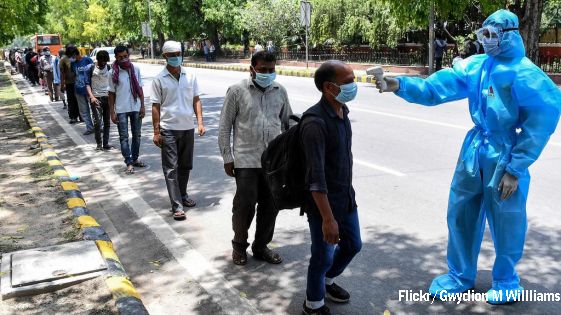
Economic consequences of Covid-19 lockdowns: Lessons from India’s first wave
As India combats the second wave of Covid-19, the impact on economic activity remains a major concern. Drawing lessons from the first wave in 2020, this article provides an assessment of how containment measures have influenced aggregate economic outcomes. It finds that economic recovery was lower by 9.3% in districts where mobility restrictions were maximum – relative to those with minimal restrictions – and incomes were hit harder than consumption.

जनभाषा? मातृभाषा में पढ़ाई शिक्षा को कैसे प्रभावित करती है
2016 में जारी किए किए गए राष्ट्रीय शिक्षा नीति के प्रारूप में मातृभाषा में शिक्षा, खास कर स्कूल के रचनात्मक वर्षों के दौरान मातृभाषा में शिक्षा के महत्व पर जोर दिया गया था। इस कॉलम में दक्षिणी भारत की बड़े पैमाने की ऐतिहासिक घटनाओं के डेटा का उपयोग करके स्कूलों में मातृभाषा के उपयोग और शैक्षिक उपलब्धि के बीच लिंक को स्पष्ट करने का प्रयास किया गया है। इसमें पाया गया कि मातृभाषा में शिक्षा के कारण प्राथमिक और माध्यमिक स्तर की स्कूली शिक्षा के दौरान शैक्षिक उपलब्धियों में लगातार वृद्धि हुई।
Understanding Career Choice in a Developing Country: Reading the Mind of High School Students in Cities of India?
The main objective of this project is to understand the process in which students choose their career path. In particular, what are the factors that play a role in the decision-making process? Are students actively thinking about how their future career will impact future expected earnings or close sectoral supply-demand gaps? Or are non-market factors, such as peer effects, stigma, or prestige, playing a larger role in the choice process?

Designing India’s national healthcare protection: Challenges and opportunities
The burden of non-communicable diseases, requiring costly hospital-based treatment, is increasing in India, and only 15% of the population has health insurance coverage. The Modi government recently introduced the Ayushman Bharat–National Health Protection Mission that aims to pay for tertiary healthcare for nearly 100 million families across the country. In this post, Debnath et al. highlight design issues that the programme must overcome to deliver on its promise.
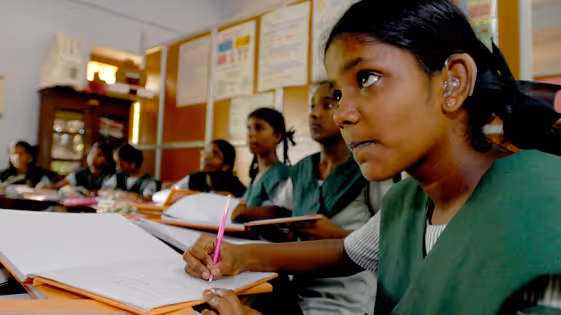
Common tongue? How mother tongue instruction influences education
The recently released draft of the National Education Policy stresses the importance of education in the mother tongue, especially in the formative years at school. This column seeks to uncover the link between vernacular language use in schools and educational achievement using data from large-scale historical events in South India. It finds that mother-tongue instruction led to persistent increases in educational achievement in primary and secondary schooling.
Public health insurance for tertiary diseases: Lessons from Andhra's Aarogyasri programme
Private health insurance covering tertiary diseases is limited to the upper middle class in India. One reason for low take-up of publicly-financed health insurance among economically weaker sections is that treatment of tertiary diseases relies critically on specific information on facilities and treatment options. This column presents evidence from Andhra’s Aarogyasri programme suggesting that community networks might be an important channel through which such information is obtained.
Social influences and public health insurance utilisation
In developing countries there are often limited formal sources of information about programme benefits or how to access them. Social networks might influence adoption by providing more programme information, offering expertise on how to make choices, and signalling whether using the programme is socially appropriate.

Impact of Elite Capture on the Provision of Public Services
The Bihar Rural Livelihoods Project commonly called JEEViKA, is a community-driven poverty reduction programme with the key aim of improving the social and economic empowerment of the rural poor.

Citizens' trust in local politicians and implications for good governance
The new state of Telangana was carved out of Andhra Pradesh in June 2014, after a prolonged movement by the people of Telangana region for a separate state. Based on field experiments among citizens in the two successor states, this column finds greater trust in politicians in Andhra relative to Telangana, which may facilitate effective functioning of the State and signal citizens’ expectations from the government.
Impact of Elite Capture on the Provision of Public Services
This project studies the effectiveness of major Government programmes in JEEViKA (Bihar Rural Livelihoods Project) villages versus others to see whether the presence of self-help groups leads to improved delivery of public services. By comparing the extent of elite capture in JEEViKA and non-JEEViKA blocks, the findings of the project contributes to the understanding of the effectiveness of community driven development (CDD) projects on elite capture and public service delivery.

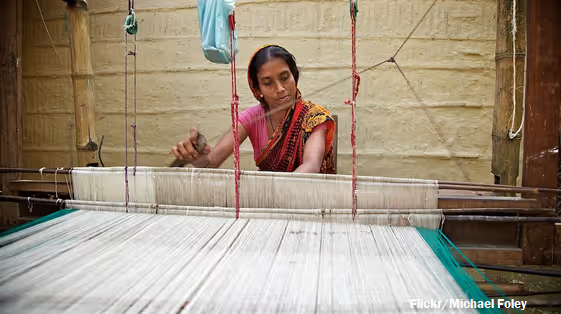
पीढ़ी-दर-पीढ़ी बुनाई : ग्रामीण भारत में पारिवारिक व्यवसायों में उत्पादकता लाभ
हर साल 12 फरवरी को मनाए जाने वाले राष्ट्रीय उत्पादकता दिवस का उद्देश्य अर्थव्यवस्था में उत्पादकता, नवाचार और निपुणता के महत्त्व पर ज़ोर देना है। इसी सन्दर्भ में प्रस्तुत इस लेख में पारिवारिक स्वामित्व वाले बुनाई उद्यम की चर्चा की गई है। आंध्र प्रदेश और तेलंगाना में बुनाई का कार्य अक्सर एक पारिवारिक उद्यम है। 1,800 से अधिक परिवारों के डेटा का उपयोग करते हुए, हैममेकर एवं अन्य द्वारा किया गया मिश्रित-विधियों का मूल्याँकन यह दर्शाता है कि पीढ़ी-दर-पीढ़ी बुनाई व्यवसाय में जुटे परिवार बुनाई कार्य में अधिक कमाते हैं और केवल एक पीढ़ी के बुनकरों वाले परिवारों की तुलना में उनकी पारिवारिक आय अधिक होती है। हालाँकि, पाया गया कि उत्पादकता के ये लाभ पूरे परिवार में समान रूप से वितरित नहीं होते हैं, क्योंकि वे उन महिला बुनकरों के लिए विस्तृत एजेंसी के रूप में तब्दील नहीं होते जो इन व्यवसायों का हिस्सा होती हैं।

Weaving through generations: Productivity gains in family-owned businesses in rural India
In Andhra Pradesh and Telangana, weaving is often a family enterprise. Using data from over 1,800 households, this ongoing mixed-methods evaluation by Patel et al. shows that households with multi-generational weaving businesses earn more in weaving revenue and have greater household incomes relative to households with only one generation of weavers. However, it notes that these gains in productivity are not equally distributed across the household, as they do not translate into greater agency for the women weavers who are part of family-owned businesses.