
.svg)
.svg)
%201.svg)
%201.svg)
.svg)

.svg)
.svg)
Timothy Besley

Timothy Besley is School Professor of Economics and Political Science at the London School of Economics. He served on the Bank of England's Monetary Policy Committee between 2006 and 2009 and is a member of the UK Government's National Infrastructure Commission. He previously taught at Princeton University, and is a Research Fellow at the Canadian Institute for Advanced Research, and the Centre for Economic Policy Research. His work focuses mainly on issues in development economics, public economics and political economy.
He has published widely on a variety of topics, mainly with a policy focus. He has been a Co-Editor of the American Economic Review, and Editor of the Economic Journal. He currently serves on the editorial boards of numerous other professional journals. His professional honours include being a Fellow of the British Academy, a Fellow of the Econometric Society and a Foreign Honourary Member of the American Economic Association and the American Academy of Arts and Sciences. In 2010, he served as President of the European Economic Association. In 2005, he won the prestigious biannual Yrjö Jahnsson Award for his research. He was educated at Oxford University (B.A. in Philosophy, Politics and Economics, 1st; M.Phil. and a D.Phil. in Economics) where he became a Prize Fellow of All Souls College.
.svg)

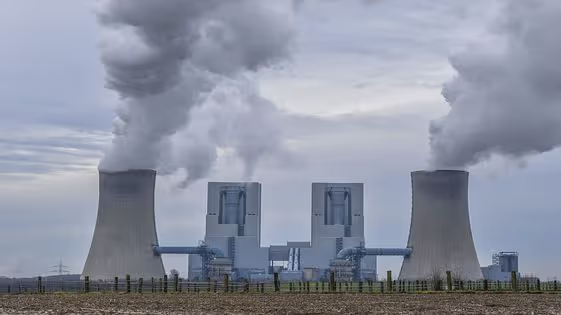
क्या कोयला-आधारित बिजली संयंत्रों को बन्द करना व्यवहार्य है? वैश्विक दृष्टिकोण सर्वेक्षण से प्राप्त साक्ष्य
हर साल 22 अप्रैल को मनाया जाने वाला ‘पृथ्वी दिवस’ आधुनिक पर्यावरण जन-आन्दोलन के जन्म की सालगिरह को चिह्नित करता है और पर्यावरण के प्रति मनुष्य के दायित्व को रेखांकित करता है। इस अवसर पर प्रस्तुत शोध आलेख में कोयला-आधारित बिजली संयंत्रों पर चर्चा की गई है और उन्हें खत्म करने की इच्छाशक्ति, लाभ व लागत पर साक्ष्य दिए गए हैं। कोयले से चलने वाले बिजली संयंत्र अत्यधिक प्रदूषणकारी ऊर्जा-स्रोत हैं, लेकिन लोग इसके बारे में या तो अनजान हैं या खराब वायु गुणवत्ता के बारे में अपना असंतोष व्यक्त करने में असमर्थ हैं। इस लेख में 51 निम्न और मध्यम आय वाले देशों के सर्वेक्षण डेटा का उपयोग करते हुए, कोयला बिजली को चरणबद्ध तरीके से समाप्त करने के लिए भुगतान की नागरिकों की इच्छा की गणना की गई है। इसमें बिजली संयंत्र के समीप रहने वाले निवासियों की भलाई को मापा गया है और गणना की गई है कि उन्हें होने वाला वायु गुणवत्ता लाभ सौर और पवन ऊर्जा उत्पादन की लागत से अधिक होगा।


How feasible is it to phase out coal-fired power plants? Evidence from a global attitudes survey
Coal-fired power plants are a highly polluting energy source but people are either unaware or unable to convey their dissatisfaction about living with poor air quality. Using survey data from 51 low- and middle-income countries, this article calculates citizens' willingness to pay to phase-out coal power. It measures the wellbeing of residents in close proximity to a power plant, and calculates that the air quality benefits accruing to them would exceed the costs of solar and wind energy generation.

Sacrificing consumption to mitigate catastrophic risks
Many scientists agree that the probability of a rare environmental disaster increases as the stock of greenhouse gases accumulate in the atmosphere. This column asks how much consumption current generations should be willing to sacrifice to reduce the risk of such a future catastrophe. If there were a way of immediately eliminating the risk of all future catastrophes, society should be willing to sacrifice 16% of its consumption in perpetuity to achieve this. A sacrifice of 5.8% of annual consumption could bring about a 30% reduction in emissions, in line with the reductions contemplated in agreements such as the Kyoto Protocol.