
.svg)
.svg)
%201.svg)
%201.svg)
.svg)

.svg)
.svg)
Upasak Das

Upasak Das is a Presidential Fellow of Economics of Poverty Reduction at the Global Development Institute at the University of Manchester. He is also an affiliate of the Centre for Social Norms and Behavioral Dynamics at the University of Pennsylvania. Prior to this, he was a Post-Doctoral Fellow at the University of Pennsylvania and was an Assistant Professor of Economics at the Centre for Development Studies, Trivandrum. He received his Ph.D. from the Indira Gandhi Institute of Development Research (IGIDR), Mumbai. His primary research interests include Development Economics, Social Norms, Political Economy, and Public Policy.
.svg)

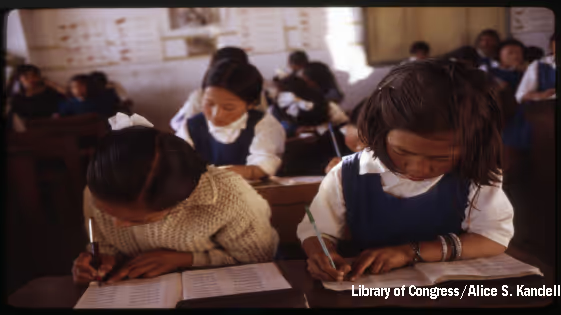
ग्रामीण भारत में गणित सीखने में लैंगिक अंतर
विकसित देशों में साक्ष्य के बढ़ते दायरे यह संकेत देते हैं कि गणित सीखने संबंधी परिणामों में महिलाओं के लिए प्रतिकूल स्थिति बनी रहती है और इसके संभावित कारण सामाजिक कारक, सांस्कृतिक मानदंड, शिक्षक पूर्वाग्रह और माता-पिता के दृष्टिकोण आदि से संबंधित होते हैं। यह लेख भारत के राष्ट्रीय स्तर के प्रतिनिधिक आंकड़ों का उपयोग करते हुए, विभिन्न आयु वर्गों में गणित सीखने में मौजूद लैंगिक असमानता को दर्शाता है और यह भी दर्शाता है कि समय के साथ इसके कम होने के कोई प्रमाण भी नहीं मिलते हैं।


Gender difference in mathematics learning in rural India
A growing body of evidence in developed countries has indicated that female disadvantage prevails and persists in mathematics learning outcomes, with the likely causes being social factors, cultural norms, teacher bias, and parental attitudes, among others. Using nationally representative data from India, this article shows that a gender gap exists in mathematics – across age groups, and with no evidence of convergence over time.

Is the MNREGA fund crunch making the programme clientelistic?
Fund allocation for MNREGA has seen a steady decline in real terms over the last few years. Analysing official MNREGA data along with survey data from Rajasthan, this column shows that in the face of limited financial resources, local implementers are more likely to allocate MNREGA jobs based on discretion and political motives.

Assessing the quality and usefulness of MNREGA assets in Maharashtra
Questions have been raised regarding the quality and usefulness of assets created under MNREGA. To examine the validity of the scepticism, this column reports results from a study of MNREGA assets in Maharashtra. While the assets are largely found to be useful and durable, the study suggests that greater attention to design and maintenance, and local participation in the decision-making process can lead to further improvement.
Political clientelism in MNREGA: Evidence from West Bengal
The problem of political clientelism becomes imminent in decentralised systems where certain individuals or groups associated with the political party locally in power, get preferential access to scarce public resources. This column investigates the link between political affiliation and/ or activity with the likelihood of receiving benefits under MNREGA, in the state of West Bengal.