
.svg)
.svg)
%201.svg)
%201.svg)
.svg)

.svg)
.svg)
Utteeyo Dasgupta

Utteeyo Dasgupta is an Associate Professor of Economics at Wagner College. His research interests are in the positive, normative and strategic aspects of decision-making, and he primarily uses economic experiments and game theory for his research. His research has been published in The Review of Economics and Statistics, the Journal of Public Economics, among other peer-reviewed journals. Utteeyo received his Ph.D. in economics from the University of Arizona. He is a Research Fellow at IZA, and a Senior Research Associate at the Center for International Policy Studies, Fordham University. He serves as an Associate Editor for Studies in Microeconomics and as a member of the Editorial Board of the Journal of Behavioral Public Administration (JBPA).
.svg)


Choosing to be trained: Behavioural restrictions on participation decisions
Widespread unemployment has prompted policymakers to consider introduction of various training programmes that can help workers accumulate additional skills to obtain new jobs and/ or retain current ones. However, these programmes can only help if targeted individuals take up such opportunities. This column argues that participation in short-term skill-building courses is not just limited by economic factors but is also influenced by intrinsic characteristics such as attitudes towards risk and competition.


Designing incentives for mid-level officials in India's public sector
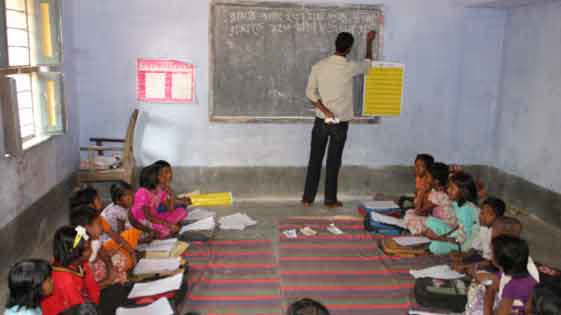
In the Indian public education system, block/cluster resource persons are mid-level officials who are responsible for monitoring the performance of teachers. In this note, Vivek et al. discuss their experience of working with the state government of Jharkhand to design a ‘results-based financing’ programme that incentivises these mid-level officials as well as teachers to perform better – with the ultimate objective of improving education outcomes.
How do better-ranked colleges help meet India’s skill shortages? Evidence using a regression discontinuity design
This project exploits the variation in the University of Delhi college admission process to estimate the effects of exposure to high-achieving peers on cognitive attainment using scores on standardised university level examinations; behavioral outcomes such as risk preference, competitiveness, and confidence; and noncognitive outcomes using measures of Big Five personality traits.
Peer influence and human capital accumulation: Evidence from Delhi University colleges
College is an important milestone in life that is believed to develop several aspects of an individual's human capital, broadly defined to include both cognitive and socio-emotional traits. Consequently, there is great emphasis on obtaining admission into a more selective college. This column draws upon data from Delhi University to examine the returns to enrolling in a more selective college.