
.svg)
.svg)
%201.svg)
%201.svg)
.svg)

.svg)
.svg)
.svg)
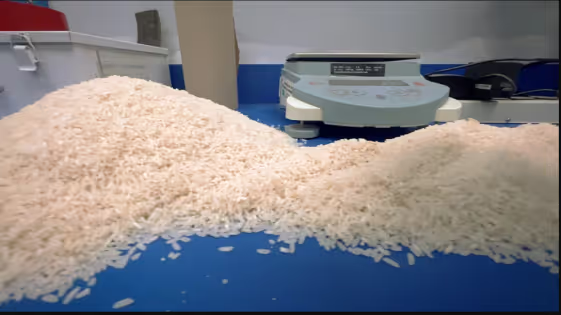
Why India's plan to sell rice for ethanol undermines food and water security
.svg)

.svg)


Agriculture

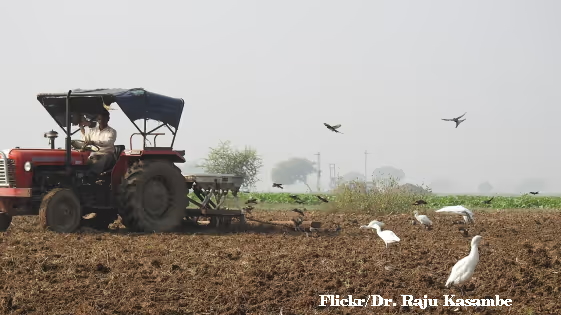
India's farm crisis: Decades old and with deep roots
In this Perspectives piece, Prof. Himanshu argues that the crisis in Indian agriculture today is not a new one; it goes back many years. Therefore, the problems of farmers cannot be addressed by the band-aids of higher minimum support prices and cash transfers. He presents an analysis of the causes and an outline of what needs to be done.


IGC Panel Discussion: Financing growth and diversification of Bihar’s agriculture
In a panel discussion held at Patna, Bihar in December 2018, Anjan Mukherji (Jawaharlal Nehru University), Mekhala Krishnamurthy (Ashoka University), Avinash Kishore (International Food Policy Research Institute), Bharat Ramaswami (Ashoka University), and Pronab Sen (IGC) discussed the issues related to agriculture in Bihar and what can be done to promote growth and diversification in the sector.

When technology disrupts politics: Lessons from India’s green revolution
The green revolution transformed India’s agricultural sector between 1960s and 1980s. Did this technological revolution in agriculture translate into a political revolution? This article shows that winners of this technological change – the agricultural producers – prospered in its wake and sought a greater share of political representation. This played a key role in India’s historical transition from single-party dominance to multi-party competition in elections.
Groundwater depletion in India: Social losses from costly well deepening
There is widespread concern about groundwater over-extraction in India and, in turn, the long-term sustainability of irrigated agriculture. Since groundwater is a common pool resource, its overuse imposes costs or negative externalities on others. This article estimates social losses from groundwater over-extraction in arid Northwest India, and finds that the opportunity for farmers to repeatedly re-invest in deeper wells for irrigation significantly exacerbates the externality.
Climate change and Indian agriculture
Indian agriculture remains vulnerable to the vagaries of weather, and the looming threat of climate change may expose this vulnerability further. This article presents findings from a study that uses new data to analyse the impact of weather shocks on agricultural productivity in the short run, and that of climate change in the long run. It shows that climate change could reduce farm incomes by 15-18%, and by 20-25% in unirrigated areas.
Contract farming and the role of government
To integrate farmers with agro-industries, the Ministry of Agriculture has released a draft Model Contract Farming Act, which seeks to create a regulatory and policy framework for contract farming. In this article, Smriti Sharma contends that the legislation should aim to protect farmers and incentivise buyers to freely contract with each other. Rather than creating bureaucratic hurdles, the government should focus on providing an enabling environment for contract farming.
Sign up to our newsletter to be notified about the latest updates
.svg)
Just One Step Away!
Complete your signup to start getting the latest news, stories, and updates delivered straight to your inbox.