
.svg)
.svg)
%201.svg)
%201.svg)
.svg)

.svg)
.svg)

.svg)

.svg)
.svg)
.svg)


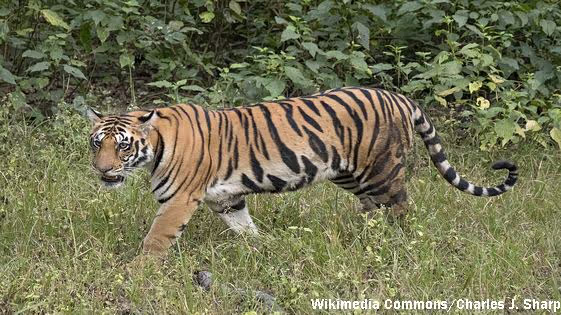

In light of the recently released tiger population estimates for India, Pranav Chanchani discusses what needs to be done make data-driven decisions to sustain tiger population as natural landscapes are being altered by human enterprise. He suggests that data on the social and ecological drivers of variation in the tiger population – including prey, cover and human tolerance for tigers – is essential for the species’ effective conservation. Evidence-based conservation will also provide a more nuanced understanding of where and how tigers can effectively be conserved beyond Protected Areas.
When we cast an eye over India’s vast tiger landscapes, what do we see? Maps of the species’ occurrence and density that have emerged from the Government’s extensive and elaborate monitoring programme present a complex picture. Pockets of tiger presence stand out against an expansive patchwork of forests where the species is absent which span 70% or more of surveyed habitats. If the goals of tiger conservation in India are to bring the species back to areas from which it has been extirpated and to sustain tigers at the highest densities that can be locally supported, then the chances of making headway in the next decade can be improved if evidence-based conservation is emphasised and forms the basis of interventions and impact evaluation.
I argue that strengthening the application of evidence-based tiger conservation in India, where nearly 70% of the world’s tigers share space with 1.4 billion people is imperative. Realising this will require that conservation decision-making and policy are data driven, and informed by a deep understanding of ecological and social mechanisms and associated conservation outcomes – including tiger numbers and human-tiger interactions. In this essay, I outline some prominent patterns in the occurrence and abundance of tigers in India, identify some key gaps in our understanding of underlying mechanisms, and posit how evidence-based tiger conservation can be advanced.
Describing patterns and spatial variation in tiger distribution and density
Across India’s tiger-bearing areas that collectively hold more than 3,500 tigers, there is a more than 15-fold variation in the species’ densities. Some of the variations we see are to be expected: habitats in different eco-regions are not equally productive for tigers and their herbivore prey species. But it is evident that patterns of species’ occurrence and density are also the outcome of human impacts in ways that are not always direct or evident.
In the approximately seven Protected Areas, where tigers are locally ‘hyper-abundant’ (with densities of eight or more tigers per 100 square kilometers), wild herbivores are also numerous, and widely distributed. Barring Kaziranga National Park, these sites are all ensconced within much larger blocks of tiger habitats. While some of these Protected Areas with high tiger densities have excluded people from core zones, others, like Wayanad in Kerala, still accommodate thousands of local residents.
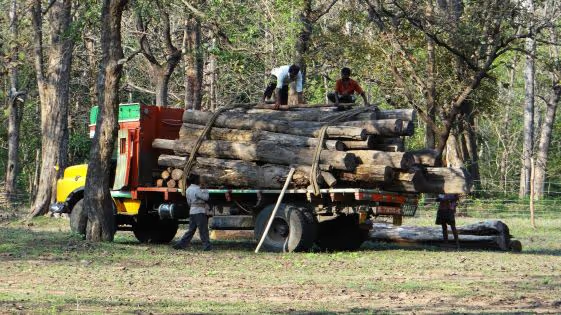
There are also many tiger reserves, national parks, wildlife sanctuaries and reserved forests which tigers inhabit at lower densities than expected. Underlying factors and mechanisms, that may limit tiger populations in these areas are often inadequately understood – examples include habitat fragmentation, skewed distribution or limited availability of key resources like water and prey, unproductive forest understory that restricts ungulate (mammals with hooves) prey, poaching, the lack of areas with adequate cover where tigers can shelter from people, or hostility towards tigers because of conflict and risks, both real and perceived.
In areas where tigers are absent or rare, including a number of tiger reserves like Sayahadri in Maharashtra and Kawal in Telangana, densities of wild ungulates are abysmally low, often because of historical or current bush meat hunting, or severed habitat connectivity. In some areas, where insurgency and political instability have destabilised both the ecological and social fabric of an area, tiger conservation is a distant concern.
In short, pronounced gradients in tiger distribution and numbers, and emergent phenomena like conflict between people and tigers are governed by a suite of interacting social, ecological and management factors and processes, that often go unseen or remain uninvestigated.
Linking patterns to underlying mechanisms
Advancing tiger conservation in landscapes, with a focus on species recovery and conflict management thus requires systematically linking demographic parameters to relevant social and ecological factors, and effective land management. This raises the question: do granular data on tiger populations and associated factors exist? And if so, are these data consistently or rigorously brought to bear on the conservation of India’s national animal?
The answer is that while more and better ecological data are available, there are still significant gaps, and much more needs to be done to bring data to bear on conservation planning and adaptive wildlife management. The sprawling national monitoring exercise generates periodic snapshots of population abundance and density, two related parameters. While knowing how many tigers there are in an area is critical, it is an inadequate metric in itself. The other data that are routinely collected in many tiger habitats of India – including the spatial variation in the density of tiger prey species, measurements of the forest understory and canopy vegetation, and data on trails patrolled by forest guards – vary immensely both in their quality and coverage and have rarely been tied back to tiger demographics. Social and human behavior data (for example on how people use forests and interact with wildlife, whether they are willing and able to tolerate wildlife, and underlying social, economic, cultural and political underpinnings) are all but absent in most contexts. Because of critical data gaps, and patchy application of these data to conservation planning, we can seldom build appropriate theories of change that are both ecologically sound and socially just. Doing so is essential to bring tigers back to Protected Areas like Buxa in West Bengal and Dampa in Mizoram, where the species remains absent even after decades of conservation efforts. Comprehensive data could provide insight to inform whether and over what timelines tigers can be brought back to the large swathes of forests spanning expansive parts of peninsular and North-East India.
The decade ahead: rethinking assumptions, recalibrating success, and reinvigorating science
Embracing evidence-based tiger conservation will require rethinking the assumptions that underlie deeply embedded paradigms of tiger conservation, recalibrating what constitutes successful tiger conservation, and reinvigorating scientific and humanistic inquiry about diverse dimensions of ecology, forest governance and management to take into account relationships between people and nature.
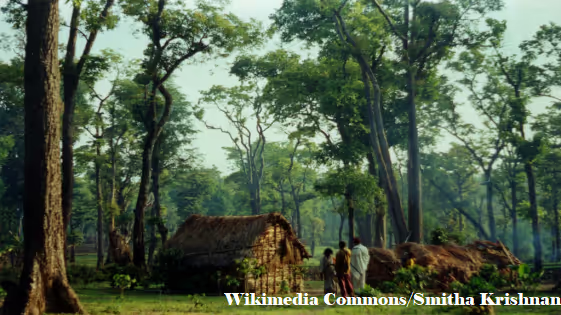
When data and evidence are thinly layered over goals and strategies to conserve tigers, conservation planning may instead be driven by assumptions, or even by dogma. For example, it is commonly assumed that tigers cannot thrive in areas that also accommodate people, even as evidence to the contrary continues to emerge, including how prevalent the occurrence of tigers is along forest edges bordering farmlands and settlements, especially when these areas also shelter prey and provide good cover.1 These assumptions then form the basis of how we govern and manage India’s forests for people and wildlife, including consequential and costly decisions such as creating inviolate spaces that separate people from wildlife, under the assertion that this is the sole pathway to successful tiger conservation.
How can evidence-based conservation be brought to bear on the question of where tiger conservation should be prioritised within working landscapes and multi-use forests? Clearly, addressing this question will require collating and generating data on the diversity of forest governance, and human disturbance regimes under which tigers have persisted, or become locally extinct, with a special focus on mechanisms of human-tiger coexistence (including in areas under community stewardship accorded by the Forest Rights Act). There are important opportunities to promote decentralised models for forest governance in other effective area-based conservation measures (OECMs) – a particular gap is the development, implementation and evaluation of forest management, restoration and protection plans. Broadening the conservation portfolio in OECMs will also reveal where tiger conservation does not need be prioritised, opening up opportunities to focus on other at-risk species and vital ecosystem processes and services. Investigations of the socio-cultural conditions under which tigers can co-exist with people will carefully need to assess the contributions of other mechanisms that can stress or impact populations. For example, the deleterious impacts of habitat fragmentation, such as large highways cutting across tiger habitats need to be dexterously teased apart from potential impacts of simply the presence of humans and livestock.
Recalibrating success for tiger conservation will entail shifting away from a narrow focus on increasing tiger numbers. Instead, the focus needs to be on sustaining tiger populations at numbers that are locally supported, while proactively strengthening protection and managing conflict. While sustaining viable tiger populations may be the long-term goal, success may also be measured as demonstrably creating enabling conditions for wildlife recovery, both social and ecological. Examples include improving habitat productivity for wild herbivores by removing unpalatable invasive species, or improving law enforcement that results in curbing bush meat hunting or greater recruitment of wild herbivores. Success also needs to be measured as the conservation of biodiversity for species that share space with tigers but have different life history strategies and resource needs. For example, synergistically managing grasslands to support endangered hispid hares, Bengal floricans and swamp deer as well as tigers, may be more holistic than strategies that only aim to boost herbivore abundance in grasslands, even if adopting such a strategy implies that fewer tigers may be supported in some areas.
Finally, for evidence-based conservation to be locally relevant, it needs to be coupled with the experience of managers and frontline staff who work tirelessly to protect and promote India’s wildlife, the lived experiences of people who share space with wildlife, and the expertise of scientists and scholars across disciplines. There are several ways in which this can be realised. For example, the keen understanding of foresters and people living in and around forests can inform hypotheses and frame theories of change about limiting factors and enabling conditions for tiger conservation, and guide zonation and management action.
Similarly, parameters and indicators that are measured and monitored to guide species recovery, address human-wildlife conflict, restore habitats or strengthen connectivity can emerge from cross-disciplinary and inclusive dialogues that prioritise both wildlife conservation and human well-being. Pivoting to evidence-based tiger conservation will also be enabled by establishing systems to grant access to the vast repository of data on wildlife populations and habitats that are collected using public funds, and inviting inquiry about the diverse contexts under which wildlife can successfully be conserved. Doing so will help diversify solutions and partnerships for the inclusive stewardship of India’s besieged natural heritage.
Note:
- For more detail see Carter et al. (2012), Chanchani et al. (2015), Kafley et al. (2016) and Warrier et al. (2020).
Further Reading
- Carter, Neil H, Binoj K Shrestha, Jhamak B Karki, Narendra Man Babu Pradhan and Jianguo Liu (2012), “Coexistence between wildlife and humans at fine spatial scales”, PNAS, 109(38): 15360-15365.
- Chanchani, Pranav, Barry R Noon, Larissa Bailey and Rekha A Warrier (2015), “Conserving tigers in working landscapes”, Conservation Biology, 30(3): 649-660.
- Kafley, Hemanta, Matthew E Gompper, Mandira Sharma, Babu R Lamichane and Rupak Maharjan (2016), “Tigers (Panthera tigris) respond to fine spatial-scale habitat factors: occupancy-based habitat association of tigers in Chitwan National Park, Nepal”, Wildlife Research, 43(5): 398-410.
- Warrier, Rekha, Barry R Noon and Larissa Bailey (2020), “Agricultural lands offer seasonal habitats to tigers in a human-dominated and fragmented landscape in India”, Ecosphere, 11(7): e03080.















































.svg)

.svg)
%201.svg)
.svg)
.svg)
