
.svg)
.svg)
%201.svg)
%201.svg)
.svg)

.svg)
.svg)
.svg)
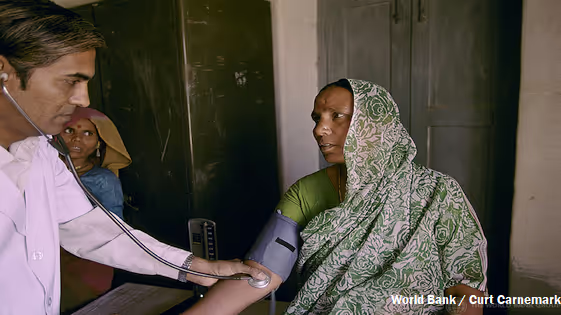
When richer families pay more for worse care: Evidence from childbirth
.svg)

.svg)


Human Development

Rural sanitation: A charter of demands
A government survey shows that 93% of rural households in India have access to a toilet and 96% of those having a toilet use them. However, critics point out contradictions between these data and micro-level assessments in different parts of India. Based on his experience of working for more than two decades in rural Odisha, Liby Johnson argues that an effective rural sanitation model requires both financial assistance to the households, and an integrated water supply.


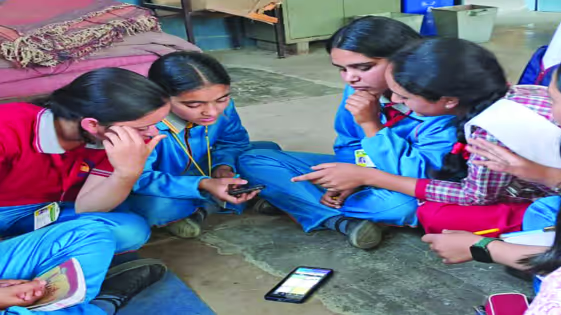
Why do parents invest in girls’ education? Evidence from rural India
Adolescent girls in rural Rajasthan frequently leave education early and marry young. This article develops a novel methodology to elicit average parental preferences over a daughter's education and age of marriage, and subjective beliefs about the evolution of her marriage-market prospects. It finds that prospects of finding a desirable groom are an important driver of girls’ education Policies that help girls stay in school can prevent early marriage.
Sustained health benefits of ICDS: Later life evidence
Child malnutrition is a serious concern for India where more than half of the children under age five are moderately or severely malnourished. The Integrated Child Development Services (ICDS) launched in 1975, target long-term nutrition and holistic development of children. Analysing data from the India Human Development Survey-II, this article evaluates the causal impact of ICDS exposure in rural areas on children’s health outcomes in later years of their lives.
Right to Education Act: Trends in enrolment, test scores, and school quality
A decade ago, India joined a range of countries that mandate free, compulsory education for school-aged children. Passed in August 2009, India’s Right to Education Act was potentially transformative legislation, yet detailed analysis of its impact on the country’s educational outcomes has been slow to emerge. This article uses three national datasets to consider whether the Act is associated with changes in student enrolment, test scores, pupil-teacher ratios, school infrastructure, and other indicators of educational health and standing.
Social protection in the Union Budget 2019
In this post, Sudha Narayanan analyses the provisions pertaining to social protection in the Union Budget 2019. She contends that while the budgetary figures give the impression that the Government is staying the course with many social welfare programmes, it may well be chipping away the architecture of social protection in India.
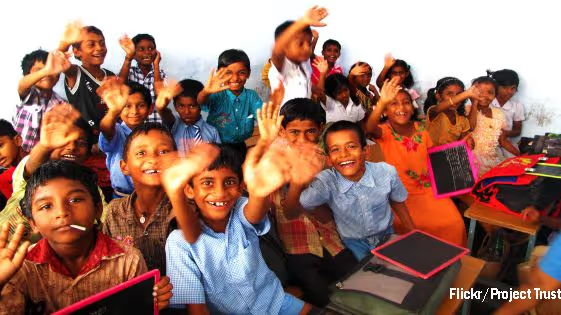
Building foundations well: The challenge for primary education
Rukmini Banerji contends that the draft New Education Policy gets it right in emphasising the importance of Early Childhood Care and Education and the need to urgently work on establishing foundational literacy and numeracy at the primary stage, where there is currently a learning crisis.
A quiet revolution: The case of primary education in Uttar Pradesh
The challenge in India’s school education system today is how to translate years of schooling into learning. While there is reason to lament the learning crisis, a quiet movement is taking place in Uttar Pradesh. In this note, Shobhini Mukerji, Executive Director of J-PAL South Asia, describes the shift brought to the state’s primary education system through the government's evidence-backed Graded Learning
It runs in the family: Parents’ education and child learning outcomes
Early life learning is known to influence later life outcomes like schooling, employment, and income. It is thus vital to identify strategies to enhance child learning in schools. This article examines the effects of parental education on child learning outcomes by leveraging the variation in access to schooling for parents arising out of the implementation of a national school construction policy in India.

Labelled loans and sanitation investments
Rural Indian households report lack of affordability as the main reason for not having a toilet. This article investigates – through an experiment in rural Maharashtra – whether microcredit labelled for sanitation can increase sanitation investments. It finds that targeted households demand the sanitation loans, and toilet uptake increases by 9 percentage points; however, roughly half of the loans were not used for sanitation

Sign up to our newsletter to be notified about the latest updates
.svg)
Just One Step Away!
Complete your signup to start getting the latest news, stories, and updates delivered straight to your inbox.