
.svg)
.svg)
%201.svg)
%201.svg)
.svg)

.svg)
.svg)
.svg)
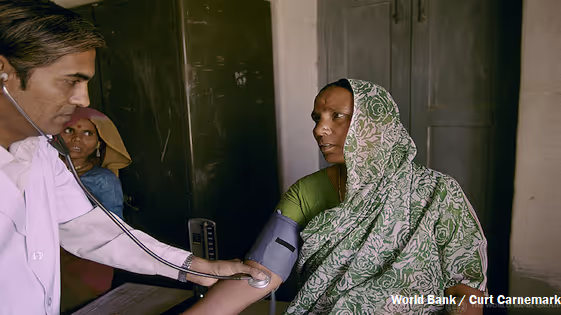
India’s primary healthcare reform: Improved service delivery, reduced mortality
.svg)

.svg)
Human Development
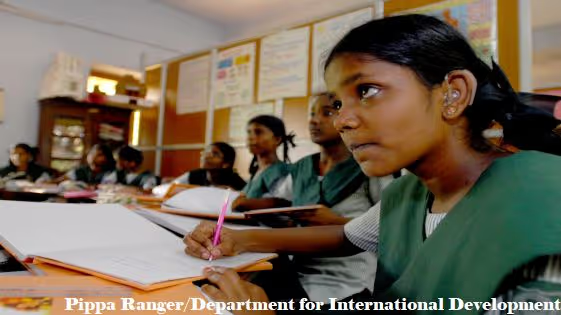
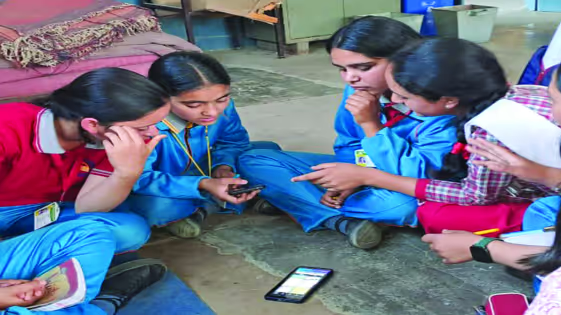
Enhancing secondary school learning: Role of remedial camps and teacher flexibility
A key dilemma in Indian education is that while children are enrolled in school, they are not actually learning. Based on an experiment in Odisha, this article explores possible solutions to the learning deficit in secondary schooling. It finds that tailored remedial programmes improve learning and correct teachers’ beliefs regarding learning levels. However, gains from increasing teacher autonomy in lesson plans are not significant.


Transforming menstrual hygiene in India
Launched in 2014, the ‘Rashtriya Kishor Swasthya Karyakram’ seeks to improve menstrual hygiene in India by addressing issues around affordability as well as awareness. In this post, Kanika Dua contends that the programme – combined with enhanced provision of sanitation facilities – helped increase the adoption of hygienic menstrual management products, particularly among rural, less educated, and economically disadvantaged women.
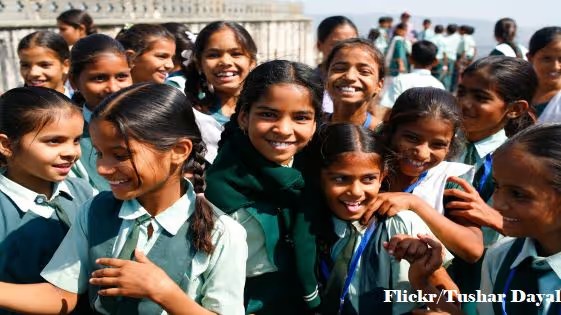
What ASER 2023 reveals about the gender gap in confidence
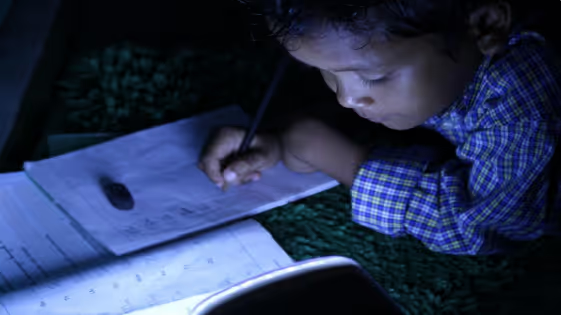
The Annual Status of Education Report (ASER) 2023 finds that although gender gaps in school enrolment have fallen over the years, girls still lag behind in terms of access to and use of digital technologies. In this post, Suman Bhattacharjea explores factors such as patterns of social and family control over youth of each sex, expectation from girls of refraining from independent action, and availability of role models at home and school.
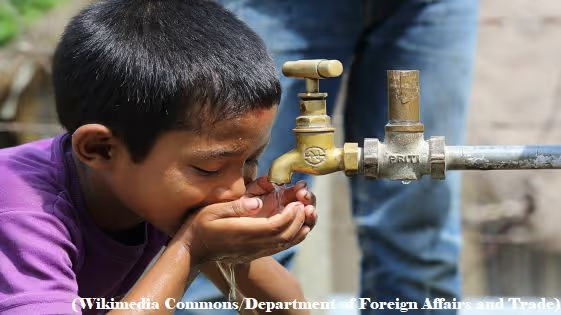
Can safe drinking water improve children’s educational outcomes?
It is well-established that treated water has health benefits, but can it also enhance children’s educational outcomes? Analysing India Human Development Survey data, this article provides evidence in this context – identifying pathways such as decreased incidence of diarrhoea, lesser time spent on fetching water, and reduced expenditure on short-term morbidity allowing for higher spend on education. Further, the impact is more pronounced for girls.
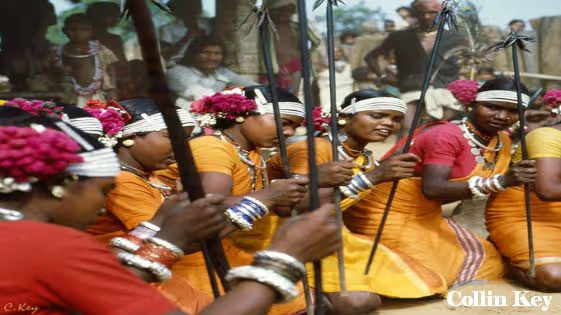
The tribal communities of central India: Challenges and way forward
The ‘Status of Adivasi Livelihoods’ Report has once again brought attention to the dire situation of tribes in central India. Based on a survey of tribal households in Madhya Pradesh and Chattisgarh, Chaudhuri and Ghosh discuss challenges such as loss of biodiversity and landlessness, poor food security and malnutrition, and illiteracy. They highlight the relief provided by food subsidies, and suggest improving governance systems and preserving tribal values to uplift these communities.
Improving healthcare access to address the rise in non-communicable diseases among Indian women
In light of the changing healthcare burden for women, with a rise in mortality due to non-communicable diseases, Bhan and Shukla outline the incidence of diseases in Indian states over the last two decades, and the role that the PMJAY programme plays to alleviate constraints to healthcare access. They note the male bias in utilisation of public-funded healthcare programmes, as evidenced from state insurance schemes, and highlight the need to understand the barriers to access and user experience of women.

Second Ashok Kotwal Memorial Lecture: Inequality, Labour and Social Democracy
The Ashok Kotwal Memorial Lecture was instituted in 2022, in memory of our founding Editor-in-Chief, as an annual lecture on key issues of development. For its second edition, I4I hosted Professor Pranab K. Bardhan on 30 November 2023 in New Delhi on 'Inequality, Labour and Social Democracy’. A video recording of the lecture has been made available here.
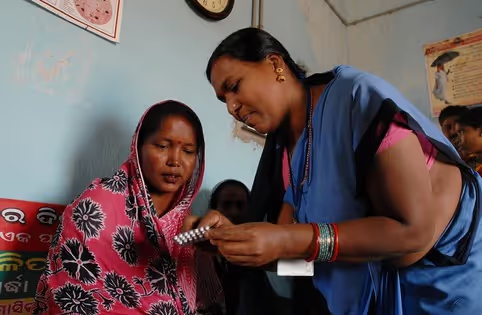
Impact of India’s Mission Parivar Vikas on fertility rates and family planning
India’s large-scale family planning programme, Mission Parivar Vikas, improves access to contraception, offers monetary incentives to beneficiaries for programme adoption, and disseminates information on family planning with the objective of reducing the prevailing high rates of fertility in 146 districts. Using data from multiple rounds of the NFHS, this article documents evidence of a decline in number of births as a result of the intervention, accompanied by reduced fertility preferences of women and men, and increased adoption of contraception.
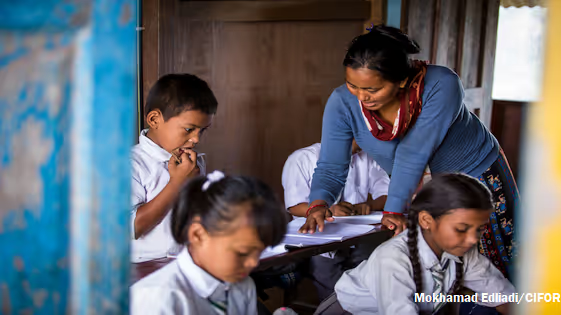
Persistent struggle for learning: A tale of tribal regions
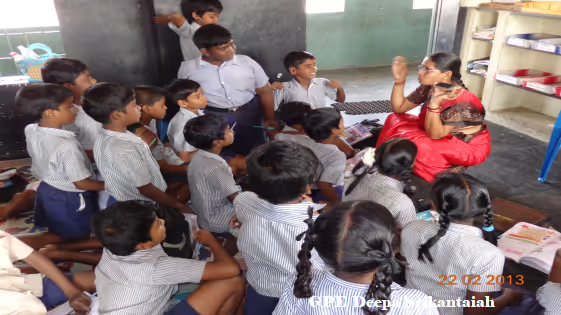
The recent National Achievement Survey shows that tribal districts lag behind in learning outcomes. This article suggests this to be of significant concern, as the distribution of schooling infrastructure does not show similar differences. It highlights the below average language and mathematics outcomes in areas with a higher share of tribal populations. It emphasises the need to focus on teachers’ involvement and pedagogical improvements, in addition to investment in physical infrastructure, to achieve the goal of inclusive learning
Sign up to our newsletter to be notified about the latest updates
.svg)
Just One Step Away!
Complete your signup to start getting the latest news, stories, and updates delivered straight to your inbox.