
.svg)
.svg)
%201.svg)
%201.svg)
.svg)

.svg)
.svg)
.svg)
Why next-generation economic reforms are crucial for reviving investment
.svg)

.svg)

Macroeconomics
Covid-19: Assessing fiscal position of government in first quarter of 2020-21
In this post, Pandey and Raju analyse the trends in the revenue, expenditure, and borrowings of the Government of India in the first quarter of 2020-21, based on data released by the Controller General of Accounts. They argue that the contraction in revenues in the Covid-struck economy has constrained the government’s capacity to effectively address the operational needs arising from the pandemic, and that greater borrowing by the government may be required in the coming months to offset a rise in expenditure.



Subsidies, merit goods, and fiscal space - II
In Part I of this two-part series, the authors presented their estimates of total budget subsidies, and their merit and non-merit components. In this part, they discuss the relationship between subsidies and the delivery of specific public services, the comparative efficiency of subsidy use by different states, and the scope for rationalisation of subsidies as a part of deep fiscal reforms, in order to create fiscal space for reviving inclusive growth following the Covid-19 lockdown shock.

What would make India’s growth sustainable?
Much of the discussion on the economic slowdown in India in recent years – as well as on the government’s measures to tackle the present economic crisis due to the Covid-19 lockdown – is focused on the supply side. In this post, Ghatak, Kotwal, and Ramaswami emphasise the demand channel, and argue that this is the fate of any growth episode that is not inclusive.

Covid-19: Assessing vulnerabilities faced by microenterprises
In India, where microenterprises form a crucial foundation for livelihoods and employment, the effects of the Covid-19 lockdown can potentially be significant. Based on the first wave of a dynamic, multidimensional survey of 1,461 microenterprises across the country, Buteau and Chandrasekar show that, while most business owners surveyed have displayed remarkable levels of confidence in the possibility of business recovery after Covid-19, more than half of them do not have a strategy to chart their recovery plan and are dipping into their savings to stay afloat.
Covid-19: Recession in India, and policy lessons from other countries
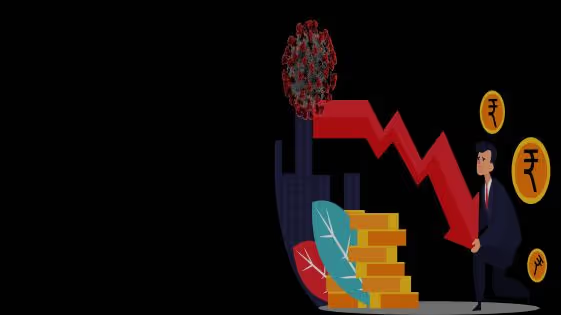
Given the prevailing economic situation in India and following the past experience of several developed countries, there is a clamour for accepting much larger fiscal deficits, and adopting unconventional monetary policy. In this post, Gurbachan Singh contends that these are relatively soft and not very effective policy options for sustainable recovery and growth. He presents a different diagnosis, and accordingly, an alternative policy prescription.

Covid-19: Conditions on state borrowing need a rethink
States have been in the firing line in the battle to save lives and livelihoods from the impact of Covid-19. However, the loss of economic activity following the nationwide lockdown, has wreaked havoc on states’ finances. While the Centre has allowed states to raise their fiscal deficits from 3% to 5% of gross state domestic product, riders have been imposed in the form of implementation of reforms. In this post, Mayank Jain and D Priyadarshini examine whether these conditions will facilitate or hinder the effective functioning of states in the current scenario.


Sign up to our newsletter to be notified about the latest updates
.svg)
Just One Step Away!
Complete your signup to start getting the latest news, stories, and updates delivered straight to your inbox.