
.svg)
.svg)
%201.svg)
%201.svg)
.svg)

.svg)
.svg)
.svg)
Why next-generation economic reforms are crucial for reviving investment
.svg)

.svg)



Macroeconomics
Foreign currency corporate borrowing: Risks and policy responses
Non-financial corporations in emerging market economies increasingly rely on foreign currency debt,and are exposed to currency depreciations and sudden stops in capital flows. Analysing data on 1,786 Indian firms during 2004-2019, this article shows that favourable global funding conditions are a much more significant determinant of foreign currency borrowing than firm-level factors. Further, it suggests that RBI’s macroprudential policies have been effectively mitigating these risks.


How open is India's capital account?
Although India began opening up its capital account in the mid-1990s, the approach towards financial liberalisation has been cautious. Tracing changes in the de-facto openness of the country’s capital account over time, Aggarwal et al. contend that greater financial integration with global markets along with monetary policy autonomy to successfully pursue an inflation target, reduces the policy space available to the RBI to stabilise currency fluctuations.

Goods and services tax: Estimating optimal rates
Introduced in India in 2017, a key feature of the goods and services tax (GST) system is that the tax rate for a particular commodity is uniform across the country. Based on a counterfactual framework that incorporates regional diversity in prices and spending to estimate optimal commodity tax rates, this article argues for a departure from this universal GST practice in India.

India’s service-led economic growth
Structural transformation that involves a shift from agriculture straight to services, is a cause of concern to many scholars as an expanding service sector might be a pale substitute to technical progress in manufacturing as the main engine of growth. Analysing microdata from India for 1987-2011, this article shows that lack of pronounced industrialisation does not mean that growth is bound to fall. However, India’s service-led growth is strikingly pro-rich.
Business sentiments and labour markets
The Covid-19 pandemic and associated lockdowns have had a significant adverse impact on jobs and livelihoods. Using 2006-2021 data from a survey on business sentiments, this article examines fluctuations in firms’ hiring of temporary/casual and permanent workers across three major economic events – the Global Financial Crisis, demonetisation, and the Covid-19 crisis. It shows that firms use temporary workers to adjust to changes in the demand of their products in response to macroeconomic uncertainty – increasing vulnerability among workers.
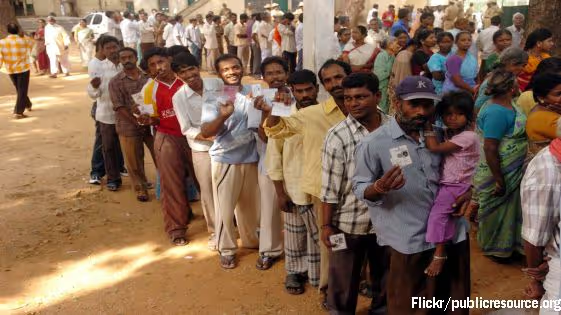
West Bengal’s economic performance relative to India over the last three decades
Against the backdrop of the ongoing elections in West Bengal, Maitreesh Ghatak examines how the state’s economic performance compares with that of the country as a whole, over the past three decades. He highlights that despite West Bengal’s lack of economic dynamism, its agricultural growth rate as well as the growth rate of consumption expenditure in its rural areas, that house 72% of the population, has been higher than the national average.


Sign up to our newsletter to be notified about the latest updates
.svg)
Just One Step Away!
Complete your signup to start getting the latest news, stories, and updates delivered straight to your inbox.