
.svg)
.svg)
%201.svg)
%201.svg)
.svg)

.svg)
.svg)
.svg)
Why next-generation economic reforms are crucial for reviving investment
.svg)

.svg)



Macroeconomics
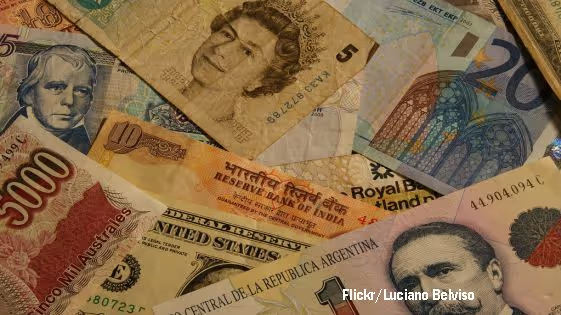
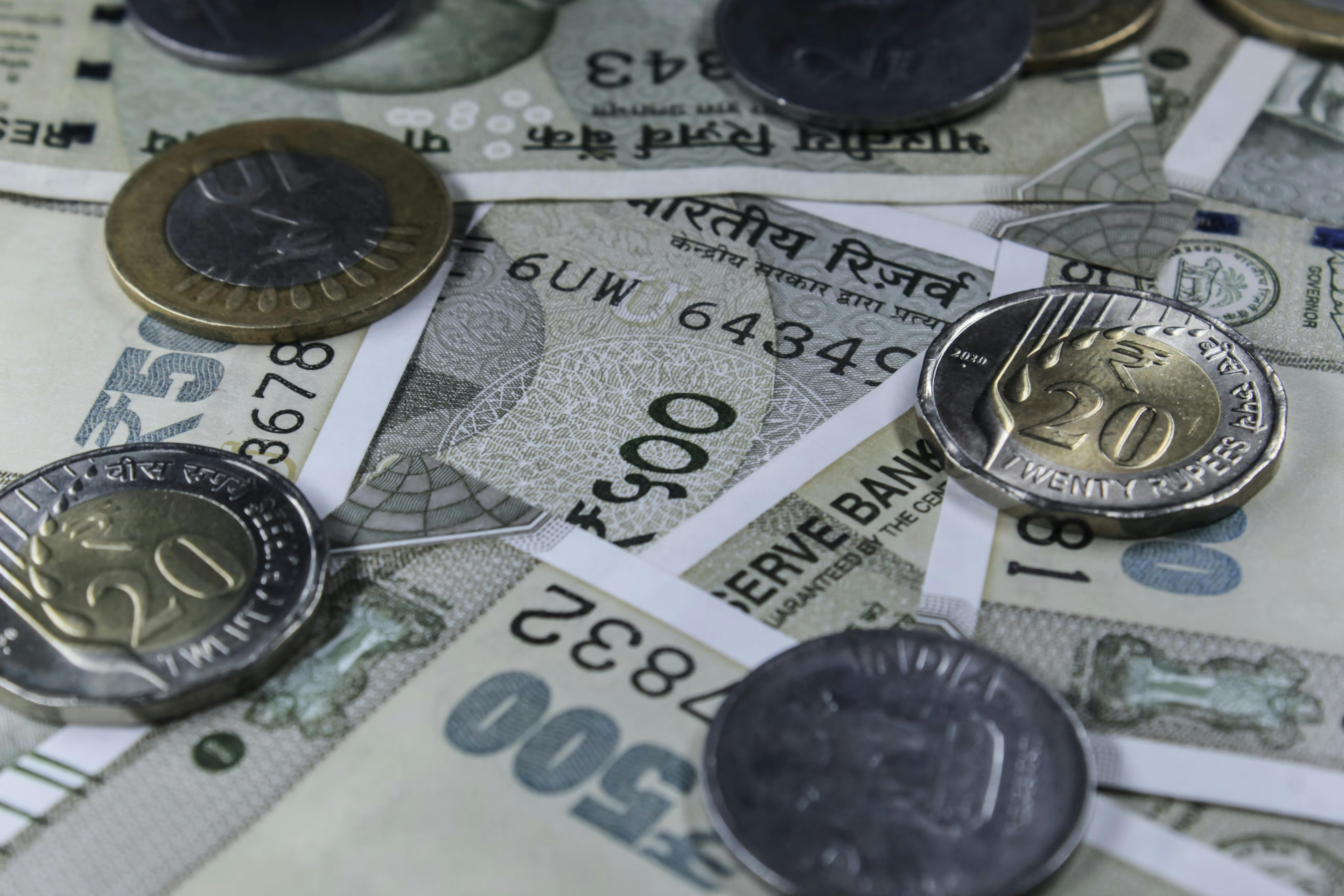
From abundant global liquidity to selective lending: How corporate finance has changed
Global credit has experienced significant changes in the last two decades. Analysing data on 1,160 Indian firms for the 2000-2017 period, this article shows that in the period following the global financial crisis, abundant global credit allowed firms to take advantage of relatively cheap financing abroad. However, since 2013, lenders are differentiating across borrowers and firms’ access to external finance has declined, with an associated reduction in their real investment activities.


Growth in India: Narratives and evidence
There are various narratives on the trajectory of India’s economic growth, and its key determining factors. This article analyses the recently released GDP data series at 2011-12 prices, extending back to 1950, to establish India’s actual growth trajectory. It also provides a theoretical explanation for the growth, and brings perspective to the role of the economic policies pursued at different stages of India’s economic history post-Independence.

De-globalisation driven by global crises
Concerns associated with the Covid-19 pandemic have led to new rationales of protectionism, with renewed emphasis on domestic production and sourcing. In this post, Assaf Razin compares the current economic crisis brought on by the pandemic to previous major economic crises, and examines what this could mean for the future of various aspects of globalisation.

A world of no lockdowns: The case of South Korea and Sweden
While most of the world was under lockdown during the Covid-19 pandemic of 2020, two countries, Sweden and South Korea, decided to keep their economies open. In this post, Bhatia et al. use a metric of six categories to compare the measures taken by the two countries in their respective economies last year.

Of twists and turns: Monetary policy and ‘term premium’
As India’s economic growth slowed down in recent years, the reliance on monetary policy to stimulate growth increased significantly – especially during the pandemic. Analysing data from 2018-2020, Rajeswari Sengupta and Harsh Vardhan show that conventional and unconventional monetary policy actions of the RBI have had only a modest impact on the ‘term premium’ – an indicator of the market’s expectations of future interest rates. This points towards the limits of monetary policy actions alone as economic stimulus during a crisis.
Inflation targeting in India: An interim assessment
Inflation targeting in India is a work-in-progress, with a five-year review due by March 2021. This article presents an interim assessment suggesting that significant progress has already been achieved to date: this is evident in the reduced volatility of a range of inflation-related outcomes and in the stronger anchoring of inflation expectations, which appears to have enhanced the ability of the RBI to respond to the exceptional Covid-19 shock.


Sign up to our newsletter to be notified about the latest updates
.svg)
Just One Step Away!
Complete your signup to start getting the latest news, stories, and updates delivered straight to your inbox.