
.svg)
.svg)
%201.svg)
%201.svg)
.svg)

.svg)
.svg)
.svg)
Why next-generation economic reforms are crucial for reviving investment
.svg)

.svg)


Macroeconomics

An assessment of policy performance under the current regime
Commenting on the recent policy paper by Subramanian-Felman, Maitreesh Ghatak discusses why – looking at the same numbers – he would tend to be less generous in his grades for the performance of policy initiatives under the current regime. Regarding the Covid-19 shock, Ghatak contends that to the extent there is a policy trade-off between lives and livelihoods, one wonders why India does not score highly on either – whether it is “hardware problems” or “software” glitches in policy design and implementation.


Fiscal rules during the Covid-19 pandemic
Several countries have amended their fiscal rules to provide for additional public spending, in order to revive their economies that have been adversely hit by the pandemic. This post examines the fiscal strategies to deal with the Covid-19 shock of a set of countries that belong to the G20 group or the middle-income EMEs, and are broadly similarly placed as India.
The Indian economy and policymaking: Towards ‘openness’
Providing his perspective on the recent policy paper by Subramanian and Felman, Nirvikar Singh contends that more emphasis is needed on financial reforms and innovation, addressing India’s export slowdown, and enhancing digital connectivity. In his view, greater transparency and openness to criticism will lead to better policymaking.
State of the Indian economy: Diagnosis and recommendations
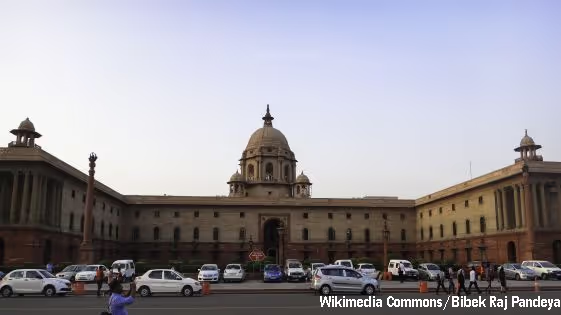
Arvind Subramanian (India’s former Chief Economic Adviser) and Josh Felman (former IMF Resident Representative to India) have brought out a new policy paper, offering a diagnosis of the Indian economy and recommendations for the forthcoming budget. In this post, Ashok Kotwal (I4I Editor-in-Chief) highlights key takeaways from their paper. Over the next few days, I4I will present a series of comments by eminent economists on this analysis.

“New Welfarism”: Old wine, new bottles?
Commenting on the recent policy paper by Subramanian and Felman, R Nagaraj contends that the authors imaginative re-branding of the erstwhile ‘populist schemes’ as “New Welfarism of the Right” is an endorsement of the current government policies, without contending with burgeoning evidence on their shortcomings. Nagaraj further argues that what the authors call ‘software’ problems of policymaking are essentially matters of governance, and the issue of crony capitalism needs to be addressed.
Evaluating inflation targeting in India
In March 2021, India will complete five years since the adoption of the inflation targeting framework by the government and RBI. Analysing inflation data since 1996 using alternative models, this article argues that the ‘output gap model’ that underlies the current regime is not the best descriptor of inflation trends in India.


Sign up to our newsletter to be notified about the latest updates
.svg)
Just One Step Away!
Complete your signup to start getting the latest news, stories, and updates delivered straight to your inbox.