
.svg)
.svg)
%201.svg)
%201.svg)
.svg)

.svg)
.svg)
.svg)
.svg)

.svg)




Miscellany

Nobel Prize in Economics 2021: Clarity, transparency, and credibility in empirical research
This year’s Nobel Prize in Economics has been awarded to David Card – for his empirical contributions to labour economics – and Joshua Angrist and Guido Imbens – for their methodological contributions to the analysis of causal relationships. In this post, Thomas Lemieux discusses the contribution of the Nobel laureates in revolutionising the way empirical work is conducted in micro-oriented fields, particularly through the use of natural experiments to answer important economic questions, and new econometric tools to interpret the results.



Culture and development
How did human society evolve from being organised predominantly around large kin-based networks, to one with strong notions of individualism? To examine this question, Joseph Henrich (Harvard University) and Patrick Francois (University of British Columbia) discuss the interactions between informal norms, formal institutions, and psychology, based on examples and evidence from around the world. With the realisation in the West that kin-based societies have limited scalability, and the Church facilitating the breakdown of these units, certain psychological traits emerged and solidified – the central premise of Henrich’s book "The WEIRDest people in the world: How the West became psychologically peculiar and particularly prosperous". As these societies gained an ascendant position, the new norms and institutions proliferated and affected the rest of the world, via pathways such as Industrial Revolution and exports. Finally, they deliberate on how the possibility of substantial psychologi

Culture and development
How did human society evolve from being organised predominantly around large kin-based networks, to one with strong notions of individualism? To examine this question, Joseph Henrich (Harvard University) and Patrick Francois (University of British Columbia) discuss the interactions between informal norms, formal institutions, and psychology, based on examples and evidence from around the world. With the realisation in the West that kin-based societies have limited scalability, and the Church facilitating the breakdown of these units, certain psychological traits emerged and solidified – the central premise of Henrich’s book "The WEIRDest people in the world: How the West became psychologically peculiar and particularly prosperous". As these societies gained an ascendant position, the new norms and institutions proliferated and affected the rest of the world, via pathways such as Industrial Revolution and exports. Finally, they deliberate on how the possibility of substantial psychologi
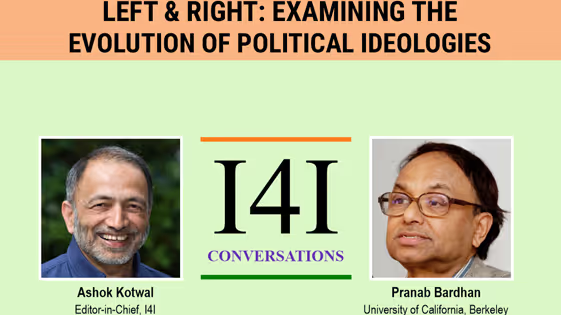
Left and right: Examining the evolution of political ideologies
With the advent of globalisation, the struggle between the ‘left’ and ‘right’ – as defined in Marxian terms – rapidly evolved from one between economic ideologies, to cultural wars. In this context, I4I Editor-in-Chief Ashok Kotwal engages in a deep-dive with Prof. Pranab Bardhan (University of California, Berkeley) on issues ranging from growing resentment towards educated elite, shifts in the form of capital and employment patterns, role of communities, to emergence of illiberal political movements, and the different types of nationalism and populism. This is the first edition of I4I’s new feature “Conversations”, which would present in-depth discussions with experts on ‘big picture’ or futuristic topics.
Left and right: Examining the evolution of political ideologies
With the advent of globalisation, the struggle between the ‘left’ and ‘right’ – as defined in Marxian terms – rapidly evolved from one between economic ideologies, to cultural wars. In this context, I4I Editor-in-Chief Ashok Kotwal engages in a deep-dive with Prof. Pranab Bardhan (University of California, Berkeley) on issues ranging from growing resentment towards educated elite, shifts in the form of capital and employment patterns, role of communities, to emergence of illiberal political movements, and the different types of nationalism and populism. This is the first edition of I4I’s new feature “Conversations”, which would present in-depth discussions with experts on ‘big picture’ or futuristic topics.

Under the thumb of history?
In June 2021, Nobel Laureate Abhijit Banerjee (Ford Foundation International Professor of Economics, MIT) delivered the inaugural Shaibal Gupta Memorial Lecture organised by Asian Development Research Institute, broadly discussing the role of history in development economics. An important body of recent work emphasises the idea of the ‘long arm of history’, that is, history cannot be escaped totally and has durable effects. For example, countries that were British colonies several years ago, continue to have British-style legal systems. However, Prof. Banerjee contends that there is no logical reason why persistence has to mean determinism – it could just be that things are slow to change due to inertia or coordination failures. Persistence does not necessarily guarantee that there will be no change; just that change takes place in unexpected ways, for instance, long-term consequences on a country’s economy on account of sudden death of the leader. At some level, one can never answer

I4I at 10: Zooming over the last nine years, and looking ahead
As ‘Ideas for India’ enters its 10th year, Editor-in-Chief Ashok Kotwal reflects on its growth as a credible, ideologically neutral, and accessible platform for evidence-based policy analysis, and presents the vision for the future.

Information provision and food safety: A field study in urban India
While street food accounts for a significant proportion of the daily food consumption of millions of people, the reliability and safety of these food supply chains remain a key public health concern. Based on a field experiment in Kolkata, this article shows that information provision and training of vendors may not be sufficient for reducing street food safety hazards.

How effective are unenforced mandates for corporate social responsibility?
By enacting the Companies Act in 2013, India became the first country in the world to mandate spending by large corporations on socially responsible initiatives. Using firm data from 2010 and 2016, this article shows that the Act increased expenditure levels on corporate social responsibility as well as their reporting. However, the hybrid mandatory-voluntary nature of the Act has led to some under compliance.


Sign up to our newsletter to be notified about the latest updates
.svg)
Just One Step Away!
Complete your signup to start getting the latest news, stories, and updates delivered straight to your inbox.