
.svg)
.svg)
%201.svg)
%201.svg)
.svg)

.svg)
.svg)
.svg)
.svg)

.svg)




Miscellany


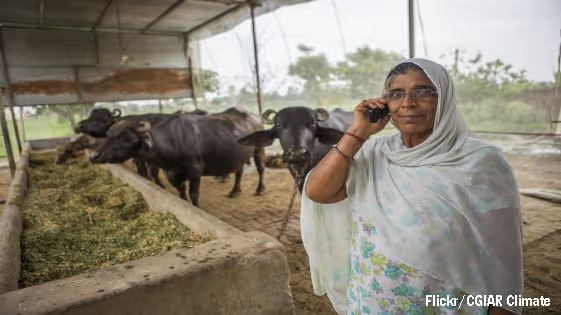
Phone survey methodology for social and economic research in India
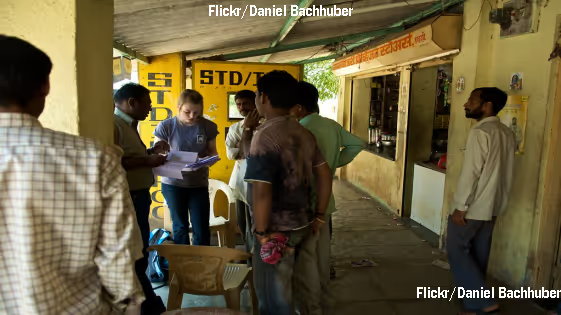
Data collection using face-to-face surveys has faced a roadblock in the wake of restricted mobility and social distancing guidelines to contain the spread of Covid-19. In this post, Coffey et al. describe their experience of conducting a mobile phone survey about social attitudes, discrimination, and public opinion, which has been carried out in seven states and cities in India since 2016.


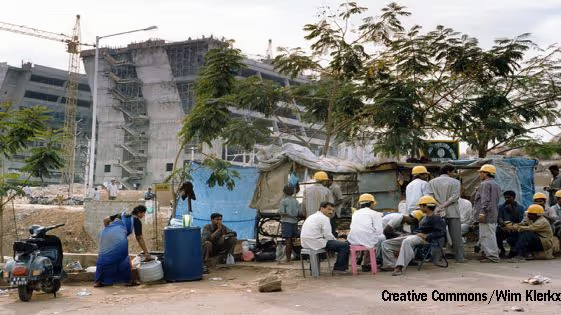
Covid-19: Journey of a construction firm through the lockdown
To check the spread of Covid-19, Government of India announced a stringent, three-week national lockdown on 25 March 2020 – with some easing of restrictions in subsequent phases. This note chronicles the journey of a construction firm and their workers over a four-month period following the announcement.
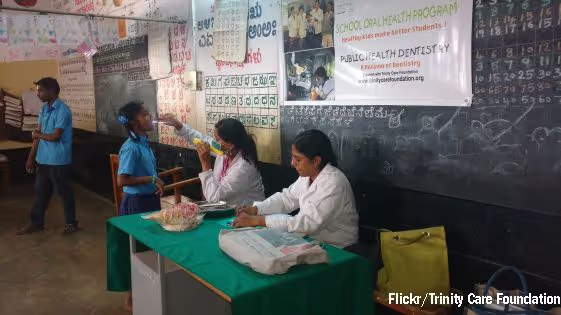
RCTs for policymaking: Ethical and methodological considerations
The last decade has seen an increased adoption of randomised controlled trials (RCTs) for answering policy questions in developing countries. RCTs are being preferred over other research methods mainly for their reduced risk of bias. However, multiple researchers have cautioned against the acceptance of this hierarchy in research designs. In this post, Sneha P situates this debate in the Indian context and discusses when RCTs are appropriate for informing decision-making in policy.

Doing our bidding: Auctions and the greater common good
This year’s Nobel Prize in Economics has been awarded to Paul Milgrom and Robert Wilson for improvements to auction theory and inventions of new auction formats. In this post, Parikshit Ghosh discusses the evolution of auction theory and the significant contributions of the Laureates.

In the eyes of the beholder: How artisans set prices for their products
The developing world is replete with people working in low-income, but creative occupations, such as artisanship. However, little is concretely known about how they set prices for their products. Based on a study of a handicraft cluster in South India, this article finds that artisans who are attached to their creative output offer significant discounts to discerning buyers, even when these buyers have a high willingness to pay.

Covid-19 lockdown and criminal activity: Evidence from Bihar
The lockdown imposed to fight the Covid-19 pandemic has had wide-ranging consequences for the society. This article analyses the impact of the lockdown on criminal activity in Bihar using up-to-date police information reports. The results show that the lockdown decreased aggregate crime by 44%. Large negative effects are observed for diverse types of crimes such as murder (61%), theft (63%), and crimes against women (64%), among others.
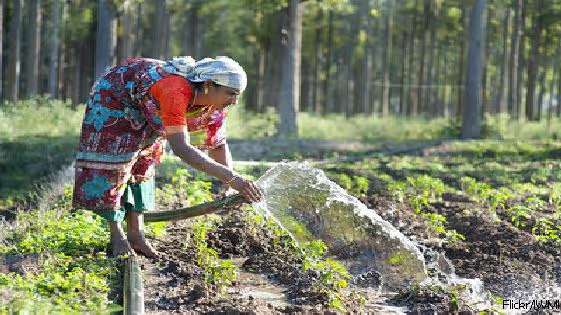
The institutional partnership model: Embedding evidence into the policy equation
One path for capitalising on government interest in evidence-informed policymaking is for the research community to build long-term institutional partnerships with governments to create an ecosystem where data and evidence become vital inputs for policy decisions. In this note, Sharanya Chandran draws from her experience of working closely with the Government of Punjab to generate evidence to address the state's top policy priorities, and argues for the promise of the institutional partnership model.


Sign up to our newsletter to be notified about the latest updates
.svg)
Just One Step Away!
Complete your signup to start getting the latest news, stories, and updates delivered straight to your inbox.