
.svg)
.svg)
%201.svg)
%201.svg)
.svg)

.svg)
.svg)
.svg)
.svg)

.svg)


Poverty Inequality

Inequality and economics: Tony Atkinson's enduring lessons
Sir Tony Atkinson, the doyen of inequality economics, passed away in January. This article, by a longstanding friend and co-author, outlines his contributions to the analysis and measurement of inequality – and many other areas of economics, including taxation, social protection, and the welfare State. The ultimate goal of Atkinson’s research was to translate economic analysis into policy actions: economics is a tool for understanding the world and taking informed decisions on policies, but economists must strive to communicate their results beyond the narrow circles of decision-makers, making them accessible for public discussion.


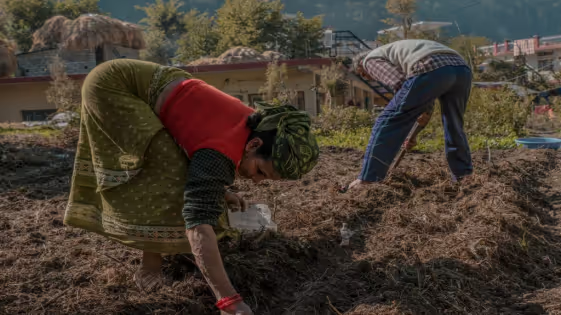
The decline of rural earning inequality in India
While earnings inequality remained virtually unchanged in urban India between 2004-05 and 2011-12, it declined sharply in rural India over this period. This column finds that although the change in the distribution of education among paid workers had an inequality-increasing effect, there was a net decline in rural inequality because returns to increased levels of education improved more for low-earning workers than high-earning ones.
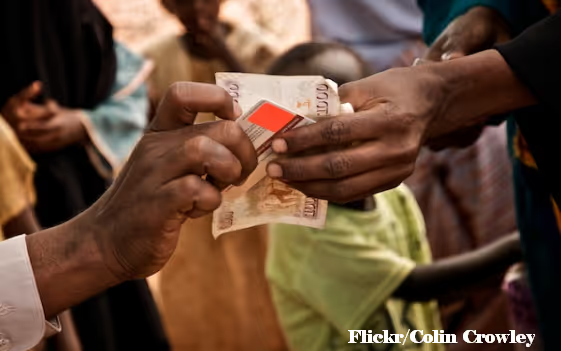
Disintermediating the State: Would a universal basic income reduce poverty more than targeted programmes?
Commenting on the discussion of the universal basic income in India’s Economic Survey 2016-17, Justin Sandefur contends that a modest version of UBI could potentially save money and shift expenditure in a progressive, pro-poor direction.
Getting kinky with chickens
In the context of Bill Gates’ commitment to chickens as a high-impact poverty intervention, Chris Blattman recently proposed a study to compare interventions that provide chicken rather than cash, and said that the answer is the best investment we could make to fight world poverty. In this article, Lant Pritchett refutes this view.
Income inequality in a globalising world
Since the turn of the century, income inequality has risen to be among the most prominent policy issues of our time. This column looks at inequality trends in recent decades. While relative global inequality has fallen, insufficient economic convergence, together with substantial growth in per capita incomes, has resulted in increased absolute inequality since the mid-1970s. The inclusivity aspect of growth is now more imperative than ever.
Inequality in the typical country in the last 25 years
While inequality has received a great deal of attention in the public debate in recent times, the poor quality of data available on this issue is a constraint. Based on a recently-compiled database of the World Bank, this column presents the trend for within-country inequality for the average country.
Decoding universal basic income for India
In this article, Jean Drèze argues that while universal basic income is a good idea in principle, as far as India today is concerned, it sounds like premature articulation. It could also become a Trojan horse for the dismantling of hard-won entitlements of the underprivileged.
A universal basic income to step up economic reform
In this article, Nimai Mehta, Academic Director of the Global Economics and Business Program at the American University, highlights the political challenge of introducing the wider set of reforms needed if a universal basic income (UBI) is to lift the poor out of poverty, and of ensuring fiscal affordability of UBI. Further, he shares some initial ideas on how these objectives may be achieved by leveraging the evolving Centre-state relations.


Sign up to our newsletter to be notified about the latest updates
.svg)
Just One Step Away!
Complete your signup to start getting the latest news, stories, and updates delivered straight to your inbox.