
.svg)
.svg)
%201.svg)
%201.svg)
.svg)

.svg)
.svg)
Amrita Dhillon

Amrita Dhillon is Professor of Economics at the Department of Political Economy at King's College, London. Her research focuses on development and political economy questions.
.svg)


Fostering social connections
This column describes an ongoing study that analyses data from Delhi’s labour-intensive garment factories to explore the relationship between trust among workers and productivity. Using the strength of pre-existing social ties among workers as proxy for the value of trust, it finds that being socially connected has significant implications for worker productivity.



How are India's new states faring?
In the year 2000, three new states – Jharkhand, Chhattisgarh and Uttarakhand – were carved out of the large states of Bihar, Madhya Pradesh and Uttar Pradesh respectively. This column analyses the performance of the new entities before and after breakup, and in relation to their respective rump states.
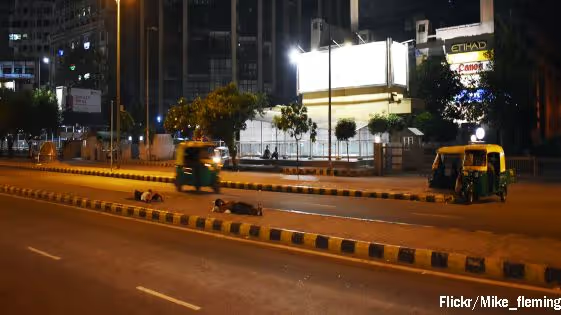
कोविड-19 संकट ने शहरी गरीबों को कैसे प्रभावित किया है? एक फोन सर्वेक्षण के निष्कर्ष-III
हालांकि भारत में कोविड-19 की दूसरी लहर के सार्वजनिक स्वास्थ्य पर विनाशकारी प्रभाव को सभी जानते हैं परंतु इसके आर्थिक और मनोवैज्ञानिक आयामों पर अपेक्षाकृत कम साक्ष्य उपलब्ध है। दिल्ली के औद्योगिक समूहों में सर्वेक्षण के आधार पर अफरीदी और अन्य ने गरीबों, अनौपचारिक श्रमिकों की आजीविका एवं मानसिक स्वास्थ्य पर महामारी के आज तक के विभिन्न चरणों के गतिशील प्रभावों की जांच की तथा महिलाओं और पुरुषों के अनुभवों की तुलना की है।
How has the Covid-19 crisis affected the urban poor? Findings from a phone survey - III
While the devastating impact of the second Covid-19 on public health in India is well-known, there is relatively little evidence on its economic and psychological dimensions. Based on surveys in industrial clusters of Delhi, Afridi et al. examine the dynamic effects of the different phases of the pandemic, on livelihoods and mental health of poor, informal workers – and how the experiences of women and men compare.

कोविड-19 संकट ने शहरी गरीबों को कैसे प्रभावित किया है? फोन सर्वेक्षण के निष्कर्ष - II
हालांकि कई टिप्पणीकारों ने चल रहे कोविड-19 संकट के कारण प्रवासियों की दुर्दशा को उजागर किया है, परंतु शहरी झुग्गी-झोंपडी बस्तियों में रह रहे कम आय वाले परिवारों के बारे में कम ही ज्ञात है। अफरीदी, ढिल्लों एवं रॉय ने 24 मार्च को कोविड लॉकडाउन की घोषणा के बाद दिल्ली के औद्योगिक क्षेत्रों में परिवारों के यादृच्छिक प्रतिदर्श के बीच, उनकी आजीविका और शारीरिक एवं भावनात्मक कल्याण पर प्रभाव का आकलन करने के लिए 3 अप्रैल को फोन-सर्वेक्षण करना शुरू किया। हाल ही के अपने नोट में, शोधकर्ताओं ने लॉकडाउन की प्रारंभिक, अधिक कठोर अवधि (3 से 19 अप्रैल) के निष्कर्षों पर चर्चा की। इस अनुवर्ती नोट में, वे प्रतिबंधों में कुछ रियायतों के साथ लागू लॉकडाउन के दूसरे चरण (20 अप्रैल से 3 मई) के निष्कर्षों की रिपोर्ट करते हैं।
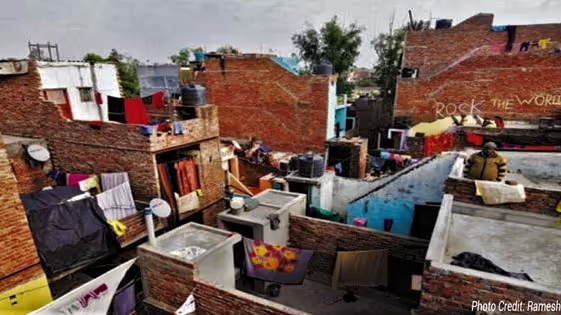
कोविड-19 संकट ने शहरी गरीबों को कैसे प्रभावित किया है? - फोन सर्वेक्षण के निष्कर्ष - I
यद्यपि कई टिप्पणीकारों ने वर्तमान कोविड-19 संकट के कारण प्रवासियों की दुर्दशा पर प्रकाश डाला है, परंतु शहरी झुग्गी झोंपडी बस्तियों में रह रहे कम आय वाले परिवारों के बारे में बहुत कम ज्ञात है। इस नोट में, अफरीदी, ढिल्लों एवं रॉय ने दिल्ली के औद्योगिक क्षेत्रों में 413 परिवारों के नमूनों के आधार पर उनकी आजीविका, एवं शारीरिक और भावनात्मक कल्याण पर प्रभाव के संबंध में फोन सर्वेक्षण द्वारा प्राप्त निष्कर्षों पर चर्चा की है। वे इस संकट के लिंग आधारित अनुभव में भी कुछ अंतर्दृष्टि प्रदान करती हैं।
How has Covid-19 crisis affected urban poor? Findings from a phone survey - II
While several commentators have highlighted the plight of migrants due to the ongoing Covid-19 crisis, less is known about how low-income families living in urban shanty towns are faring. Afridi et al. began conducting a phone survey on 3 April – after the Covid lockdown was announced on 24 March – among a sample of households in the industrial areas of Delhi, to assess the impact on their livelihoods, and physical and emotional well-being. In their recent note, the researchers discussed findings from the initial, more stringent period of the lockdown (3-19 April). In this follow-up note, they report findings from Phase 2 of the lockdown, following some easing of restrictions (20 April-3 May).
How has Covid-19 crisis affected the urban poor? Findings from a phone survey - I
While several commentators have highlighted the plight of migrants due to the ongoing Covid-19 crisis, less is known about how low-income families living in urban shanty towns are faring. In this note, Afridi et al. discuss findings from a phone survey of a sample of 413 households in the industrial areas of Delhi, on the impact on their livelihoods, and physical and emotional well-being. They also provide some insights into the gendered experience of this crisis.