
.svg)
.svg)
%201.svg)
%201.svg)
.svg)

.svg)
.svg)
Ashok Kotwal
Ashok Kotwal served as the Editor-in-Chief of Ideas for India from 2012 to 2022.
He was Professor Emeritus of Economics at the University of British Columbia in Vancouver, Canada. He served as the Head of the Department from 1995-2000 and as the Director, Centre for India and South Asia Research at the University of British Columbia from 2003 to 2008. His research has focused on development issues such as the process of poverty decline, labour and credit markets in developing countries, the role of agriculture in development, the role of international trade, and rural governance. More recently, he had been engaged in the study of poverty alleviation schemes such as Public Distribution System and MNREGA (Employment Guarantee Act).
.svg)

कृषि कानून: गतिरोध का समाधान
हाल ही में इंडियन एक्सप्रेस के एक लेख में भरत रामास्वामी ने किसानों के विरोध से उत्पन्न मौजूदा संकट को हल करने के लिए कुछ उत्तेजक सुझाव पेश किए हैं। इस पोस्ट में रामास्वामी ने अशोक कोटवाल (प्रधान संपादक, आइडियाज फॉर इंडिया) के साथ एक साक्षात्कार में उन विचारों पर विस्तार से प्रकाश डाला है।


Farm laws: Resolving the deadlock
In a recent Indian Express article, Bharat Ramaswami has proposed some rather provocative suggestions on how the present crisis triggered by the farmers’ protests can be resolved. In this post, Ramaswami elaborates on those views in an interview with Ashok Kotwal (Editor-in-Chief, Ideas for India)
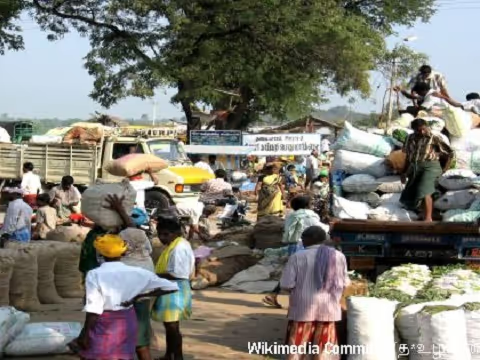
ई-संगोष्ठी का परिचय: नए कृषि कानून को समझना
क्या कृषि कानून किसानों की आय बढ़ाने में मदद करेंगे? क्या किसानों को बाजारों तक विस्तारित पहुंच से लाभ मिल सकता है? क्या वे कॉन्ट्रैक्ट फार्मिंग के कानून के कारण शहरी फर्मों के साथ अनुबंध स्थापित करने के लिए अधिक इच्छुक होंगे? क्या आवश्यक वस्तु अधिनियम में परिवर्तन से जल्दी खराब होने वाली वस्तुओं की मजबूरन बिक्री में कमी लाने में मदद मिलेगी? या सुधार का परिणाम केवल तब मिलेगा जब कुछ आवश्यक बुनियादी ढांचों का निर्माण हो जाएगा? क्या ये विधेयक कृषि में विविधता लाने में मदद करेंगे? आइडियास फॉर इंडिया के हिन्दी अनुभाग पर अगली छह पोस्टों में चलने वाली इस संगोष्ठी में छह विशेषज्ञ (भरत रामास्वामी, सुखपाल सिंह, संजय कौल, सिराज हुसैन, मेखला कृष्णमूर्ति तथा शोमित्रो चटर्जी) इन मुद्दों पर अपना दृष्टिकोण व्यक्त करेंगे।
Introduction to e-Symposium: Understanding the new farm laws
Would the farm laws help increase farmers’ incomes? Could farmers benefit from an expanded access to markets? Would they be more willing to engage in contracts with urban firms because of the law on contract farming? Would the changes in the Essential Commodites Act help to reduce distress sales for perishable commodities? Or, would the reform bear fruit only after some essential infrastructure is built? Would these laws help in diversifying agriculture?
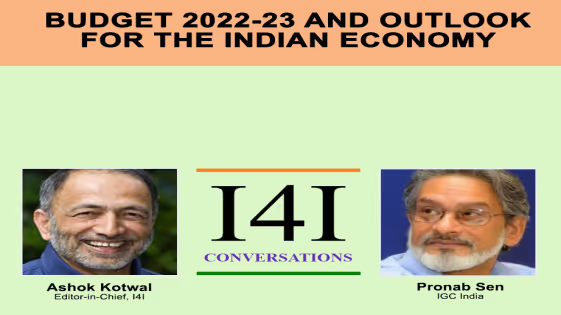
Budget 2022-23 and outlook for the Indian economy
Several commentators have lauded the recently presented Budget 2022-23 as a ‘growth budget’, on account of the large allocations made for capital expenditure on public infrastructure. On the other hand, concerns have been expressed about the Budget’s potential to create jobs for the masses, allay inflation worries, and strengthen social sectors such as health and education. Should we be optimistic or cautious? In this edition of I4I Conversations, Ashok Kotwal (Editor-in-Chief, Ideas for India) speaks with Pronab Sen (IGC India) to dissect the various policies and proposals in the Budget, and deliberate on the outlook for the Indian Economy. Dr Sen explains that the rhetoric around the Budget is mixing up accounting and economic classifications in the context of the announcement of 35% increase in public capex, why we cannot think of infrastructure as a homogenous activity in terms of the intensity of employment generation, how the support for MSMEs may be cherry-picking the units...
Budget 2022-23 and outlook for the Indian economy
Several commentators have lauded the recently presented Budget 2022-23 as a ‘growth budget’, on account of the large allocations made for capital expenditure on public infrastructure. On the other hand, concerns have been expressed about the Budget’s potential to create jobs for the masses, allay inflation worries, and strengthen social sectors such as health and education. Should we be optimistic or cautious? In this edition of I4I Conversations, Ashok Kotwal (Editor-in-Chief, Ideas for India) speaks with Pronab Sen (IGC India) to dissect the various policies and proposals in the Budget, and deliberate on the outlook for the Indian Economy. Dr Sen explains that the rhetoric around the Budget is mixing up accounting and economic classifications in the context of the announcement of 35% increase in public capex, why we cannot think of infrastructure as a homogenous activity in terms of the intensity of employment generation, how the support for MSMEs may be cherry-picking the units ...
State of the Indian economy: Diagnosis and recommendations
Arvind Subramanian (India’s former Chief Economic Adviser) and Josh Felman (former IMF Resident Representative to India) have brought out a new policy paper, offering a diagnosis of the Indian economy and recommendations for the forthcoming budget. In this post, Ashok Kotwal (I4I Editor-in-Chief) highlights key takeaways from their paper. Over the next few days, I4I will present a series of comments by eminent economists on this analysis.
What would make India’s growth sustainable?
Much of the discussion on the economic slowdown in India in recent years – as well as on the government’s measures to tackle the present economic crisis due to the Covid-19 lockdown – is focused on the supply side. In this post, Ghatak, Kotwal, and Ramaswami emphasise the demand channel, and argue that this is the fate of any growth episode that is not inclusive.

Webinar video: The new Coronavirus and the Indian economy
The global pandemic has created a terrible trade-off for every country between an economic crisis caused by a shutdown of the economic activity and a health crisis and fatalities as the healthcare system gets overwhelmed. The burden of the economic hardship is unbearably heavy on the poor. This is especially so in India where a significant part of the population live hand to mouth.
Covid-19: Ashok Kotwal speaks with Pronab Sen
In conversation with Ashok Kotwal on the ongoing economic crisis caused by lockdown to mitigate Covid-19 spread, Pronab Sen breaks down the problem into survival of individuals and livelihoods, and the survival of enterprises and the productive capacity of the economy. He contends that if enough is not done for the latter, the former will become very difficult to manage – once the pandemic begins to recede.

What should we do about the Indian economy? A wide-angled perspective - III
In the previous part of this series, Ashok Kotwal and Pronab Sen presented an export-led development strategy employed by successful Asian countries and why India failed on this front. In this part, they trace the genesis of the present economic slowdown.
What should we do about the Indian economy? A wide-angled perspective - IV
In the previous part of this series, Ashok Kotwal and Pronab Sen traced the genesis of the present economic slowdown. In this part, they discuss the way forward to arrest the slowdown. They suggest a rural-led growth strategy, which would deliver slower overall growth but will have a bigger positive impact under the present circumstances. They argue that a rural-led strategy may also circumvent some of the obstacles that are presently preventing India from implementing the template followed by successful Asian countries.
What should we do about the Indian economy? A wide-angled perspective - II
In the previous part of this series, Ashok Kotwal and Pronab Sen described the generic process of development in a dual economy. In this part, they present the strategies employed by successful Asian countries that led to a total structural transformation of their economies. They further explain the unique problems that make India’s progress on this front difficult.
I4I Event: Panel Discussion on financing development in India
‘Ideas for India’ is hosting a panel discussion on ‘Financing development in India’ on Monday, 9 September 2019, at Desire Hall, Le Méridien Hotel, New Delhi at 6:30pm. The panellists are Prachi Mishra (Goldman Sachs), Andy Mukherjee (Bloomberg), and Ananth Narayan (SP Jain Institute of Management and Research). The discussion will be moderated by Pronab Sen (IGC India), and feature reflections from Minouche Shafik, Director, London School of Economics. In this post, Ashok Kotwal (Editor-in-Chief, I4I) outlines the key issues for deliberation.
GST Explainer: Introduction
Seventeen years after its framework was formed, India’s biggest tax reform – the goods and services tax – was rolled out on 1 July 2017. Some consider the ‘one nation, one tax’ system to be a game changer; some are opposed to it; almost everyone has questions around its working and how it affects them. This explainer seeks to demystify the GST.
The challenge of job creation
The process of economic transformation that entails labour transitioning from low- to high-productivity activities, been much slower in India than in other Asian countries like China. Why is this so and what can be done to generate more productive jobs in India or make existing jobs more productive, faster? In this editorial, Ashok Kotwal discusses the challenge of job creation in the Indian economy.
For the New Year
Five months ago we launched this portal to start new conversations on issues of vital importance for Indian growth and development. We had hoped that by making serious research accessible to lay people we could help elevate the level of public debate. The time has come to assess our progress – where have we succeeded, where are we lacking and should we alter our course to achieve our goals.
A new voice
It is with some trepidation, but with huge excitement, that I present to you Ideas for India – a new voice in the cacophony of conversations on Indian growth and development. Hopefully, this will be a voice that will clarify rather than obscure, a distinct voice that will grow on you, a voice that you would want to hear first thing every morning.
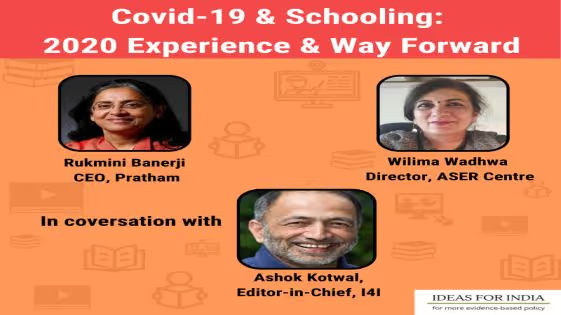
Covid-19 and schooling: 2020 experience and way forward
The onset of the Covid-19 pandemic brought with it significant challenges for the education sector. On the one hand, closing schools meant imposing a heavy cost on a whole generation of students, and on the other hand, keeping schools open was a health hazard. India and several other developing countries – reluctantly at first – adopted online teaching. However, this was riddled with problems given the weak access to digital connectivity and devices. So how was the schooling experience in 2020, and are there any lessons for the future? To explore these crucial questions, I4I Editor-in-Chief Ashok Kotwal speaks with Rukmini Banerji (CEO of Pratham; India’s largest education non-profit) and Wilima Wadhwa (Director, Annual Status of Education Report (ASER) Centre). Banerji and Wadhwa discuss the mechanics of the ASER 2020 phone survey; availability of educational materials and learning activities in rural homes; how families, communities, and schools came together to keep up children’s le
Introduction to e-Symposium: Ideas for reforms in education policy in India
A New Education Policy is being formulated in India based on a time-bound grassroots consultative process. As a contribution to the discussions, Rukmini Banerji of the education NGO Pratham and Ashok Kotwal, Editor-in-Chief, I4I, are hosting an e-symposium on ideas for reforms in education policy. Over the next few days, the e-symposium will bring together key findings from recent research in education and experience-based insights by stakeholders from academia and civil society.

Debate: The Aadhaar Bill
In a debate on the Aadhaar Bill, commentators from academia and civil society will weigh in on issues around potential benefits and privacy concerns.
Response to the Bhagwati-Panagariya rejoinder on MNREGA
In a recent article, Abreu et al. refuted the Bhagwati-Panagariya argument for phasing out MNREGA in favour of cash transfers. In this article, Abreu et al. respond to claims in a rejoinder by Bhagwati-Panagariya, regarding net benefits of MNREGA employment, the self-selection feature of the programme, and rural asset creation.

The challenge of fulfilling aspirations
This year’s election is a watershed in Indian history. This editorial discusses possible reasons for the stunning defeat of the previous government. While there is no denying that the previous government could be faulted for many things including creating a leadership vacuum and letting corruption go unchecked, the knockout blow came from its inability to reform the institutions that are responsible for fulfilling legitimate aspirations of the masses. What should the central government do?
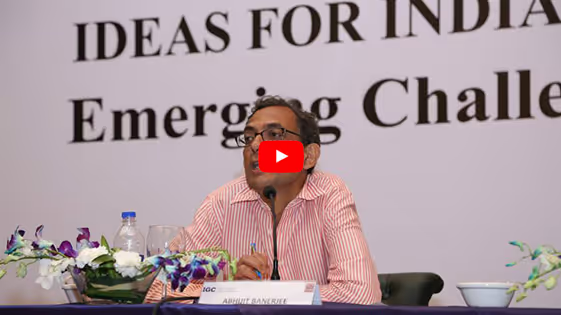
Emerging challenges: Economic and social
To mark the second anniversary of I4I in July 2014, we invited two eminent scholars – Abhijit Banerjee (MIT) and Mukul Kesavan (Jamia Milia) to discuss the emerging economic and social challenges in India, post the recent Parliamentary election. The discussion was moderated by Ashok Kotwal (Editor-in-Chief, Ideas for India). Take a look at a ‘highlights’ video of the discussion here!
Some reflections on the National Food Security Act
The Food Security Bill became an Act with little parliamentary opposition. Yet the public debate has lingered. Would subsidised food grains reduce malnutrition? Won’t it be better to invest in health and education instead? Can we afford the cost of subsidising food for such a large chunk of the population? Should we continue to waste money on the flawed PDS system? How will the grain markets be affected? This column offers a perspective on these important questions.
A suggestion for WTO negotiations
India’s new food security law is likely to breach WTO’s limit on farmer support. India is keen to ask for a temporary exemption from the rule so that the law can be implemented unhindered. But, in return, it may have to agree on trade facilitation. This article argues that while our food procurement policies do need reform, there is no link between the food security law and free trade.
Doing a number on the Food Security Bill
In a recent article, Kotwal, Murugkar and Ramaswami pointed out errors in estimation by Surjit Bhalla that led him to assert that the Food Security Bill will increase cost of food subsidy by 336%, and presented correct costs of the Bill. Bhalla then defended his methodology and calculations and criticised the authors’ arguments. This article responds to Bhalla’s defence, and says that the astronomical estimates of the Bill are irrelevant.
Correct costs of the Food Security Bill
In a recent article, Surjit Bhalla has asserted that the Food Security Bill will increase costs of food grain subsidy by 336%. Correcting errors in his calculation brings this figure down to 18%. In this article, the authors explain the errors and present the correct cost figures of the Bill.
I4I turns 1!
It has been a year since the voice of ‘Ideas for India’ was first heard. Our mission was to be an outlet for evidence-based arguments on a wide set of issues relevant to Indian growth and development. We had hoped then that this would be a voice that would clarify rather than obscure, a distinct voice that would grow on you. Have our hopes been realised? That is for the readers to judge. We in the Editorial Board feel that this has been an exhilarating ride so far.
Food Bill: Neither populist nor unaffordable
Criticism of the National Food Security Bill has led to the government dropping the idea of issuing an Ordinance and instead, saying it would try to get the Bill passed in a special session of Parliament. This article addresses some of the key questions raised by critics of the Bill.
The impacts of linking NREGA payments to UID. A Study of Maharashtra
This project attempts to measure the impact of Universal Identification (UID)-linked wage payments on corruption in public works projects funded under MNREGA (National Rural Employment Guarantee Act).
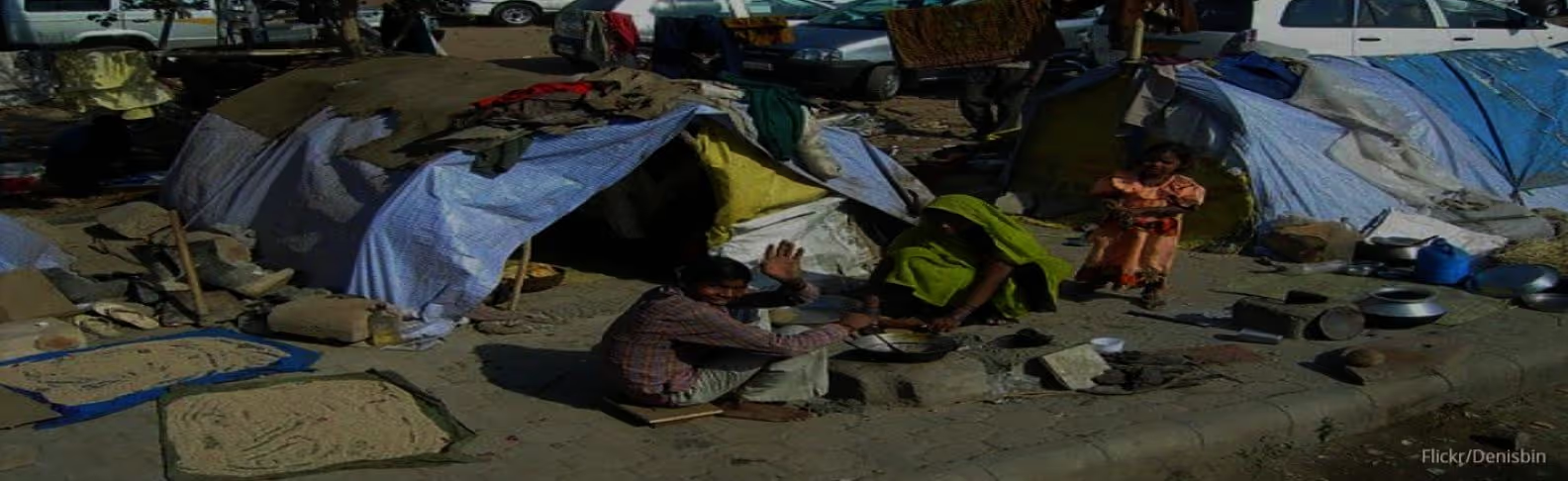
विचार-गोष्ठी की प्रस्तावना: कांग्रेस के 'न्याय' का विश्लेषण
जारी संसदीय चुनाव में कांग्रेस पार्टी के घोषणापत्र में की गई एक बड़ी घोषणा न्यूनतम आय की गारंटी के प्रस्ताव – न्यूनतम आय योजना (न्याय) की है। इस विचार गोष्ठी में भरत रामास्वामी (अशोका विश्वविद्यालय), ज्यां द्रेज (रांची विश्वविद्यालय), प्रनब बर्धन (कैलिफोर्निया विश्वविद्यालय, बर्कली), एस. सुब्रामनियन (इंडियन काउंसिल ऑफ सोशल साइंस रिसर्च), अश्विनी कुलकर्णी (प्रगति अभियान), कार्तिक मुरलीधरन (कैलिफोर्निया विश्वविद्यालय, सैन डीएगो), प्रनब सेन (इंटरनेशनल ग्रोथ सेंटर), निरंजन राजाध्यक्ष (आइडीएफसी इंस्टिट्यूट), और मैत्रीश घटक (लंदन स्कूल ऑफ इकनॉमिक्स) इस योजना से संबंधित मुख्य मुद्दों की जांच-परख कर रहे हैं।
Introduction to e-Symposium: Decoding Congress’ NYAY
A major announcement in the Congress manifesto, in the ongoing parliamentary election, is the minimum income guarantee proposal – Nyuntam Aay Yojana (NYAY). In this symposium, Bharat Ramaswami (Ashoka University), Jean Drèze (Ranchi University), Pranab Bardhan (University of California, Berkeley), S. Subramanian (Indian Council of Social Science Research), Ashwini Kulkarni (Pragati Abhiyan), Karthik Muralidharan (University of California, San Diego), Pronab Sen (International Growth Center), Niranjan Rajadhyaksha (IDFC Institute), and Maitreesh Ghatak (London School of Economics), weigh in on key issues pertaining to the scheme.

Aadhaar that doesn’t exclude
Aadhaar is in the news today partly because of security concerns and partly because of reports that the poor are unable to receive PDS rations because of failures in Aadhaar authentication. In this article, Kotwal and Ramaswami focus on the latter with an eye to look for ways to bring down the exclusion errors.
A symposium on Piketty: Introduction
Thomas Piketty’s book on ´Capital in the Twenty First Century’ has made waves. The fact that a 700-odd page tome full of numbers and graphs can become an international bestseller is itself noteworthy. It may be a testament to the concern that people have over the growing inequality within developed countries. What is startling is its claim that the developed world may be gravitating to the pattern of wealth distribution based on inheritance that characterised the pre-modern world. The contribution this book has made in putting together historical data that clearly indicate the trend of growing inequality is truly monumental.
(Mis)Leading attack on MNREGA
Bhagwati and Panagariya have argued for phasing out MNREGA in favour of cash transfers. In this article, Abreu et al. contend that the argument is based on inflating the costs of the programme and deflating the benefits. While they do not claim that all is well with MNREGA, they believe it needs better governance, not slow suffocation.
What explains the steep poverty decline in India from 2004 to 2011?
Ashok Kotwal, Editor-in-Chief, Ideas for India, interviews Pronab Sen on the recent poverty figures that show a steep decline in poverty in India between 2004 and 2011. According to him, the shift in terms of trade in favour of agriculture and higher rural wages accelerated the trickle down of the fast economic growth to the poor.
Why is poverty declining so slowly in India?
Despite two decades of fast growth of per capita GDP, India has experienced a very slow decline in poverty. The column suggests that this disconnect between GDP growth and poverty decline can largely be attributed to the positive feedback emanating from a skill biased growth pattern.

Protectionism under the guise of food security
India has backed out of the commitment it made at the WTO negotiations in Bali in November 2013. The implicit explanation is that the government needs to accumulate food grain stocks to provide subsidised grain to the poor and ensure food security. In this article, Kotwal, Murugkar and Ramaswami critique this reasoning and India’s position on the issue.
Bali conundrum: WTO and Indian agriculture
The outcome of the recent WTO meetings at Bali is a stopgap arrangement, which implies that the Indian government does not have to make any changes in the implementation of the new Food Security Act in the near future. In this article, the authors suggest disentangling consumer support and producer support via cash transfers so that India can build a safety net for its poor without violating WTO agreements.
Farewell to Nalini!
I4I Editor-in-Chief Ashok Kotwal pens a farewell note for outgoing Managing Editor Nalini Gulati.
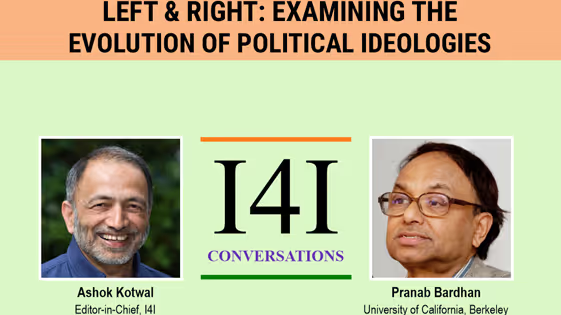
Left and right: Examining the evolution of political ideologies
With the advent of globalisation, the struggle between the ‘left’ and ‘right’ – as defined in Marxian terms – rapidly evolved from one between economic ideologies, to cultural wars. In this context, I4I Editor-in-Chief Ashok Kotwal engages in a deep-dive with Prof. Pranab Bardhan (University of California, Berkeley) on issues ranging from growing resentment towards educated elite, shifts in the form of capital and employment patterns, role of communities, to emergence of illiberal political movements, and the different types of nationalism and populism. This is the first edition of I4I’s new feature “Conversations”, which would present in-depth discussions with experts on ‘big picture’ or futuristic topics.
Left and right: Examining the evolution of political ideologies
With the advent of globalisation, the struggle between the ‘left’ and ‘right’ – as defined in Marxian terms – rapidly evolved from one between economic ideologies, to cultural wars. In this context, I4I Editor-in-Chief Ashok Kotwal engages in a deep-dive with Prof. Pranab Bardhan (University of California, Berkeley) on issues ranging from growing resentment towards educated elite, shifts in the form of capital and employment patterns, role of communities, to emergence of illiberal political movements, and the different types of nationalism and populism. This is the first edition of I4I’s new feature “Conversations”, which would present in-depth discussions with experts on ‘big picture’ or futuristic topics.
I4I at 10: Zooming over the last nine years, and looking ahead
As ‘Ideas for India’ enters its 10th year, Editor-in-Chief Ashok Kotwal reflects on its growth as a credible, ideologically neutral, and accessible platform for evidence-based policy analysis, and presents the vision for the future.
I4I के 2020 के हाइलाइट: प्रधान संपादक की टिप्पणी
अब जब हम वर्ष 2021 में प्रवेश कर रहे हैं, प्रधान संपादक अशोक कोटवाल पीछे मुड़ कर देखते हैं कि पिछला वर्ष कितना अभूतपूर्व और महत्त्वपूर्ण रहा है। साथ ही उन्होंने आइडियास फॉर इंडिया के 2020 के मुख्य हाइलाइट भी प्रस्तुत कर रहे हैं।
I4I 2020 highlights: Note from the Editor-in-Chief
As we near the end of 2020, Editor-in-chief Ashok Kotwal reflects on the unprecedented and momentous year that was, and presents key highlights from I4I.
I4I turns 7!
As I4I completes seven years, Editor-in-Chief Ashok Kotwal reflects on the achievements and challenges, and the vision going forward.
I4I Event: What is the way forward for the Indian economy?
On Tuesday, 18 December 2018, I4I is organising a Panel Discussion on ‘The Way forward for the Indian economy’, in Delhi. The panellists are K.P. Krishnan (Ministry of Skill Development and Entrepreneurship), T.N. Ninan (Business Standard), Ila Patnaik (NIPFP), and Sanjeev Sanyal (Ministry of Finance). In this post, Ashok Kotwal (Editor-in-Chief, I4I) – who will moderate the discussion – sets the context and lays out the key issues for deliberation.
Winner of Infosys Prize 2018 in Social Sciences: Sendhil Mullainathan
The Infosys Prize 2018 for Social Sciences has been awarded to Sendhil Mullainathan, Professor of Computation and Behavioral Science, University of Chicago, for his path-breaking work in behavioural economics. In this post, I4I Editor-in-Chief, Prof. Ashok Kotwal discusses the substantial impact of Mullainathan’s work on diverse fields such as development, public finance, corporate governance, and policy design – and relevance to India.
Winner of Infosys Prize 2018 in Social Sciences: Sendhil Mullainathan
The Infosys Prize 2018 for Social Sciences has been awarded to Sendhil Mullainathan, Professor of Computation and Behavioral Science, University of Chicago, for his path-breaking work in behavioural economics. In this post, I4I Editor-in-Chief, Prof. Ashok Kotwal discusses the substantial impact of Mullainathan’s work on diverse fields such as development, public finance, corporate governance, and policy design – and relevance to India.
Ashok Kotwal speaks with Jean Drèze
I4I Editor-in-Chief Ashok Kotwal speaks with Jean Drèze, visiting Professor at Ranchi University and an ‘economist-activist’ who has been working in India at the grassroots level for a long time. They discuss a range of issues including cash vs. in-kind transfers; combining academic research with on-the-ground action; improving governance; and the principles of a good society.
Introducing a new feature: – ‘Explainers’
Our day-to-day lives are tossed around due to economic changes, resulting sometimes from government policies and sometimes by unidentifiable forces of the world economy. Governments always label every policy change as a ‘reform’ there by signaling an improvement. But it isn’t always so. Often it generates winners and losers and we want to know who these are. Our wellbeing is also affected by the churning in the outside world such as artificial intelligence, automation, global warming, oil prices, and so on. We may not be able to control these forces but at least we would like to understand how they would affect us so that we can safeguard ourselves. Moreover, you – our readers – would not be reading I4I if you were not intellectually curious. With this in mind, we are starting a new feature ‘Explainers’.
Humanising economics
In a tribute to Richard Thaler, recipient of this year’s Nobel Prize in Economics, Ashok Kotwal and Nalini Gulati discuss his pioneering work on decision-making that lies in the space between economics and psychology.
The perplexing case of Gujarat
The common perception is that Gujarat has performed a lot better than the rest of India in terms of development, particularly in the past decade. This column analyses data recently compiled by the Raghuram Rajan Committee and finds that while Gujarat has been among the top performing states in terms of output growth; the fast growth has not translated into meaningful development in the state.
I4I Panel Discussion: A conversation on Indian Development
To celebrate the first birthday of I4I, we invited eminent economists Abhijit Banerjee and Raghuram Rajan to have a conversation about vital issues in Indian development.
On ideology
In recent debates over issues such as the National Food Security Bill or the use of the Unique Identification, we seem to find people with similar values in opposing ideological camps. This editorial seeks to understand why that might be, and argues that we should steer clear of misidentifying the mechanics of achieving certain goals as fundamental ideological differences.