
.svg)
.svg)
%201.svg)
%201.svg)
.svg)

.svg)
.svg)
Britta Augsburg

Britta Augsburg is Associate Director of the Institute for Fiscal Studies. Her research concentrates on understanding the effectiveness of programmes and policies that tackle constraints to productivity of poverty affected individuals and households, with a particular focus on credit and technology adoption constraints. She has worked on a number of studies related to microfinance and particularly the effectiveness of this financial tool in achieving improved outcomes for the intended beneficiaries. Analysing the effectiveness of microfinance in inducing uptake of sanitation technology (basically toilets) has focused a significant amount of her research towards the field of sanitation, researching constraints to uptake both on the demand and the supply side, as well as understanding the complementarity of sanitation and other investments in producing positive (child) outcomes.
.svg)


To invest in sanitation or not? The role of gender differences in perceptions
Although sanitation is essential for health, many households remain without a toilet due to financial constraints. This article describes the extent to which perceptions of costs and benefits of sanitation investments vary by gender and within the household. It demonstrates how these intra-household gender differences impact the success of a sanitation microcredit intervention in Maharashtra. Impacts of these differences on intervention success are largely concentrated in households where the woman is involved in the decision-making process.


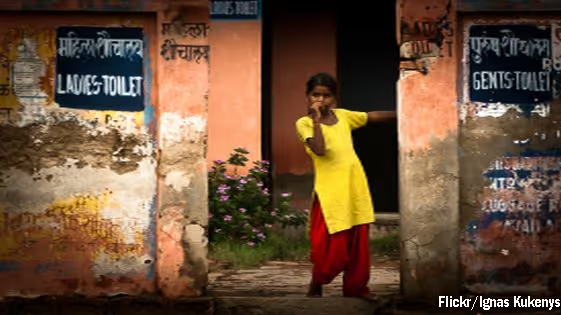
शौचालय नहीं तो दुल्हन नहीं: भारत में पुरुषों का शौचालय स्वामित्व और उनकी शादी की संभावनाएं
निरंतर किये जा रहे अनुसंधान से पता चलता है कि परिवारों के लिए स्वच्छता निवेश में लागत एक प्रमुख बाधा रही है। मध्य-प्रदेश और तमिलनाडु में किये गए एक सर्वेक्षण के आधार पर, यह लेख दर्शाता है कि वित्तीय और स्वास्थ्य-संबंधी विचारों के अलावा, घर में शौचालयों का निर्माण करने के बारे में परिवारों का निर्णय इस विश्वास से प्रभावित होता है कि खुद का शौचालय होने से उनके लड़कों के लिए अच्छे जीवन-साथी खोजने की संभावनाओं में सुधार होता है।

Incentivising quality of public infrastructure: Does it work?
Community toilets in slums are often poorly maintained, and upgrading facilities is difficult due to low willingness-to-pay among potential users and ‘free riding’. Based on an experiment in Uttar Pradesh, this article examines the impact of one-time facility upgrade and cash incentives to caretakers. While there are improvements in the quality of facilities and reduced free-riding, more residents practise open defecation, with poor public health outcomes.

Covid-19: Debunking fake news among slum-dwellers
Urban slum-dwellers are among the groups that are most at-risk of Covid-19, and their precarious situation is further compounded by rampant misinformation regarding the Virus. Based on a survey of about 4,000 households in slum areas in Uttar Pradesh, this article shows that recorded phone messages from doctors giving information on Covid-19 – along with high financial incentives to pay attention – can debunk related fake news.

वर्गीकृत ऋण और स्वच्छता संबंधी निवेश
ग्रामीण भारतीय परिवार शौचालय बनवाने का खर्च वहन नहीं कर पाने को शौचालय नहीं बनवाने का मुख्य कारण बताते हैं। इस लेख में ग्रामीण महाराष्ट्र के एक प्रयोग के जरिए जांच की गई है कि स्वच्छता के लिए वर्गीकृत सूक्ष्मऋण (माइक्रोफाइनांस लेबल्ड फॉर सैनिटेशन) स्वच्छता में निवेश बढ़ा सकता है या नहीं। इसमें पाया गया कि लक्षित परिवारों ने स्वच्छता ऋणों की मांग की और शौचालय के उपयोग में 9 प्रतिशत अंकों की वृद्धि हुई। हालांकि मोटे तौर पर आधे ऋणों का उपयोग स्वच्छता के लिए नहीं किया गया।

Labelled loans and sanitation investments
Rural Indian households report lack of affordability as the main reason for not having a toilet. This article investigates – through an experiment in rural Maharashtra – whether microcredit labelled for sanitation can increase sanitation investments. It finds that targeted households demand the sanitation loans, and toilet uptake increases by 9 percentage points; however, roughly half of the loans were not used for sanitation
No toilet, no bride: Toilet ownership and marriage prospects of men in India
A growing body of research shows that costs are a key barrier to sanitation investments by households. Based on a survey in Madhya Pradesh and Tamil Nadu, this column finds that apart from financial and health considerations, the decision of households to acquire toilets is influenced by the belief that toilet ownership improves prospects of finding good marriage matches for sons.
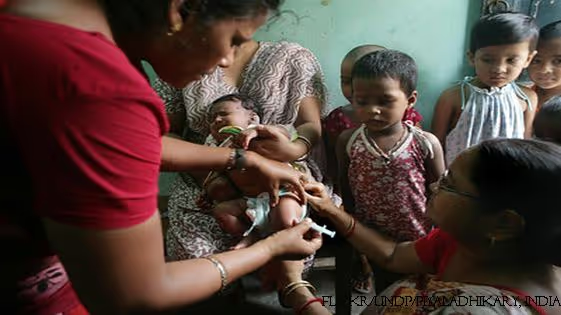
Covid-19: Willingness to vaccinate among slum-dwellers
Vaccination is among the success stories in modern-day medicine, and is seen by the WHO as a key element of the response to the Covid-19 pandemic. In this note, Augsburg et al. discuss findings from a survey of 4,000 slum dwellers in two cities of Uttar Pradesh, on their willingness to vaccinate and pay for it. They contend that, as billions are poured into a vaccine’s development and tackling supply difficulties, policymakers should also prepare for the next challenges: compliance and ability to pay.