
.svg)
.svg)
%201.svg)
%201.svg)
.svg)

.svg)
.svg)
Maitreesh Ghatak

Maitreesh Ghatak was educated at the Presidency College, University of Calcutta, Delhi School of Economics, and Harvard University, where he received his Ph.D. in 1996. He has been Professor of Economics at the London School of Economics since 2004, having earlier taught at the University of Chicago. He is the Editor-in-Chief of the Journal of Development Economics since 2009 and the Director of the research programme Economic Organization and Public Policy (EOPP) at STICERD, LSE since 2006. Earlier he was the Managing Editor of the Review of Economic Studies, and a Co-Editor of the Economics of Transition. He is currently a member of the Executive Committee of BREAD, and a Co-Editor of Economica. He is a founder member of the research networks Theoretical Research in Development (ThReD) and Non-Profits, Governments, and Organisations (NGO). His areas of research interest are development economics, economics of contracts and organisations, and public economics. Current projects include the role of market structure in microfinance, land acquisition and compensation for displaced farmers, non-profits and social enterprise, and incentives and organisation design in public service delivery.
.svg)


The crisis of farmer suicides
More than 15,000 Indian farmers have committed suicide per year, on average, in the last two decades – a suicide rate that appears to be higher than that of the general population. In this article, Maitreesh Ghatak emphasises the need to think of farmer suicides as a policy problem, rather than tragedy, and to deliberate on the causes and remedies.


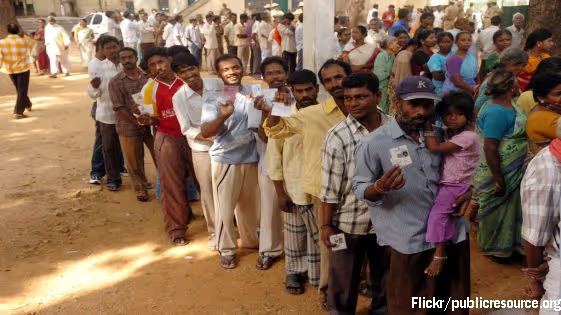
West Bengal’s economic performance relative to India over the last three decades
Against the backdrop of the ongoing elections in West Bengal, Maitreesh Ghatak examines how the state’s economic performance compares with that of the country as a whole, over the past three decades. He highlights that despite West Bengal’s lack of economic dynamism, its agricultural growth rate as well as the growth rate of consumption expenditure in its rural areas, that house 72% of the population, has been higher than the national average.

An assessment of policy performance under the current regime
Commenting on the recent policy paper by Subramanian-Felman, Maitreesh Ghatak discusses why – looking at the same numbers – he would tend to be less generous in his grades for the performance of policy initiatives under the current regime. Regarding the Covid-19 shock, Ghatak contends that to the extent there is a policy trade-off between lives and livelihoods, one wonders why India does not score highly on either – whether it is “hardware problems” or “software” glitches in policy design and implementation.
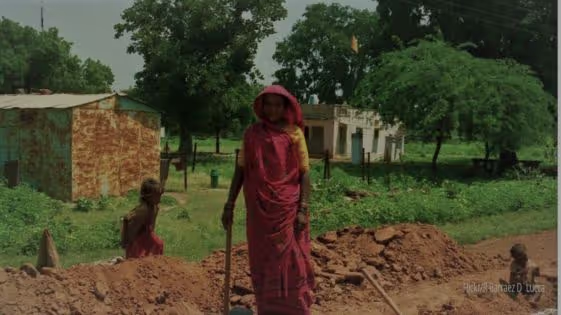
What would make India’s growth sustainable?
Much of the discussion on the economic slowdown in India in recent years – as well as on the government’s measures to tackle the present economic crisis due to the Covid-19 lockdown – is focused on the supply side. In this post, Ghatak, Kotwal, and Ramaswami emphasise the demand channel, and argue that this is the fate of any growth episode that is not inclusive.
Union Budget 2018: Unpleasant arithmetic and the art of the possible
In this article, Maitreesh Ghatak contends that while the Union Budget 2018-19 deserves some praise for signalling priorities given the constraints, it disappoints in terms of its vision of reforms.
The dangers that lie beneath India's IT layoffs
The ongoing layoffs in India’s IT sector are at a scale that has not been seen since the global financial crisis of 2008. In this article, Maitreesh Ghatak, Professor of Economics at LSE, contends that while this is a major shock, the country’s demographic dividend, and global trends such as automation, demand an economic strategy that prioritises job creation more broadly.
Nobel prize in Economics 2016: The economy as a nexus of contracts
An important line of research in microeconomics has tried to explain how the economic institutions that underpin the ‘invisible hand of the market’ actually work. The specific economic institution that Hart and Holmström focus on is contracts. In a tribute to the Nobel laureates, Maitreesh Ghatak, Professor of Economics at the London School of Economics, discusses the working and importance of contract theory.
Fixit, not Brexit
In a referendum on 23 June, Britain voted for its exit from the European Union. In this article, Maitreesh Ghatak, Professor of Economics, London School of Economics, discusses the causes and likely consequences.
Union Budget 2016: A UPA-III Budget
In this article, Maitreesh Ghatak, Professor of Economics at the London School of Economics, contends that the Modi government presented a reasonably good United Progressive Alliance (UPA)-III Budget that tinkers at the margin. However, in his view, minor tweaks may not suffice in the current growth scenario.
Land acquisition Act: Addressing both justice and prosperity
The Modi government’s land acquisition ordinance did away with the consent and social impact assessment requirements for private projects in certain sectors under UPA’s 2013 land Act. In this article, Ghatak and Ghosh contend that in seeking to eliminate these hurdles, the ordinance puts more weight on prosperity and less on justice. In their view, justice and prosperity need not be irreconcilable objectives.
Land acquisition debate: The price is not right
The central government’s move to amend the 2013 land acquisition Act has come under criticism for being ‘anti-farmer’. In this article, Maitreesh Ghatak and Parikshit Ghosh argue that while the amendments would streamline the land acquisition process, the law will still be fatally flawed unless a more rational method of determining compensation for land owners is put in place.
From 'Mess in India' to Made in India' as a global brand?
PM Modi recently launched the ‘Make in India’ campaign to attract investment and boost manufacturing. In this article, Maitreesh Ghatak contrasts the campaign with the Chinese model of economic governance, and reflects on its potential to enable higher growth and poverty reduction.
The Land Acquisition Act is deeply flawed
In the second part of the Land Acquisition Act debate, Ghatak and Ghosh argue that the legislation is ill-conceived and falls short on several counts. They contend that the formula for compensation is arbitrary, and recommend holding large-scale land auctions to discover the true value of land. They contradict Pande’s point that the Act strikes a fine balance between industrialists and farmers.
Developing a Land Acquisition Policy for India
The Land Acquisition Bill is a key piece of legislation under consideration in the Indian Parliament. This column argues that the current policy on compensating landowners, as proposed in the Bill, is misguided and could adversely affect the pace and character of future growth in India. It draws lessons from economic theory as well as the failed land acquisition experience in Singur to propose a workable model for determining appropriate compensation for land acquisition.
Land acquisition: Is there a way out?
India is hungry for space to grow into a developed economy. Yet this hunger is increasingly raiding farmland and threatening traditional livelihoods. For some, this is a necessary evil, for others it is unjustified exploitation. This column argues that the debate need not be so stark and that politicians, policymakers and the public need to see that another way is possible.
Moving beyond the growth-versus-redistribution debate
The two dominant narratives on the state of the Indian economy – one centred on growth and the other on poverty – are in a constant state of conflict. In this article, Maitreesh Ghatak, Professor of Economics at the London School of Economics, argues that we need to move beyond the stale growth-versus-redistribution debate and focus on economic mobility through investments in human capital.
Improving Access to and Measuring the Impact of Public Health Insurance in India
This project aims to add to the broad literature on improving the quality of public services by looking at the effect of providing incentives to agents for spreading information regarding a government-funded health insurance programme on the level of programme knowledge and enrolment among beneficiaries.
Improving Access to and Measuring the Impact of Public Health Insurance in India
This project aims to add to the broad literature on improving the quality of public services by looking at the effect of providing incentives to agents for spreading information regarding a government-funded health insurance programme on the level of programme knowledge and enrolment among beneficiaries.
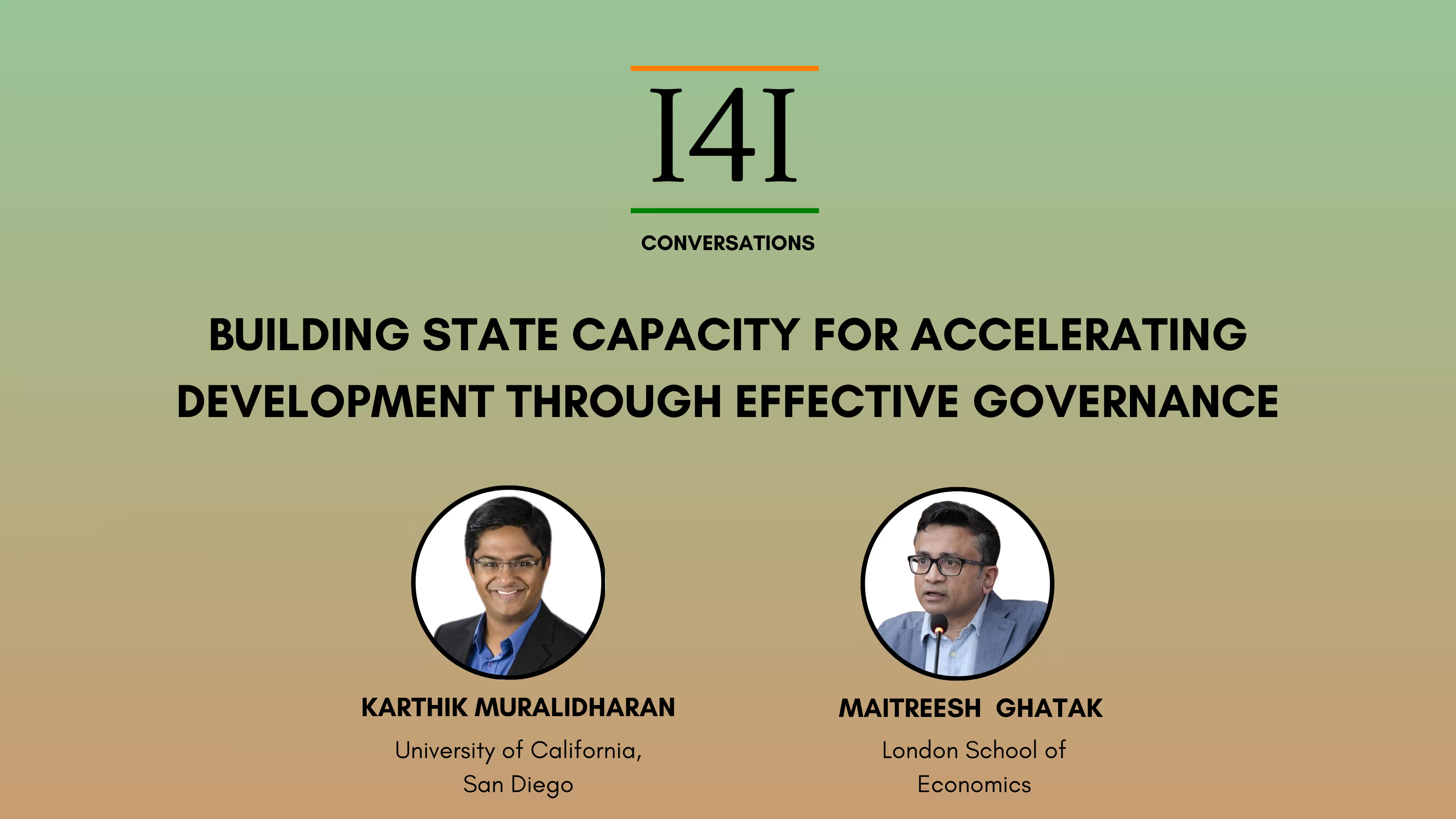
Building State capacity for accelerating development through effective governance
In a new edition of I4I conversations, Maitreesh Ghatak (London School of Economics) is joined by Karthik Muralidharan (University of California, San Diego) to discuss his new book, Accelerating India's Development: A State-Led Roadmap for Effective Governance.
Building State capacity for accelerating development through effective governance
In a new edition of I4I conversations, Maitreesh Ghatak (London School of Economics) is joined by Karthik Muralidharan (University of California, San Diego) to discuss his new book, Accelerating India's Development: A State-Led Roadmap for Effective Governance.
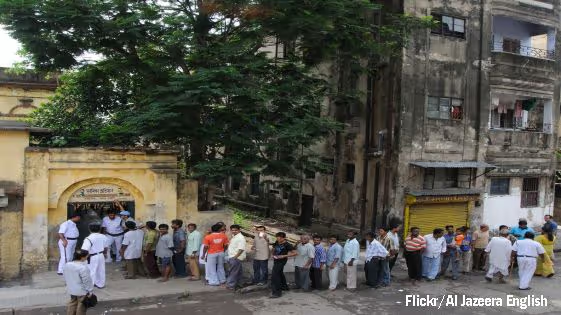
2021 पश्चिम बंगाल विधानसभा चुनाव: क्या कोविड-19 के बढ़ने से प्रभाव पड़ा?
पश्चिम बंगाल राज्य में हुए हाल के विधानसभा चुनावों में सत्तारूढ़ तृणमूल कांग्रेस विजयी हुई है। इस लेख में घटक और मैत्रा ने 2016, 2019, तथा 2021 के चुनावी आंकड़ों का उपयोग करते हुए, चुनाव लड़ने वाले दलों के वोट शेयरों में बदलाव – सत्ता-समर्थक और सत्ता-विरोधी लहरों के सापेक्ष संतुलन, लैंगिक और धार्मिक ध्रुवीकरण के पहलुओं के साथ-साथ कोविड-19 के बढ़ने से हुए प्रभाव का विश्लेषण किया है।
2021 West Bengal Assembly election: Did the Covid-19 surge matter?
In the recent Assembly elections in the state of West Bengal, the ruling Trinamool Congress bucked an anti-incumbency headwind to secure victory. Using electoral data from 2016, 2019, and 2021, Ghatak and Maitra analyse the change in vote shares of the contesting parties, examining the relative balance of pro- and anti-incumbency forces at work, aspects of gender and religious polarisation, as well as the impact of the Covid-19 surge.

Why 'free' speech is not always 'costless'
A recent CBI raid at the premises of the owners of NDTV has sparked off yet another round of debates about freedom of the media, the spectre of authoritarianism, and freedom of expression in India. In this article, Maitreesh Ghatak contends that confusion over what ‘free speech’ means stems from equating the two different senses in which it is used: free as in unconstrained, and free in the sense of not having a price or cost.
Free speech and the rule of law
In this article, Maitreesh Ghatak, Professor of Economics at the London School of Economics, argues that the fight over freedom of expression in India is a shadow fight; the real fight is about preserving the sanctity of our law-enforcement and judicial institutions to protect freedoms of any kind.
Surrogacy bill: Boon or ban(e)?
The Surrogacy (Regulation) Bill, 2016 proposes a complete ban on commercial surrogacy and restrictions on altruistic surrogacy. In this article, Maitreesh Ghatak, Professor of Economics, London School of Economics, contends that the bill does not provide any compelling argument for the ban. Rather, by singling out those who are not even allowed the option of altruistic surrogacy, it reveals its biases.
Bihar verdict: Development, cow politics, and caste
The Nitish Kumar-led Grand Alliance of JD(U)-RJD-Congress defeated the Modi-led NDA in the recent Bihar assembly elections. In this article, Maitreesh Ghatak, Professor of Economics at the London School of Economics, analyses the role of alternative models of development associated with the two leaders, divisive social issues, and caste-based politics in the verdict.
Response to the Bhagwati-Panagariya rejoinder on MNREGA
In a recent article, Abreu et al. refuted the Bhagwati-Panagariya argument for phasing out MNREGA in favour of cash transfers. In this article, Abreu et al. respond to claims in a rejoinder by Bhagwati-Panagariya, regarding net benefits of MNREGA employment, the self-selection feature of the programme, and rural asset creation.
Mirror, mirror on the wall, which is the most dynamic state of them all?
This column analyses the economic performance of 16 major Indian states over the last three decades. It finds that Bihar has improved the most during the 2000s, Kerala has always been a star performer in terms of HDI, Rajasthan has achieved the maximum decline in inequality, Tamil Nadu tops in poverty reduction, and the levels and growth rates of per capita income of Maharashtra and Gujarat have consistently been the highest. However, no one state can be singled out as the top performer in the 2000s. Moreover, while Gujarat’s overall record is undoubtedly very good all through the last three decades, its performance in the 2000s does not seem to justify the wild euphoria and exuberant optimism about Modi’s economic leadership. In particular, there is no evidence of any significant growth acceleration in Gujarat in the 2000s.
Cash Transfer versus In-Kind Transfers: A conceptual framework and preliminary evidence
This project studied the performance of a conditional cash transfer scheme called Mukhyamantri Cycle Yojana, which provides money to purchase a bicycle to every student who is enrolled in standard nine of a government-run/-aided school. The findings show that although the bicycle programme has performed well in terms of coverage rate, and in curtailing direct forms of corruption, a large majority of the beneficiaries stated their preference in favour of receiving the benefits in kind instead of cash.
Land Acquisition for Business and Compensation of Displaced Farmers
This project addresses the question of how farmers displaced by acquisition of agricultural land for the purpose of industrialisation ought to be compensated. Prior to acquisition, the farmers are leasing in land from a landlord, either a private owner or a local government.
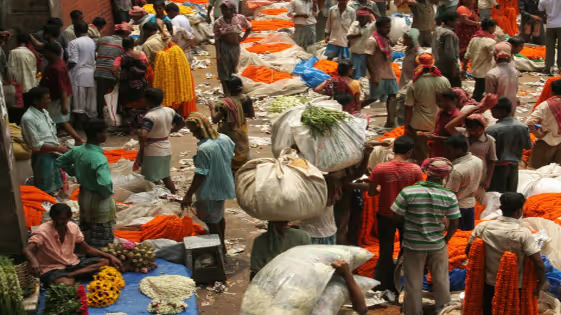
आज कितने भारतीय गरीब हैं?
वर्ष 2022-23 के पारिवारिक उपभोग व्यय सर्वेक्षण के तहत जारी एक तथ्य पत्रक के बाद भारत में गरीबी पर बहस फिर से शुरू हो गई है। इस लेख में घटक और कुमार उल्लेख करते हैं कि शोधकर्ताओं में आम सहमति है कि देश में अत्यधिक गरीबी 5% से कम है। घटक और कुमार इस बात का गहराई से अध्ययन करते हैं कि गरीबी रेखा का निर्धारण कैसे किया जाता है तथा निष्कर्ष निकालते हैं कि गरीबी रेखा की गणना के लिए आवश्यक विस्तृत आँकड़ों के अभाव में, अत्यधिक गरीबी के अनुमानों के बारे में संदेह बना रहेगा।
Determining how many Indians are poor today
Poverty debates in India have seen a revival since the release of a fact sheet from the 2022-23 household consumption expenditure survey. In this post, Ghatak and Kumar note that the general consensus among researchers is that extreme poverty is under 5%. However, they contest this by digging deeper into how the poverty line is determined and conclude that in the absence of detailed data necessary for calculation of an updated poverty line, doubts will remain about the estimates of extreme poverty
Introduction to e-Symposium: Estimation of poverty in India
Estimates of poverty in India put forth in two papers published earlier this year – by Bhalla, Bhasin and Virmani; and Roy and van der Weide – have sparked the “Great Indian Poverty Debate 2.0”. Across this week, from 3-8 October, this I4I e-Symposium brings together articles from the authors of the aforementioned papers, and commentaries from other contributors. They dissect the methodology employed by the two papers, and discuss the implications of the findings. Anchored by Maitreesh Ghatak, the e-Symposium aims to provide a nuanced view of the poverty estimates and what they truly say about the incidence and eradication of extreme poverty in India.

‘न्याय’ विचार-गोष्ठी: गरीबी के दीर्घकालिक समाधान के बजाय उपयोगी 'प्राथमिक उपचार'
लंदन स्कूल ऑफ इकनॉमिक्स के अर्थशास्त्र के प्रोफेसर मैत्रीश घटक का तर्क है कि न्याय द्वारा जिस तरह के नकद अंतरण के बारे में सोचा गया है, उससे जीवन निर्वाह के हाशिए पर जी रहे गरीब लोगों को कुछ राहत और सुरक्षा संजाल (सेफ्टी नेट) उपलब्ध होगा। हालांकि, यह स्पष्ट नहीं है कि यह लक्ष्यीकरण की समस्या से कैसे निपटेगा। इसके अलावा, यह गरीबी की समस्या का दीर्घकालिक समाधान नहीं है जिसके लिए स्वास्थ्य, शिक्षा और कौशल निर्माण सहित अन्य चीज़ों में निवेश ज़रूरी है।
NYAY e-Symposium: Not long-term solution to poverty but useful ‘first-aid’
Maitreesh Ghatak (Professor of Economics, London School of Economics) contends that a cash transfer, as envisaged by NYAY, will provide some relief and a safety net to the poor living on the margins of subsistence. However, it is not clear how it will deal with the problem of targeting. Moreover, it is not a long-term solution to the problem of poverty, which requires investment in health, education, and skill formation, among other things.
Can Rahul Gandhi’s minimum income guarantee proposal work?
Congress president Rahul Gandhi has promised a minimum income guarantee scheme for the poor if the party is voted to power in the upcoming elections. Discussing the proposal and associated concerns, Prof. Maitreesh Ghatak contends that while the idea of building up a social safety net in India is welcome, designing such schemes has to be done with much care.
Is India ready for a universal basic income scheme?
Maitreesh Ghatak, Professor of Economics, London School of Economics, contends that potential resources do exist to fund a universal basic income scheme, via subsidy cuts and/or raising more tax revenue - but the real issue is whether there will be political support to do so.
Angus Deaton: The real world economist
In a tribute to Angus Deaton, recipient of this year’s Nobel Prize in Economics, Maitreesh Ghatak, Professor of Economics at the London School of Economics, outlines Deaton’s contribution to economic and policy analysis, and to bridging the gap between theory and empirics. He also highlights the strong connection to India in his work.
(Mis)Leading attack on MNREGA
Bhagwati and Panagariya have argued for phasing out MNREGA in favour of cash transfers. In this article, Abreu et al. contend that the argument is based on inflating the costs of the programme and deflating the benefits. While they do not claim that all is well with MNREGA, they believe it needs better governance, not slow suffocation.
Please weight
The latest wealth index by New World Wealth that looks at multimillionaires has ranked India eighth in the global rich list. This article contends that looking at absolute numbers may be misleading. Accounting for population and economic differences across countries, it shows that while India does not stand out in terms of income going to the top 1%, it does in terms of income going to the top 0.1%.
Notes ban: Modinomics vs. Moditics
Maitreesh Ghatak, Professor of Economics at the London School of Economics, contends that while the ban on high-denomination currency notes is bad economics, it is a brilliant political move.
The Chit fund crisis: Should not put all financial intermediaries in the same bracket
The government has announced a bailout package for the participants of unregulated saving schemes that have been put at risk by the current Chit fund crisis in West Bengal. In this article, Banerjee and Ghatak caution against putting deposit-takers and micro-lenders in the same bracket while considering stricter financial regulation to prevent recurrence of such events.

इस साल के अर्थशास्त्र नोबेल की दास्तान
इस पोस्ट में मैत्रीश घटक इस बात पर विचार-विमर्श कर रहे हैं कि कैसे रैन्डमाइज्ड कंट्रोल ट्राइयल्स (आरसीटी; यादृच्छिकीकृत नियंत्रित परीक्षणों) को — जिसके प्रयोग की अगुआई इस वर्ष के अर्थशास्त्र में नोबेल पुरस्कार विजेता बैनर्जी, डुफ्लो और क्रेमर ने की थी — गरीबों के जीवन को सीधे प्रभावित करने वाले कार्यक्रमों एवं व्यवधानों के साथ वास्तविक जीवन में सफलतापूर्वक लागू किया गया। घटक इस बात का दावा करते हैं कि ये परीक्षण केंद्रीकृत नीति निर्माण की शीर्ष-पाद पद्धति में अत्यावश्यक सुधार उपलब्ध करा सकते हैं।
What lies behind this year's economics Nobel
In this post, Maitreesh Ghatak discusses how randomised controlled trials – the use of which was pioneered by this year’s economics Nobel Laureates, Banerjee, Duflo, and Kremer – have been successfully applied in real life with programmes and interventions that directly impact the poor. He contends that they can provide a much-needed corrective to the top-down approach of centralised policymaking.
Case study on successful land acquisitions in Bihar
This project addresses the question of compensation policies for rural communities that lose their traditional lands and livelihoods to make way for business (e.g., industry, commercial agriculture, urban development). The empirical study surveys households in affected areas as well as neighbouring non-affected areas in order to estimate the income losses for the former and assess the suitability of compensations offered by the government in relation to their losses.