
.svg)
.svg)
%201.svg)
%201.svg)
.svg)

.svg)
.svg)
Manisha Shah

Manisha Shah is an Associate Professor of Public Policy at University of California, Los Angeles (UCLA). She is also a Faculty Research Associate at the National Bureau of Economic Research (NBER); a Faculty Affiliate at University of California, Berkeley’s Center for Effective Global Action; a Faculty Affiliate at the Abdul Latif Jameel Poverty Action Lab (J-PAL); and a Research Fellow at the Institute for the Study of Labor. She received her Ph.D. in agricultural and resource economics from University of California, Berkeley.
Shah is a development economist whose primary research and teaching interests lie at the intersection of applied microeconomics, health, and economic development. She has written several papers on the economics of sex markets in order to learn how more effective policies and programmes can be deployed to slow the spread of HIV/AIDS and other sexually transmitted infections. She also works extensively in the areas of child health and education. Shah is currently leading projects in India, Tanzania, and Indonesia, and has also worked in Pakistan, Ecuador, and Mexico. Her research has been supported by Bill and Melinda Gates Foundation, William and Flora Hewlett Foundation, the World Bank, and the National Science Foundation, among others.
.svg)


Covid-19 and mental health: Large-scale phone survey in six Indian states
The Covid-19 pandemic brought with it the dual crises of public health and the economy, particularly in low-income settings with limited formal safety nets. Based on a large-scale phone survey conducted across six Indian states, this article finds that stricter containment measures, while potentially crucial to check the spread of the virus, are associated with worse mental health among women and higher food insecurity.



Right to Education Act: Trends in enrolment, test scores, and school quality
A decade ago, India joined a range of countries that mandate free, compulsory education for school-aged children. Passed in August 2009, India’s Right to Education Act was potentially transformative legislation, yet detailed analysis of its impact on the country’s educational outcomes has been slow to emerge. This article uses three national datasets to consider whether the Act is associated with changes in student enrolment, test scores, pupil-teacher ratios, school infrastructure, and other indicators of educational health and standing.
अच्छी मॉनसून तो परीक्षा में कम प्राप्तांक? शिक्षा से भटकाव
भारत में अच्छी मॉनसून कृषि की उत्पादकता बड़ा देती है जिसके कारण रोजगार और वेतन भी बढ़ जाता है। क्या यह अतिरिक्त रोजगार गरीब बच्चों के मामले में उनकी स्कूली शिक्षा की कीमत पर होता है? इस लेख में पता चलता है कि बढ़ी हुई घरेलू आय से छोटे बच्चों को लाभ होता है क्योंकि उनकी मानव पूंजी पर अधिक निवेश किया जा सकता है। हालांकि वेतन बढ़ जाने के कारण बड़े बच्चों को स्कूल की पढ़ाई के बजाय घर का काम, खेत का काम, या दिहाड़ी मजदूरी का काम करना पड़ता है।
Good monsoon, bad test scores? Substituting away from schooling
Good monsoons in India raise agricultural productivity and hence, bring added work and higher wages. Is this extra work at the expense of schooling for poor children? This column finds that increased household income benefits younger children as more can be invested in their human capital; however, older children may substitute away from schooling into domestic work, farm work, or wage labour, in response to higher wages.
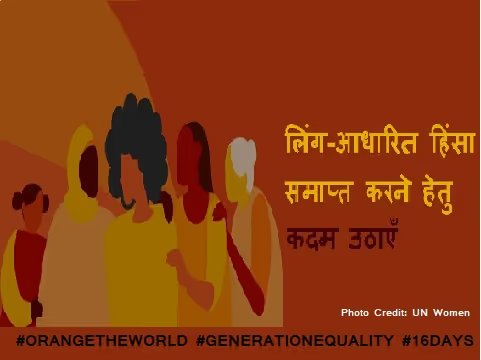
कोविड-19: ‘आभासी महामारी’ और महिलाओं के खिलाफ हिंसा
महिलाओं के खिलाफ हिंसा दुनिया भर में एक समस्या है जिसकी आर्थिक लागतें वैश्विक जीडीपी में 1% से 4% तक आती हैं। यह लेख इस बात की जांच करता है कि भारत में कोविड-19 लॉकडाउन के दौरान महिलाओं के खिलाफ हिंसा की संख्या और तरीके किस प्रकार बदल गए हैं। इसमे यह दर्शाया गया है कि सबसे कड़े प्रतिबंध वाले जिलों में घरेलू हिंसा और साइबर क्राइम की शिकायतों में बढ़ोतरी हुई है जबकि बलात्कार और यौन हमले की शिकायतों में कमी आई है।

कोविड-19: ‘आभासी महामारी’ और महिलाओं के खिलाफ हिंसा
महिलाओं के खिलाफ हिंसा दुनिया भर में एक समस्या है जिसकी आर्थिक लागतें वैश्विक जीडीपी में 1% से 4% तक आती हैं। यह लेख इस बात की जांच करता है कि भारत में कोविड-19 लॉकडाउन के दौरान महिलाओं के खिलाफ हिंसा की संख्या और तरीके किस प्रकार बदल गए हैं। इसमे यह दर्शाया गया है कि सबसे कड़े प्रतिबंध वाले जिलों में घरेलू हिंसा और साइबर क्राइम की शिकायतों में बढ़ोतरी हुई है जबकि बलात्कार और यौन हमले की शिकायतों में कमी आई है।

Covid-19: ‘Shadow pandemic’ and violence against women
Violence against women is a problem worldwide, with economic costs ranging from 1% to 4% of global GDP. This article investigates if the magnitudes and types of violence against women have changed during the Covid-19 lockdowns in India. It shows that domestic violence and cybercrime complaints have increased, while rape and sexual assault complaints have decreased, in districts with the most stringent restrictions.

Covid-19: ‘Shadow pandemic’ and violence against women
Violence against women is a problem worldwide, with economic costs ranging from 1% to 4% of global GDP. This article investigates if the magnitudes and types of violence against women have changed during the Covid-19 lockdowns in India. It shows that domestic violence and cybercrime complaints have increased, while rape and sexual assault complaints have decreased, in districts with the most stringent restrictions.