
.svg)
.svg)
%201.svg)
%201.svg)
.svg)

.svg)
.svg)
Nishith Prakash

Nishith Prakash is a Professor of Public Policy and Economics, with a joint appointment with the School of Public Policy and Urban Affairs and the Department of Economics at Northeastern University, Boston. Before joining Northeastern University, he was an associate professor of economics with a joint position with the Department of Economics and the Human Rights Institute at the University of Connecticut, Storrs. Born and raised in Bihar, India, he earned a BA (honours) in economics from Shivaji College, an MA in economics from Delhi School of Economics, Delhi University, and a PhD in economics from the University of Houston, Texas. He was a post-doctoral research associate at Cornell University. He has previously held Visiting Assistant Professor positions at Ohio University, and Dartmouth College, and he has been a Visiting Fellow at Yale University, Columbia University, Massachusetts Institute of Technology, Boston University, and Women and Public Policy Program at Harvard Kennedy School.
He is a Research Fellow at CESifo, Centre for Research and Analysis of Migration (CReAM), The Institute for the Study of Labor (IZA), Households in Conflict Network (HiCN), Innovations for Poverty Action (IPA) Network Researcher, Global Labor Organization (GLO), and Member of Insights on Immigration and Development (INSIDE-SPAIN). He is also currently serving on the Editorial Board of the journal PLOS ONE and Associate Editor at the Journal of Development Economics.
His research revolves around empowering human capital in low-income countries. His primary research interests include development, political economy, public policy, the economics of education, and behavioral economics. Throughout his academic pursuit, Professor Prakash has focused on the relationship between government policies and economic development and harnessed rigorous empirical evidence to study the impact of policies and institutions in enabling inclusive growth. He has experience in conducting surveys in developing countries, working with large-scale observational and administrative data sets, and conducting field experiments (RCTs), and has worked closely with the Education Department (in Bihar, Nepal, Zanzibar, and Zambia), the State Police (in Bihar, Madhya Pradesh, and Telangana), the Health Department (in Bihar), the Ministry of Home Affairs (Government of India), and the World Bank. His teaching interests include Development Economics, Applied Econometrics, and the Economics of Gender and Inequality.
Professor Prakash’s research has been featured in The Economist, BBC, World Bank Development Impact Blog, World Economic Forum, Financial Times, Forbes, The Statesman, The Atlantic, The Indian Express, The Hindu, The Times of India, and other national and international newspapers.
.svg)

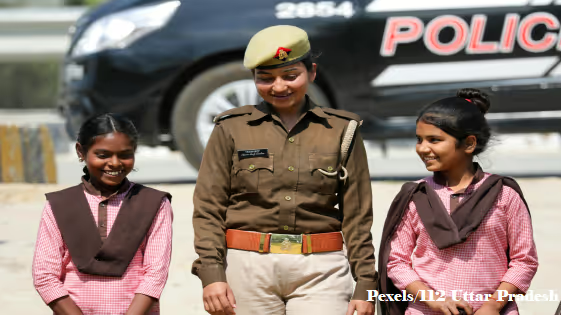
How police patrols reduced severe street harassment in India
Street harassment is a pervasive issue, with negative impacts on women’s safety and mobility in urban public spaces. Based on an experiment conducted in collaboration with the Hyderabad City Police, this article demonstrates that visible, anti-harassment policing strategies combined with efforts to transform underlying social attitudes, can make a difference.



लैंगिक समानता और सशक्तिकरण की ओर बढ़ते पहिए
भारत के बिहार और ज़ाम्बिया के ग्रामीण इलाके में, सरकार ने किशोरियों को स्कूल आने-जाने के लिए साइकिल प्रदान करके शिक्षा में लैंगिक अंतर को दूर करने के कार्यक्रम शुरू किए। इस लेख में, इन पहलों के तात्कालिक और दीर्घकालिक प्रभावों पर चर्चा करते हुए, शिक्षा में लैंगिक समानता को बढ़ावा देने के लिए अधिक प्रभावी और स्थाई नीतियाँ डिज़ाइन करने के बारे में रोशनी डाली गई है। यह अंतर्राष्ट्रीय महिला दिवस 2025 के उपलक्ष्य में हिन्दी में प्रस्तुत श्रृंखला का तीसरा लेख है।

हाई स्कूल में विज्ञान? कॉलेज और नौकरी के परिणाम
भारत में विज्ञान के अध्ययन के साथ जुड़े कैरियर पथ, हाई स्कूलों में अन्य विषयों के अध्ययन से जुड़े कैरियर पथ के मुक़ाबले, अधिक प्रतिष्ठित और लाभप्रद माने जाते हैं। यह लेख उच्चतर माध्यमिक विद्यालय में विज्ञान के अध्ययन और श्रम-बाजार की कमाई के बीच के संबंध की जांच करता है। परिणाम यह बताते हैं कि हाई स्कूल में विज्ञान का अध्ययन, व्यवसाय या मानविकी के अध्ययन की तुलना में 18-25% अधिक आय के साथ जुड़ा हुआ है। यह उच्च आय छात्रों की अंग्रेजी में प्रवीणता के साथ और बढ़ जाती है।

Understanding Career Choice in a Developing Country: Reading the Mind of High School Students in Cities of India?
The main objective of this project is to understand the process in which students choose their career path. In particular, what are the factors that play a role in the decision-making process? Are students actively thinking about how their future career will impact future expected earnings or close sectoral supply-demand gaps? Or are non-market factors, such as peer effects, stigma, or prestige, playing a larger role in the choice process?

Does it pay to speak English in India?
There is a widely held belief that there are sizeable economic returns to English-language skills in India. This column seeks to estimate the wage returns to English skills in India. It is found that being fluent in English increases the hourly wages of men by 34% and of women by 22%. But the effects vary. Returns are higher for older and more educated workers and lower for less educated, younger workers, suggesting that the complementarity between English skills and education appears to have strengthened over time.
Cycling to School: Increasing High School Enrolment for Girls in Bihar
This project studies the impact of an innovative Programme in the Indian state of Bihar that aimed to reduce the gender gap in secondary school enrolment by providing girls who continued to secondary school with a bicycle that would improve access to school. The findings shows that the Programme was much more cost effective at increasing girls' enrolment than comparable conditional cash transfer programmes.
Education in Bihar: Still a long road ahead
In the north Indian state of Bihar, education has been improving faster than in the rest of the country. But as this column reminds us, Bihar is starting from the bottom. For education to continue to improve, Bihar needs to universally provide drinking water facilities, separate toilets for girls in schools, and more teachers and classrooms per student.
Women's Reservations in Bihar and Children's Health Outcomes
This project investigates the impact of political decentralization and gender quota in local governance on different measures of health outcomes and behaviors. The findings of the prioject are consistent with local leaders having better information or greater concern for women and child health.
Education Policies and Practices
The objective of this project was to study the status of education in Bihar both in absolute terms and in relation to other states in India and also to identify best practices in education policies and make policy recommendations for Bihar. The findings showed that in terms of quality education, Bihar's performance is satisfactory in relative terms, but weak in absolute terms.
Pedalling towards gender equality and empowerment
In Bihar, India and in rural Zambia, the government introduced programmes to address gender gaps in education by providing adolescent girls with bicycles for their commute to school. Discussing the immediate and long-term impacts of these initiatives, this article provides insights into designing more effective and sustainable policies to promote gender parity in education. This is the fifth post of a five-part series to mark International Women’s Day 2025.
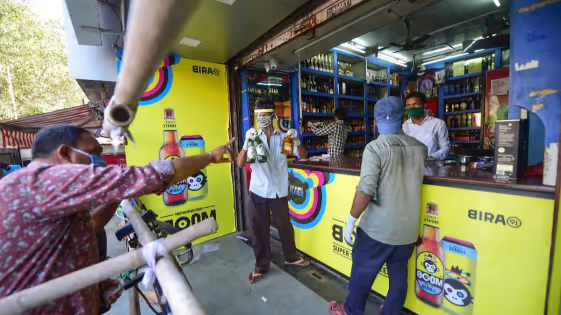
बिहार में शराबबंदी: विवेकपूर्ण नीति या व्यर्थ प्रयास?
बिहार में 1 अप्रैल 2016 से शराबबंदी लागू करने का मुख्यमंत्री नीतीश कुमार का निर्णय इस तर्क पर आधारित है कि शराब का सेवन महिलाओं के प्रति हिंसा का प्राथमिक कारण है। इस लेख के जरिये कुमार और प्रकाश तर्क देते हैं कि शराब पर पूर्ण प्रतिबंध से महिलाओं के प्रति हिंसा नहीं रुकेगी- लेकिन शराब महँगी करने से जरूर मदद मिल सकती है।
जब आपराधिकता अपराध को जन्म देती है: निर्वाचित राजनेताओं की भूमिका
राजनीति का अपराधीकरण समाज के लिए एक बहुत बड़ा खतरा बन गया है। यद्यपि साहित्य में आपराधिक रूप से आरोपी नेताओं के आर्थिक परिणामों पर अध्ययन तो किया गया है, लेकिन उनके क्षेत्राधिकार में आपराधिक माहौल पर उनके प्रभाव के बारे में बहुत कम जानकारी उपलब्ध है। 2009-2018 के भारत के आंकड़ों का विश्लेषण कर इस लेख में यह दिखाया गया है कि कमजोर कानून-व्यवस्था वाले जिलों में एक अतिरिक्त आपराधिक रूप से आरोपी नेता 64 अतिरिक्त आपराधिक मामलों का कारण बन जाता है।
When criminality begets crime: The role of elected politicians
The criminalisation of politics has become a massive threat to society. While the impact of criminally accused leaders on economic outcomes has been studied in the literature, little is known about their effect on the crime environment of the jurisdiction. Analysing data from India for 2009-2018, this article shows that in districts with weak rule of law, an additional criminally accused leader leads to 64 more criminal cases.

Political Change and Crime Reduction in Bihar
The aim of this project was to understand the mechanisms through which the political changes in 2005 contributed to the dramatic subsequent reduction in violent crimes. This project is an extension of the previous project on 'Political change and crime reduction in Bihar'. This study finds out the role the role of infrastructure construction in the concomitant crime reduction and surge in economic growth, in parallel, or in conjunction with policing efforts. The findings of this project provide a unique perspective on the dynamics and factors of law and order and economic growth in Bihar over the last 15 years.
Political decentralisation, female leadership, and health in rural Bihar
Political decentralisation and female representation in governance are known to improve social welfare by influencing policy decisions in favour of women and children. Analysing data from rural Bihar, this column finds that having a female leader at the village council level has a strong positive association with institutional births, and child survival rates for richer households.
Criminally accused politicians and economic outcomes
Despite a history of widely contested and transparent elections, and presence of vibrant and open media, an increasing number of criminally accused politicians are being elected in India. Based on an analysis of elections to State Legislative Assemblies during 2004-2008 in 20 states, this column finds that electing a politician accused of a serious or financial crime adversely affects economic growth and public service delivery in the constituency.
Bihar's alcohol ban: Prudent policy or tail-chasing?
Bihar Chief Minister Nitish Kumar’s decision to implement prohibition in the state from 1 April 2016 is based on the rationale that alcohol consumption is the primary reason for violence against women. In this article, Kumar and Prakash argue that a blanket ban on alcohol won’t stem violence against women – but making alcohol costlier may help.
He is a criminal but he is our criminal: Criminally accused politicians in India
The recent increase in the number of criminally-accused politicians elected to state assemblies has caused much furore in India. Despite the potentially important consequences and the widely divergent views, the implications of their elections to state legislative assemblies on constituency-level economic performance are unknown.