
.svg)
.svg)
%201.svg)
%201.svg)
.svg)

.svg)
.svg)
S. Subramanian
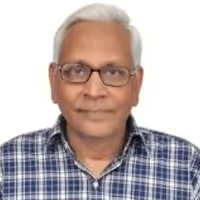
S. Subramanian is a retired professor from the Madras Institute of Development Studies (MIDS), and a former Indian Council of Social Science Research National Fellow. He is an elected Fellow of the Human Development and Capabilities Association, and a member of the advisory board of the World Bank’s Commission on Global Poverty. His work has been on aspects of social and economic measurement, collective choice theory, and development economics. He is the author of, among other books, Rights, Deprivation, and Disparity: Essays in Concepts and Measurement; The Poverty Line; and Economic Offences (Oxford University Press, Delhi: 2006, 2012 and 2013 respectively).
.svg)

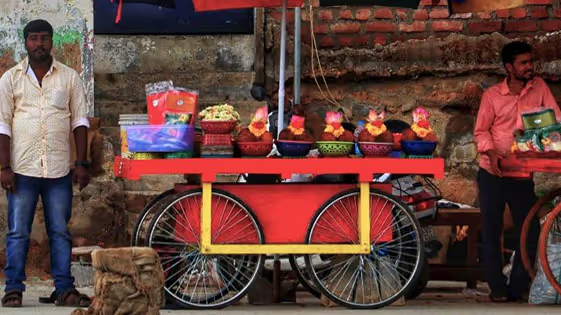
क्या एक व्यापक लॉकडाउन का कोई उचित विकल्प है?
कोविड-19 के खिलाफ भारत की लड़ाई में, हम दो विकल्पों में से अनिवार्यत: एक का चयन कर रहे हैं, एक ओर सामाजिक दूरी और दूसरी ओर लोगों को अपनी आजीविका से वंचित करना। सामान्य तथा अनिवार्य लॉकडाउन की अस्थिरता को स्वीकार करते हुए, देबराज रे और सुब्रमण्यन एक प्रस्ताव रखते हैं जिसके तहत युवाओं को कानूनी रूप से काम करने की अनुमति दी जाती है और अंतर-पीढ़ी संचरण से बचने के लिए उपायों के केंद्र को घरों पर स्थानांतरित कर दिया जाता है।


Covid-19: Is there a reasonable alternative to a comprehensive lockdown?
In India’s battle against Covid-19, we are inevitably confronted by the choice between social distancing on the one hand, and denying people their livelihood on the other. Recognising the unsustainability of a general, mandatory lockdown, Ray and Subramanian put forth a proposal whereby the young are legally permitted to work and the locus of measures to avoid intergenerational transmission is shifted to the household.
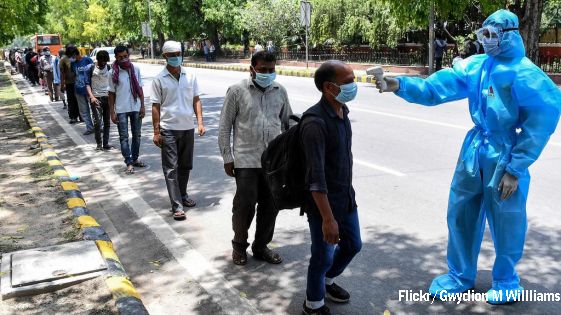
Covid-19 and other diseases: An ‘Animal Farm’ perspective
Debraj Ray and S Subramanian contend that despite the apparent sentiment of ‘we are all in this together’, the global burdens of Covid-19 and the global benefits of anti-Covid-19 policy have been skewed against the poorer nations of the world, and within nations, against the poor and the vulnerable.

What is happening to rural welfare, poverty, and inequality in India?
An analysis of the draft National Statistical Office report that the Government has decided not to put out shows a deterioration in 2017-18 in consumption and poverty levels in rural India. The reasons may be the demonetisation of 2016 and the shoddy introduction of goods and services tax (GST) in 2017. This article carries the analysis forward with some additional results and analyses relating to trends and levels of consumer expenditure in rural India.
‘न्याय’ विचार-गोष्ठी: वित्तपोषण के लिए करों की जांच-पड़ताल अत्यंत महत्वपूर्ण
इंडियन काउंसिल ऑफ सोशल साइंस रिसर्च के पूर्व नैशनल फैलो प्रोफेसर एस. सुब्रामनियन ने आय अंतरण योजना को समायोजित करने के लिए बढ़े कराधान और वांछित वृद्धि के संभावित स्तर के लिए कुछ अनुमान करने के प्रश्न से सीधा निपटने के महत्व पर बल दिया है।
NYAY e-Symposium: Crucial to look into taxes for financing
Prof. S. Subramanian (National Fellow, Indian Council of Social Science Research) emphasises the importance of dealing directly with the question of enhanced taxation and some estimate of the likely order of magnitude of the required enhancement – in order to accommodate an income transfer scheme.
The 'poverty line' - III
In the last of a three-part series on the poverty line, Prof. S. Subramanian, former National Fellow, Indian Council of Social Science Research, discusses how the official methodology of poverty measurement in India has thrown the door open to anarchy.
The 'poverty line' - II
In the second of a three-part series on the poverty line, Prof. S. Subramanian, former National Fellow, Indian Council of Social Science Research, argues that there is a built-in incentive for official poverty lines to be pitched ‘low’.
The 'poverty line' - I
In the first of a three-part series on the poverty line, Prof. S. Subramanian, former National Fellow, Indian Council of Social Science Research, contends that the term should not be bandied about frivolously.
The coexistence of prosperity and poverty in India
Credit Suisse recently reported that the richest 10% Indians own about 75% of the country’s wealth, highlighting the growing problem of inequality. This column presents trends in inequality in India during 1961-62 – 2002-03 based on relative, absolute and intermediate measures. It demonstrates that growth may be considered inclusive or exclusive depending on the measure of inequality used.