
.svg)
.svg)
%201.svg)
%201.svg)
.svg)

.svg)
.svg)
Subha Mani

Subha Mani is an Associate Professor of economics and a Research Associate at the Center for International Policy Studies at Fordham University. Subha also holds a Research Affiliate position at the Population Studies Center at the University of Pennsylvania. She has her B.A. (honors) degree in economics from Delhi University, a Masters degree in economics from Mumbai University and a Ph.D. degree in economics from the University of Southern California. Her areas of specialisation are development economics, applied econometrics, applied microeconomics and field experiments. Subha’s main area of interest is human capital accumulation. Her work investigates issues including - causes of chronic malnourishment, potential for catch-up in health and education, policies that foster catching up, and the interrelationship between early life nutrition and interventions on later life outcomes. Her work also quantifies the economic and social returns from participating in vocational education programmes in developing countries. Subha has conducted fieldwork in India. Her scholarly work has been published in the Journal of Development Economics, Oxford Bulletin of Economics and Statistics, Journal of African Economies and Economic and Political Weekly. Her research has received funding from Fordham University, Monash University, Indian School of Business, International Growth Center – India, 3ie Impact Evaluation, and Grand Challenges Canada. http://faculty.fordham.edu/smani/smani/Welcome.html
.svg)


Choosing to be trained: Behavioural restrictions on participation decisions
Widespread unemployment has prompted policymakers to consider introduction of various training programmes that can help workers accumulate additional skills to obtain new jobs and/ or retain current ones. However, these programmes can only help if targeted individuals take up such opportunities. This column argues that participation in short-term skill-building courses is not just limited by economic factors but is also influenced by intrinsic characteristics such as attitudes towards risk and competition.


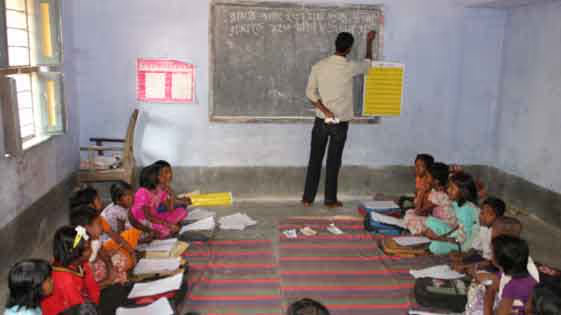
Designing incentives for mid-level officials in India's public sector
In the Indian public education system, block/cluster resource persons are mid-level officials who are responsible for monitoring the performance of teachers. In this note, Vivek et al. discuss their experience of working with the state government of Jharkhand to design a ‘results-based financing’ programme that incentivises these mid-level officials as well as teachers to perform better – with the ultimate objective of improving education outcomes.
How do better-ranked colleges help meet India’s skill shortages? Evidence using a regression discontinuity design
This project exploits the variation in the University of Delhi college admission process to estimate the effects of exposure to high-achieving peers on cognitive attainment using scores on standardised university level examinations; behavioral outcomes such as risk preference, competitiveness, and confidence; and noncognitive outcomes using measures of Big Five personality traits.
Peer influence and human capital accumulation: Evidence from Delhi University colleges
College is an important milestone in life that is believed to develop several aspects of an individual's human capital, broadly defined to include both cognitive and socio-emotional traits. Consequently, there is great emphasis on obtaining admission into a more selective college. This column draws upon data from Delhi University to examine the returns to enrolling in a more selective college.
Vocational education: A means to an end?
Youth underemployment, especially among less educated populations perpetuates poverty. Despite the importance of youth unemployment, there is little knowledge on how to create smooth school-to-work transition and or how to improve the human capital of those who can no longer be sent back to school. This column presents evidence supporting positive returns from having access to and completing a vocational training course for women residing in low-income households in New Delhi.
Learning and Earning: Evidence from a Randomized Evaluation in India
This project estimates the short-and-medium-run effects of participating in a subsidised vocational training programme aimed at improving labour market outcomes of women residing in low-income households in a developing country.

How has MNREGA impacted the lives of women and children in India?
In this article, Subha Mani, Professor of Economics at Fordham University, summarises evidence that shows that MNREGA has mostly positively impacted the lives of women and children in India.