
.svg)
.svg)
%201.svg)
%201.svg)
.svg)

.svg)
.svg)
.svg)
.svg)

.svg)
.svg)
.svg)




In this article, Subha Mani, Professor of Economics at Fordham University, summarises evidence that shows that MNREGA has mostly positively impacted the lives of women and children in India.
Tweet using #MNREGA10yrs
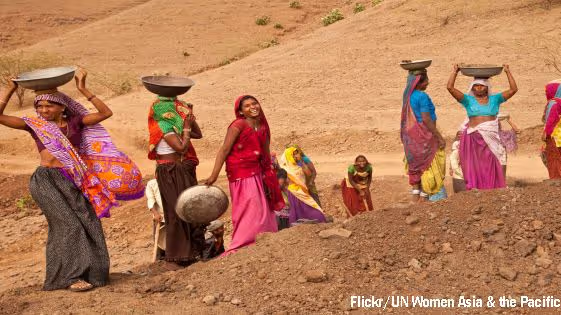
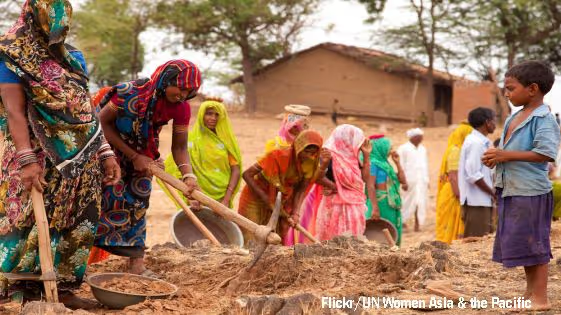
The Mahatma Gandhi National Rural Employment Guarantee Scheme (MNREGS) is the largest social protection programme in the world that provides 100 days of unskilled wage employment to any household residing in rural areas whose adult members volunteer to do unskilled manual work. Several features of this programme make it particularly attractive for women – equal wages for men and women; provision of onsite childcare (although it is not frequently available); and the requirement that at least one-third of the beneficiaries must be women.
Theory
The programme has the potential to impact the lives of millions of women and children in many ways: First, an increase in women’s labour supply is likely to improve their earnings and consequently their bargaining power in the household. This also has implications for their children; increase in mother’s employment will positively (negatively) impact children’s human capital (health and education) if the income (substitution) effect of mother’s labour force participation outweighs the substitution1 (income2) effect. Improvements in women’s bargaining power can further augment both the quantity and quality of children’s human capital. Second, improvements in MNREGS-led public good provision (example, access to roads, flood control, land development, and maintenance of irrigation system, and canals) can also directly improve welfare outcomes for both women and children. Conversely, participation in the MNREGS can also have some perverse impacts for women and children. For instance, increase in women’s labour force participation and bargaining may also result in more conflict in the household. Increase in manual work may also worsen women’s health. It may also increase the demand for child labour for both farm and off-farm work, decreasing their human capital. As a result, the net effect of access to and participation in the MNREGS for women and children remains theoretically unknown.
Data
Over the last 10 years, the rollout of the MNREGS has also coincided with two unique panel datasets3 – Young Lives Panel Survey and the Indian Human Development Survey (IHDS), as well as multiple rounds of (pre and post MNREGS) repeated cross-sectional datasets4 available from the National Sample Survey (NSS), District Information System for Education (DISE), ASER (Annual Status of Education Report) and District Level Household and Fertility Survey (DLHS). These datasets have allowed researchers to exploit the spatial and temporal variation in programme rollout to examine the intent-to-treat effects of the programme, and in some cases, the impact of the scheme on programme beneficiaries. The intent-to-treat5 effects give us the ‘net’ effects of the programme but do not isolate the mechanisms or channels through which we might observe these improvements or decrements. On the other hand, the impact of the scheme on programme beneficiaries can normally measure the impact of the intervention through only a particular mechanism such as women’s labour force participation (or household labour force participation or public good provision etc.) leaving the ‘net’ effects of the programme unknown.
Table 1. Summary of existing work on the examination of the impact of MNREGS on women and/or children
SourceOutcomesDataResultsMeasuresAfridi, Mukhopadhyay and Sahoo (Forthcoming)Mothers: Labour force participation; Children: Enrolment, grade progression and schooling expenditureYoung Lives Panel DataImprovement in women’s labour force participation and consequently improves children’s outcomesDirect impact of access to MNREGS on women’s labour force participation and its associated indirect effect on child schoolingDas and Singh (2015)Children: Years of schoolingDLHSNo impact on years of schoolingIntent-to-treat effects of the programmeDasgupta (2013)Children: Height-for-age z-scoresYoung Lives Panel DataAccess to MNREGS mitigates the negative effect drought shocks have on height-for-age z-scores8Impact of the programme on the vulnerableLi and Sekhri (2013)Children: Enrolment (and by type of school), passing rate, proportion of repeaters, number of teachers (and by type of school)DISELowers overall enrollment while increasing private school enrollment and decreasing enrollment in govt. schools. Grade repetition and passing rate worsens in private schools, and no. of teachers increase in private schoolIntent-to-treat and general equilibrium effectsMani, Behrman, Galab and Reddy (2014)Children: Grade progression, reading comprehension test scores, writing test scores, math test scores, Peabody Picture Vocabulary Test (PPVT) scoresYoung Lives Panel DataPositive and significant impact on children’s outcomes with stronger impact for girlsIntent-to-treat effects of the programmeUppal (2009)Children: Height-for-age z-scores and child labourYoung Lives Panel DataPositive but only marginally significant effects on height-for-age z-scores; Reduces incidence of child labour among femalesImpact of household participation in MNREGSAzam (2012)Women: Labour force participation, participation in public works, and real wages for casual wage workersNSSPositive impact on women’s labour force participation, participation in public works programmes, and real wages for casual wage workersIntent-to-treat effects of the programmeDesai, Vashishtha and Joshi (2015)Women: Labour force participation in MNREGS, income, having a bank account, ability to freely seek healthcare, control over resources and decision-making; Children: Completed grades of schooling, reading, writing, and hours spent in schoolIHDSPositive impact for both women and childrenImpact of household participation in programmeKhera and Nayak (2009)Women: Labour force participation, working conditions, wagesQualitative data from 10 districts in six northern Indian statesA large share of women in NREGS jobs report collecting and keeping their own wages. It is also associated with greater dignity and equal wages between men and womenDescriptive statistics based on survey of NREGS workers onlyPankaj and Tankha (2010)Women: Participation in MNREGS, share of income from MNREGS in household income, retention of MNREGS wages, attendance and participation in Gram Sabhas, having a bank account in their namePrimary data from four Indian statesSimple comparison suggest positive association between MNREGS participation and women’s outcomesDescriptive statistics from survey of NREGS women workers onlyShah and Steinberg (2015) Children: Enrolment and math scoresASERVaried impacts with positive effects reported for younger children and negative effects for older childrenIntent-to-treat effect of the programmeImbert and Papp (2015)Women: Wages from casual workNSSNo impact on women’s wages from casual workIntent-to-treat effect of the programmeZimmermann (2014)Women: Employment (total, public, private and family), private wageNSSNo impact on women’s employment outcomes (total, public, private and family), private wageIntent-to-treat effect of the programme
What the evidence says
A review of the papers in Table 1 suggests the following. First, the estimates obtained from panel data surveys (Young Lives Panel Survey and IHDS) that follow the same individual/household over time shows that the programme benefitted both women and children. Authors using these data sets find that the programme improved women’s labour force participation, wages, decision-making, and children’s education and health (only among those exposed to drought shocks). Second, several studies using national-level repeated cross-sectional data find almost no impact on women’s outcomes and/or children’s outcomes. Third, the panel surveys that track children and women have much richer data on children’s human capital, child labour, and women’s outcomes (labour force participation, wages, decision-making, ownership of bank accounts, and others). However, the sample size in these surveys is much smaller than that available from national-level surveys. Fourth, the programme serves as a safety net for the rural poor. Finally, some of the variation in findings can possibly be attributed to variation in the quality of data, research methodology, variable definitions, treatment of endogenous programme placement6, and clustering7.
Anti-poverty programmes like the MNREGS can serve as a very powerful policy instrument that can improve multidimensional welfare outcomes. Existing evidence suggests positive association between the scheme and women’s labour force participation, income, decision-making and children’s education and health outcomes. The programme also has the potential to affect households’ physical and mental health, self-esteem, income inequality, asset accumulation, and much more. More evidence on the effectiveness of this programme along other dimensions of well-being is much needed. We also need more qualitative evidence on the process through which the programme is implemented in order to improve MNREGS targeting and implementation so that it can reach the poorest of the poor in the nation.
Notes:
- Substitution effect of maternal employment suggest that improvements in mother’s labour force participation would reduce mother’s time devoted to childcare activities and can consequently have a diminishing effect on child outcomes.
- Income effect of maternal employment suggest that improvements in income associated with women’s labour force participation will lead to an increase in the demand for child health and schooling inputs and consequently improve child outcomes.
- Panel data refers to multi-dimensional data involving measurements over time for the same group of units or entities. A panel dataset may be one that follows a given sample of individuals over time and records observations or information on each individual in the sample.
- Cross-sectional data is a type of data collected by observing many subjects (such as individuals, firms, countries, or regions) at a particular point of time.
- Intent-to-treat effect is the difference in average outcomes between the treatment group (computed over all those that are assigned to the treatment group, irrespective of whether they actually receive the treatment/intervention or not) and the control group (computed over all assigned to the control group that are not meant to receive the treatment/intervention).
- Endogenous programme placement occurs when programmes are not randomly placed. For instance, MNREGS was rolled out in a non-random/endogenous manner; the programme was first placed in the poorest rural districts of India and then reached the less poor districts in India.
- Clustering is to account for the presence of unobserved correlation between individuals in a particular group.
- ´Height-for-age’ z-score is a statistical measure that captures the deviation of the actual height of a child from the median height of a standard sample of children of his/her age. Median refers to the middle value when a set of values are arranged in ascending/descending order.
Further Reading
- Afridi, F, A Mukhopadhyay and S Sahoo (2016), “Female Labour Force Participation and Child Education in India: Evidence from the National Rural Employment Guarantee Scheme”, IZA Journal of Labor and Development, Forthcoming.
- Azam, M (2012), ‘The Impact of Indian Job Guarantee Scheme on Labor Market Outcomes: Evidence from a Natural Experiment’, IZA Discussion Paper No. 6548.
- Das, S and A Singh (2013), ‘The Impact of Temporary Work Guarantee Programs on Children´s Education: Evidence from the Mahatma Gandhi National Rural Employment Guarantee Act from India’, Working Paper.
- Dasgupta, A (2013), ‘Can the Major Public Works Policy Buffer Negative Shocks in Early Childhood? Evidence from Andhra Pradesh’, Mimeo.
- Dasgupta, A (2014), ‘Can MNREGA buffer negative shocks in early childhood?’, Ideas for India, 29 August 2014.
- Desai, S, P Vashishtha and O Joshi (2015), ‘Mahatma Gandhi National Rural Employment Guarantee Act: A Catalyst for Rural Transformation’, National Council of Applied Economic Research, New Delhi.
- Imbert, Clement and John Paap (2015), “Labor Market Effects of Social Programs: Evidence from India´s Employment Guarantee”, American Economic Journal: Applied Economics (2015) 7(2): 233-263. Available at: https://www.dropbox.com/s/pm9qx6sgr3kd5pk/2014-11-07%20Labor%20Market%20Effects%20of%20Social%20Programs%20-%20Imbert%20Papp.pdf?dl=0
- Khera, R and N Nayak (2009), “Women workers and perceptions of the National Rural Employment Guarantee Act”, Economic and Political Weekly, 44(43), 49-57. Available at: https://core.ac.uk/download/files/103/2790414.pdf
- Li, T and S Sekhri (2013), ‘The Unintended Consequences of Employment Based Safety Net Programs: Evidence from Indian NREGA’, Working Paper.
- Mani, S, JR Behrman, S Galab and PP Reddy (2014), ‘Impact of the NREGS on Schooling and Intellectual Human Capital’, Working Paper, Young Lives, Oxford Department of International Development (ODID), University of Oxford.
- Pankaj, A and R Tankha (2010), “Empowerment effects of the NREGA on Women Workers: A study in four states”, Economic and Political Weekly, 45(30), 45-55. Available at: http://www.environmentportal.in/files/Empowerment%20Effects%20of%20the%20NREGS.pdf
- Shah, M and BM Steinberg (2015), ´Workfare and Human Capital Investment: Evidence from India´. Available at: http://scholar.harvard.edu/files/steinberg/files/paper.pdf
- Uppal, V (2009), ‘Is the NREGS a safety net for children? Studying the access to the National Rural Employment Guarantee Scheme for Young Lives families, and its impact on child outcomes in Andhra Pradesh’, Student Paper, Young Lives, Oxford Department of International Development (ODID), University of Oxford.
- Zimmermann, L (2012), ‘Labor Market Impacts of a Large-Scale Public Works Program: Evidence from the Indian Employment Guarantee Scheme’, IZA Discussion Paper No. 6858.



























.svg)

.svg)
%201.svg)
.svg)
.svg)
