
.svg)
.svg)
%201.svg)
%201.svg)
.svg)

.svg)
.svg)

.svg)

.svg)


Environment

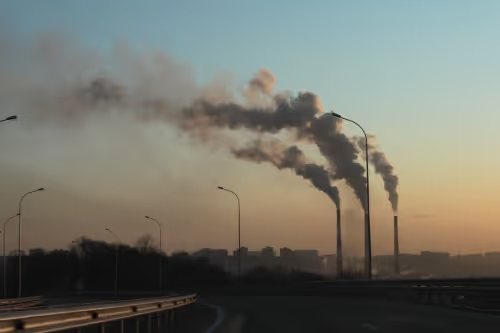
Coal and the climate change debate
In the run-up to the Paris Climate Summit, there has been a growing call among advanced nations to phase out fossil fuels. In this article, Arvind Subramanian, Chief Economic Adviser, Government of India, argues that shunning coal is not viable for India. Instead, the world should come together to find effective techniques to ‘clean and green’ coal.


India's energy efficiency
India is the fourth largest energy consumer in the world but is not well endowed with energy resources, making efficiency in energy use very important. This column analyses the spatial dynamics of electricity usage in India’s manufacturing sector. Such an understanding can help in defining a more focused and targeted energy policy.
How development affects climate sensitivity of electricity demand in India
The annual average temperature in India in 2009 was about 0.91°C above the average temperature recorded during the 1961-1990 period. This column analyses the impact of daily weather as well as long-term climate change on electricity demand in India, and how income growth influences this relationship. It shows that the marginal effect of hotter climate on electricity demand is greater when incomes are higher.
Incentivising states to conserve forests
Central tax revenues will now be shared among states not just on the basis of population, area, and income, but also forest cover. In this article, Jonah Busch, an environmental economist at the Center for Global Development, contends that the fiscal reform has the potential to become quite a potent climate instrument. It can serve as an example for other countries with similar tax revenue distribution systems and high rates of deforestation.
Making the best out of waste
Given rapid urbanisation and the increasing amounts of solid waste generated in India cities, there is a pressing need for effective waste management processes. In this article, Sourabh Bhattacharjee and Ujjwal Sinha, who have been associated with a successful waste management project in Saharanpur, provide an outline of the project and highlight lessons for other Indian cities.
Can solar micro-grids deliver basic electricity access in Indian villages?
About one-third of India´s population remains without access to basic electricity services. This column discusses preliminary lessons from an experiment in rural Uttar Pradesh that seeks to set up solar micro-grids in unelectrified habitations. It finds that while the cost of solar power is a potential obstacle to its adoption, the technology does generate substantial benefits in the form of improved lighting and reduced kerosene expenditures.
Harnessing India's wind power potential
While India’s wind power sector has progressed significantly in the past decade, only about 22% of its potential has been harnessed so far. In this article, Deepthi Swamy - who was part of a team that worked with the Ministry of New and Renewable Energy to develop a framework for the National Wind Energy Mission - discusses the issues faced by the sector, need for a mission-mode approach, and the proposed contours for such a mission.
Solar power for street vendors? Lessons from an experiment in Bihar
Rapid urbanisation in developing countries is aggravating the issue of insufficient access to energy for basic needs such as lighting. This column discusses lessons from an experiment in Bihar wherein street vendors were provided solar-powered lights, the batteries of which were charged at centralised stations installed in urban marketplaces. Based on problems encountered in terms of the mode and cost of operation, it suggests that the provision of electric grid connections, with stand-alone solar lights as backup, may be a better approach.
Creating the climate for India's low-carbon growth story
The ‘Expert Group on Low Carbon Strategies for Inclusive Growth’ recently laid out a detailed roadmap for India to take on climate change mitigation proactively. In this note, Varad Pande – a member of the Expert Group – outlines the key strengths of the roadmap, and contends that India must now create the political and administrative climate to implement it.

Sign up to our newsletter to be notified about the latest updates
.svg)
Just One Step Away!
Complete your signup to start getting the latest news, stories, and updates delivered straight to your inbox.