
.svg)
.svg)
%201.svg)
%201.svg)
.svg)

.svg)
.svg)

.svg)

.svg)


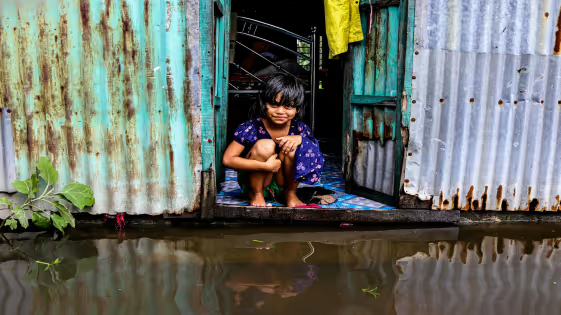

Environment
India Sustainable Growth Conference: A recap
India is at the forefront of the global challenge of sustainable growth – adaptation to climate change and mitigation of its adverse effects must take place simultaneously with efforts to alleviate poverty and improve development indicators. The India Sustainable Growth Conference, hosted at LSE in May, brought together researchers, policymakers, and other stakeholders to share ideas on how to tackle the challenges confronting the India in this regard.



Financing India’s green structural transformation
While India has launched an ambitious green structural transformation programme – with some initial successes to its credit – it is still nascent and there is a need to mobilise more resources. In this post, Ejaz Ghani outlines how global risk pooling, fiscal reforms, public-private partnerships and innovative financial instruments can help finance green growth – thereby enabling India to achieve both poverty reduction and climate risk mitigation.
Going green while being in the red
In the third post of a three-part blog series, I4I Editor-in-Chief Parikshit Ghosh advocates for a holistic approach that harmonises India’s environmental policy, social safety nets, and macroeconomic management. Given the difficulty of predicting where and when climate-related needs will arise, he puts forth the idea of a consolidated green fund for the country.
India’s opportunity for sustainable growth
In the second post of a three-part blog series, Tim Dobermann and Nikita Sharma contend that it is important for India to choose a growth trajectory that prioritises raising living standards while minimising environmental decline. They discuss how innovations in at least two areas – energy and conservation – are helping India realise this opportunity.
The why and how of environmental protection: Examining the evidence
In the first post of a three-part blog series, I4I Editorial advisor Nalini Gulati summarises a selection of studies on the adverse impact of environmental degradation on human health as well as economic outcomes, followed by ideas from research on how effective policy design and implementation can mitigate the damage and enable conservation of the environment.
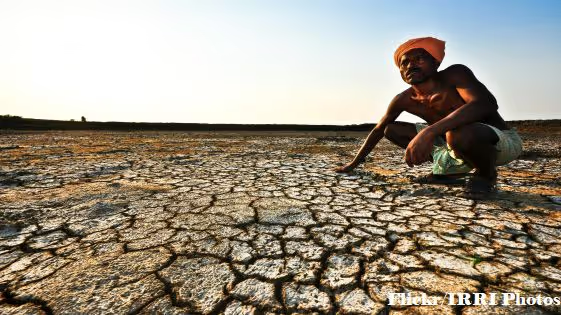
Safeguarding agricultural households against climate shocks
Extreme climate events are taking place more often and for longer, jeopardising the economic stability of agricultural households. This article shows that coping strategies adopted by households in response to climate shocks – such as occupational diversification and sale of livestock – yield lower returns relative to normal circumstances. A larger proportion of the educated agricultural workforce takes up casual labour, while livestock is sold at distress prices.
India Sustainable Growth Conference, 2-4 May 2024
Hosted by the International Growth Centre, LSE STICERD’s Economics of Environment and Energy Programme, University of Warwick and Indian Statistical Institute, the India Sustainable Growth Conference will be held at the London School of Economics and Political Science during 2-4 May 2024. This conference serves as a platform for sharing ground-breaking ideas on sustainable economic growth and the environment, with a focus on the challenges and opportunities in India. It will bring together policymakers, academic leaders, and industry experts to discuss innovative research and strategies,
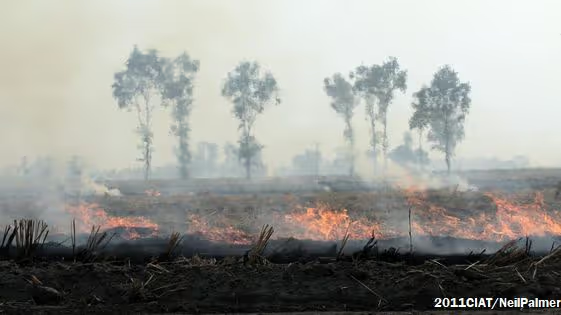
Do women leaders improve environmental outcomes? Evidence from crop fires in India
This study looks at how women leadership improves environmental outcomes. Using satellite data from India, it compares incidence of crop fires between constituencies where women narrowly won or lost elections against men and finds that female legislators decrease crop fire incidence and lower particulate emissions. A survey to understand mechanisms suggests that female leaders are more likely to consider crop fires a serious issue, weigh their impacts on child health, and implement crop residue management policies.

Does India’s air pollution impact more than just health?
Air pollution presents a significant risk to human health in India, a fact which is now widely appreciated. Less well-known is a body of evidence suggesting that air pollution harms the day-to-day functioning of those with no diagnosable health harms, through avenues such as impaired decision-making and reduced capabilities in a wide range of tasks. Aguilar-Gomez et al. outline this research on the ‘non-health’ impact of pollution in various industries, and the ways in which people respond to ambient pollution.


Sign up to our newsletter to be notified about the latest updates
.svg)
Just One Step Away!
Complete your signup to start getting the latest news, stories, and updates delivered straight to your inbox.