
.svg)
.svg)
%201.svg)
%201.svg)
.svg)

.svg)
.svg)

.svg)

.svg)

Environment
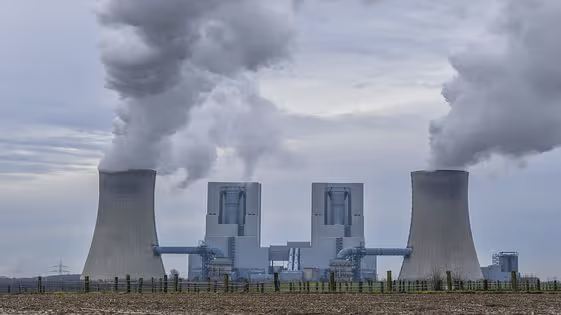
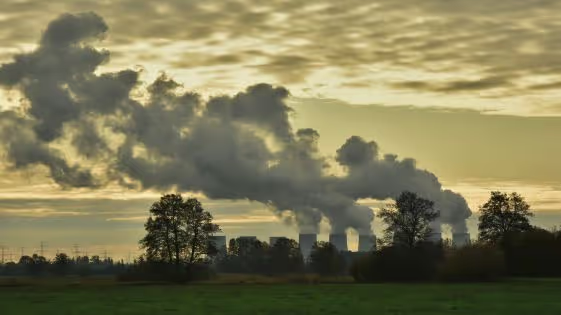
How feasible is it to phase out coal-fired power plants? Evidence from a global attitudes survey
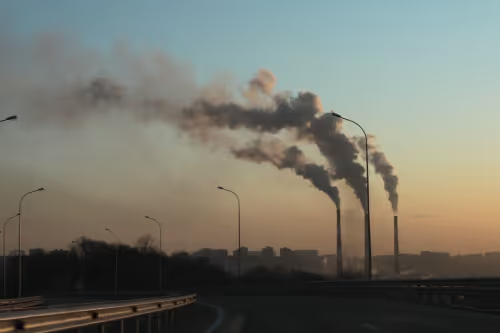
Coal-fired power plants are a highly polluting energy source but people are either unaware or unable to convey their dissatisfaction about living with poor air quality. Using survey data from 51 low- and middle-income countries, this article calculates citizens' willingness to pay to phase-out coal power. It measures the wellbeing of residents in close proximity to a power plant, and calculates that the air quality benefits accruing to them would exceed the costs of solar and wind energy generation.


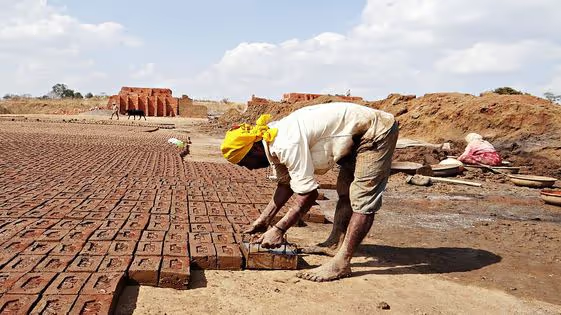
Effects of climate shocks on sectoral inequality
Over the last three decades, agricultural and industrial sector workers have suffered consumption losses due to temperature rise while those in the services sector saw consumption increases. This article discusses the broad range of impacts of climate change across sectors, and highlights the stark rise in inequality of household consumption due to increased temperature variability. It emphasises the need for social protection schemes, and data on the economic impacts of climate change to aid the design of adaptation policies.

Pivoting to evidence-based tiger conservation
In light of the recently released tiger population estimates for India, Pranav Chanchani discusses what needs to be done make data-driven decisions to sustain tiger population as natural landscapes are being altered by human enterprise. He suggests that data on the social and ecological drivers of variation in the tiger population – including prey, cover and human tolerance for tigers – is essential for the species’ effective conservation. This evidence-based conservation will also provide a more nuanced understanding of where and how tigers can effectively be conserved beyond Protected Areas.
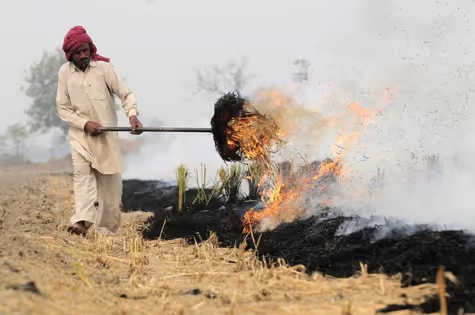
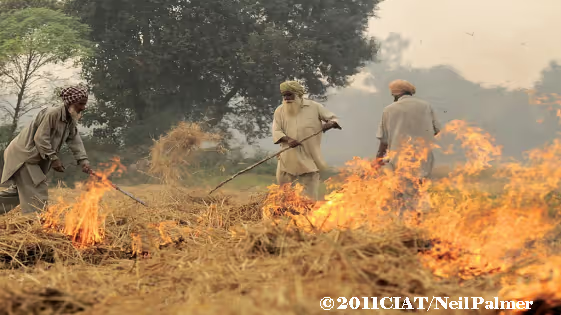
Designing transfer payments to reduce crop burning in India
Air pollution caused due to crop burning has severe health impacts, particularly in north India. Despite the introduction of a conditional cash transfer programme to adopt environmentally friendly practices, farmers lack liquidity and trust in the process. This article describes a study undertaken in Punjab, and reveals that although the programme may face challenges with compliance, contracts that include partial upfront payments can help reduce crop burning and increase the use of equipment to manage crop residue.

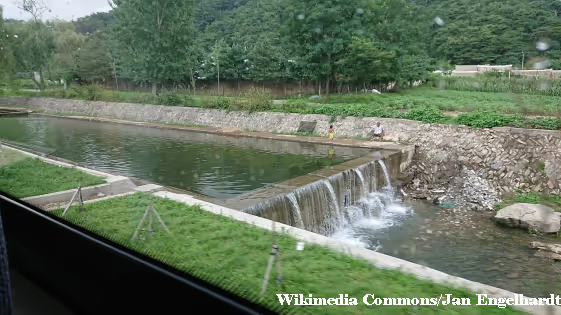
Climate change and riverine pollution: The need for high-quality environment data in India
Controlling water pollution and protecting water resources in India requires comprehensive collection and monitoring of data. In this article, Pohit and Mehta describe a project undertaken by NCAER and TCD, which used automated sensors attached to boats to collect data on water quality parameters at key points along the Ganga river in Uttar Pradesh and West Bengal. They emphasise how these findings can help understand the sources of pollution to ensure effective policy interventions and regulatory compliance by polluters.
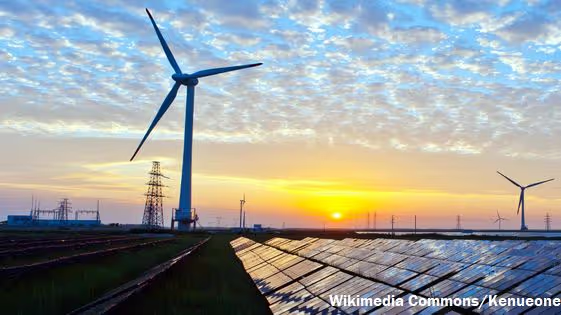
Keeping development at the forefront of India’s long-term climate strategy
India’s Long Term Low Emissions Development Strategy (LT-LEDS) sets out multiple low-carbon transitions, highlighting that climate action will be intimately tied to developmental processes. In this article, Chandra et al. identify some of the challenges and opportunities embedded within these transitions, and reflect on how these will impact developmental priorities such as employment and energy security. To operationalise the LT-LEDS effectively, they argue that India will benefit from planning now to minimise the trade-offs between low-carbon futures and development.

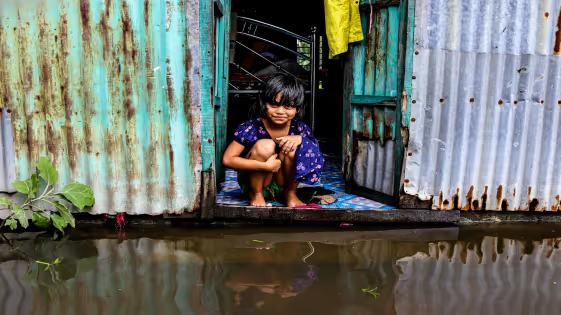
Economic dynamics of natural disasters: Evidence from the Kerala floods
To understand the economic impact of natural disasters, this article uses the 2018 floods in Kerala – a time when it received higher rainfall than the neighbouring states of Karnataka and Tamil Nadu ¬– to design a natural experiment. Using household and district-level data, the study finds that although flooding lowered economic activity during the disaster, the demand for credit, household income and wages all increased relative to the neighbouring states during the post-disaster boom, facilitated by labour market conditions and government’s reconstruction efforts.

How human and ecosystem health are intertwined: Evidence from vulture population collapse in India
Livestock farmers in India have historically relied on vultures to dispose of dead animals. However, the collapse of vulture populations in India due to accidental poisoning has prevented the scavenging of carcasses, worsening sanitation. In this post, Frank and Sudarshan estimate the consequences of the loss of vultures on public health and estimate that human mortality increased during the period when vultures reached their new collapsed population level, and note that vultures’ role in the ecosystem cannot be easily replicated.
How could Indian law tackle climate governance?
As climate change becomes an increasing concern, addressing the problem only through policy may not be enough. In this piece, Dubash and Sridhar suggest that legislation around climate can ensure economy-wide outcomes, and put forth nine considerations that countries hoping to implement climate law should satisfy to effectively tackle climate change. They discuss possible approaches to design these laws – taking into account the broader political context – to make sure that both environmental and development objectives are met.


Sign up to our newsletter to be notified about the latest updates
.svg)
Just One Step Away!
Complete your signup to start getting the latest news, stories, and updates delivered straight to your inbox.