
.svg)
.svg)
%201.svg)
%201.svg)
.svg)

.svg)
.svg)

.svg)

.svg)


Environment
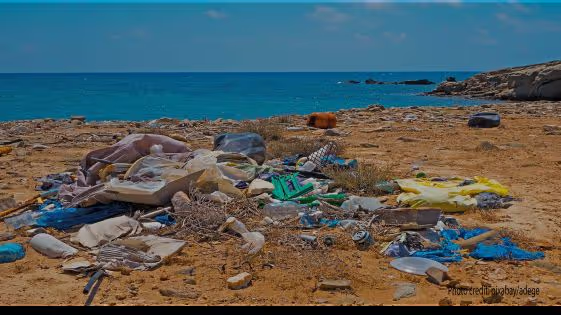
Reducing the flow of plastic to oceans in India
Growing consumer demands are causing the generation of colossal amounts of plastic waste, and the poor state of waste management implies that large proportions of this litter is making its way into the oceans. Based on an exploratory study across India in 2019 – with focus on ‘hotspots’ in Chennai, Mangalore, and Kochi – Kumar et al. outline nine actions that can be taken to mitigate this issue.


Tracking India’s greenhouse gas emission intensity target
One of the targets in India’s ‘Nationally Determined Contributions’ under the United Nations Framework Convention on Climate Change, is to reduce the greenhouse gas emission intensity of GDP by 33-35% by 2030, from 2005 level. In this post, Manisha Jain examines the differences in data on India’s emission intensity between country reports and third-party sources, and suggests ways to improve official reporting.
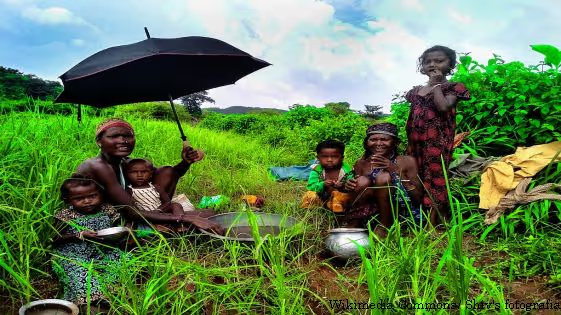
Implementing Forest Rights Act: Story of two villages in Maharashtra
The Forest Rights Act, 2006 was a landmark forest legislation in India, which recognised individual and community rights over forest resources. However, as of November 2018, only 44.83% of titles have been distributed among the total number of claims received across the country. Based on field studies in Maharashtra, Sayak Sinha describes the various issues in the implementation of the Act that make it difficult for the historically marginalised tribals and forest-dwellers to obtain rights.
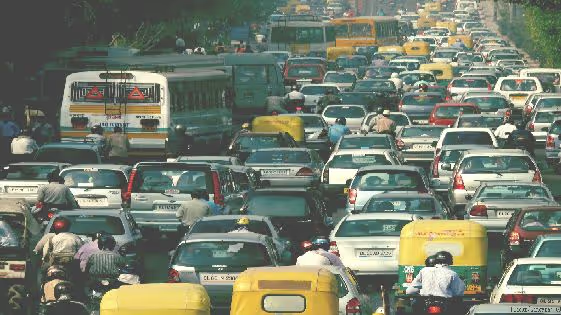
Covid-19, population, and pollution: A roadmap for the future
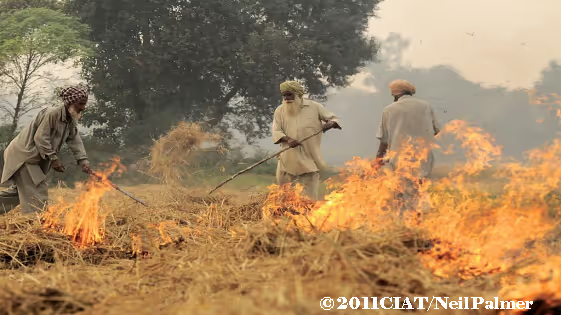
The impact of the ongoing Covid pandemic is turning out to be multidimensional, and among the long-run considerations that it has brought to the fore are population and pollution. In the run up to World Environment Day on 5 June, Rishabh Mahendra and Shweta Gupta discuss these issues in the context of the current crisis, and draw policy lessons for the future.

Covid-19: Green stimulus to revive a comatose economy
The economic impacts of Covid-19 in India are likely to be quite steep. Singh and Mohan contend that any stimulus package to restart the economy has to be ‘green’; it must encourage an economic path that reduces the carbon intensity of the economy, instead of propping up business models that have no place in a future low-carbon world. They further discuss what steps can be taken in three key areas: electricity, transport, and the urban economy, to deliver broad-based growth and improve environmental outcomes.

Impacts of water loss on low-income farmers in Karnataka
Worsening environmental conditions threaten to undermine progress in reducing rural poverty. This article studies the effects of increasing water scarcity in India. It finds that drying up of wells results in a precipitous and persistent decline in farm income and wealth, with little evidence of agricultural adaptation. However, farmers take up relatively more off-farm employment opportunities, particularly in locations with a more developed manufacturing sector.
Delhi’s air: Parikshit Ghosh speaks with Mohan P George
Edited excerpts from an in-depth interview with Dr. Mohan P George (Senior Scientist, Delhi Pollution Control Committee), conducted by Parikshit Ghosh (Member of the I4I Editorial Board; Associate Professor, Delhi School of Economics) on the crucial public policy problem of air pollution in Delhi.
The child health impacts of coal: Evidence from India’s coal expansion
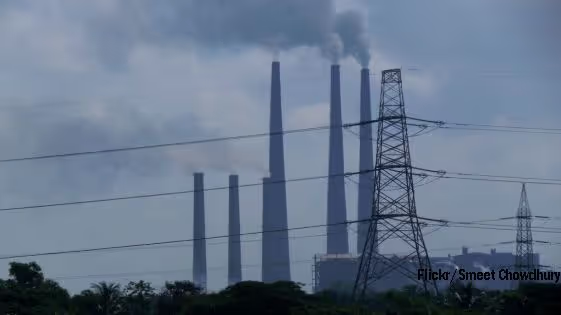
In recent years, electricity generation from coal has rapidly increased in India. This article explores the consequences of India’s large and ongoing coal plant expansion on child health and human capital. It finds that children who are born exposed to a median-sized coal plant are shorter than those who are born with no coal plant exposure. Supporting air pollution as a channel, effects are larger among children living closer to coal plants.
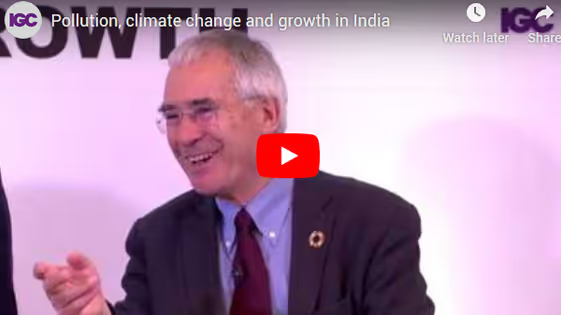
IGC Panel Discussion: Pollution, climate change, and growth in India
In September 2019, the International Growth Centre (IGC) organised a panel discussion in New Delhi to bring together experts to deliberate on issues related to pollution, climate change, and growth in India. The panellists for the discussion were Michael Greenstone (Energy Policy Institute at the University of Chicago), Nicholas Stern (London School of Economics) and Ulka Kelkar (World Resources Institute). The session was chaired by Kanika Chawla (CEEW Centre for Energy Finance).

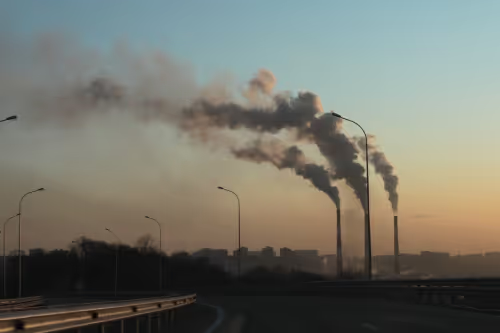
Sign up to our newsletter to be notified about the latest updates
.svg)
Just One Step Away!
Complete your signup to start getting the latest news, stories, and updates delivered straight to your inbox.