
.svg)
.svg)
%201.svg)
%201.svg)
.svg)

.svg)
.svg)

.svg)

.svg)

Environment
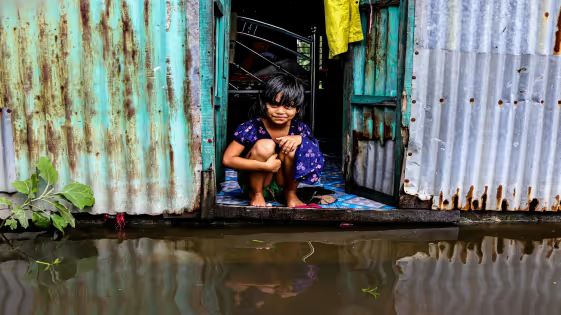
Climate migration frightens... climate poverty is frightening!
There has been much discourse on how long-term climate change will affect human mobility in the 21st century. This article estimates the long-term welfare and mobility responses to climate change. Depending on the scenario, climate change will force between 210 and 320 million people to move, mostly within their own countries. Massive international flows of climate refugees are unlikely, except under generalised and persistent conflicts. The poorest economies will be hardest hit, thus increasing global inequality and extreme poverty.



IGC Panel Discussion: Should electricity be a right?
In September 2019, the International Growth Centre (IGC) hosted a panel discussion in New Delhi to bring together experts to discuss whether a basic minimum quantity of electricity should be available to all and what action could be taken to solve the problem of restricted power supply. The panellists included Robin Burgess (IGC and London School of Economics and Political Science), Anant Sudarshan (University of Chicago), Michael Greenstone (University of Chicago), and R. Lakshmanan (Rural Electrification Corporation Ltd). The discussion was moderated by Rahul Tongia (Brookings India).
Is adaptation to climate damages a blessing or curse for developing nations?
Pathways reflecting current climate action commitments by different nations mean a global warming level much higher than the level at which the world will be faced with manageable climate damages. Furthermore, developing countries are going to face the maximum brunt of these damages. In this post, Ingmar Schumacher argues that it is in the interests of developing countries to pursue full international cooperation on mitigation of climate change.
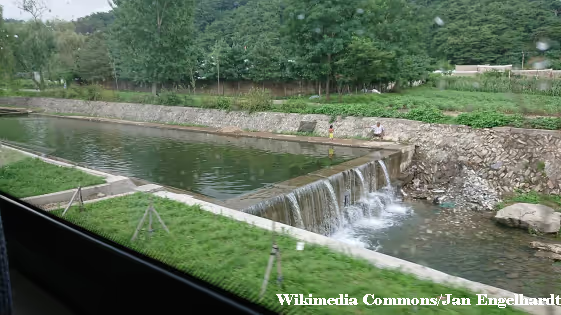
Usharmukti project: A confluence of institutions for rejuvenating rivers
Usharmukti, a project of the Government of West Bengal, is being carried out in collaboration with civil society organisations in the western part of the state, to carry out watershed activities under MNREGA to conserve soil and water. In this note, Ashwini Kulkarni describes the main idea behind and working of the innovative project from her visit to the project area.
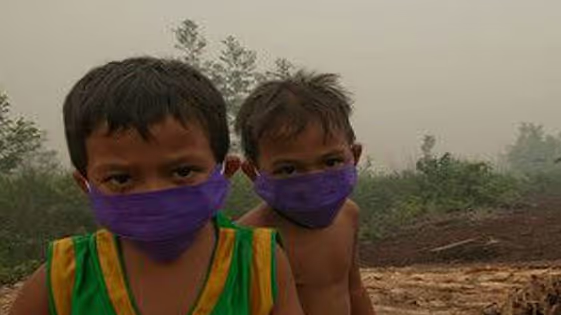
Early-life exposure to air pollution: Effect on child health in India
More than half of Indian population gets exposed to PM2·5 greater than the annual limit recommended by the National Ambient Air Quality Standards. This article examines the effect of outdoor air pollution on child health by combining satellite PM2.5 data with geo-coded Demographic and Health Survey of India. It finds that children exposed to high levels of pollution in their early lives have worse child health outcomes than those exposed to lower levels of pollution.

How much do households contribute to ambient air pollution in India?
Burning solid fuels like firewood in homes for cooking, heating, and other energy services is the single largest source of air pollution exposure in India. In this post, Chowdhury, Chafe, Pillarisetti, Lelieveld, Guttikunda, and Dey compare the estimates of the percentage contribution of household fuel combustion to ambient air pollution, from seven independent studies. They argue that cleaning up household fuel use benefits those directly exposed, in addition to having broader population benefits by reducing ambient air pollution.
The ‘Right to Energy’ and carbon tax: A game changer in India
India's carbon emissions in 2014 were more than three times its level in 1990. While the emissions have increased sharply, their distribution across income groups is extremely skewed. The poor in India who contribute the least to climate change face the maximum brunt. In this post, Azad and Chakraborty discuss a proposal of taxing carbon while redistributing the revenue to the poor by giving them access to free energy up to a limit.
Compensatory afforestation funds: A means or an end?
India has one of the most ambitious targets for forest cover as part of its Nationally Determined Contributions to the Paris Agreement which will require considerable land and financial resources. In this post, Shubham Sharma argues that mere creation of a fund for compensatory afforestation, when natural forests are diverted for development might not be the best solution. Integrated solutions are required to address the causes of diversion of forest land.
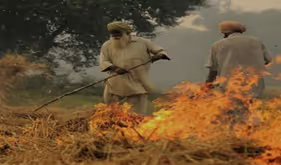
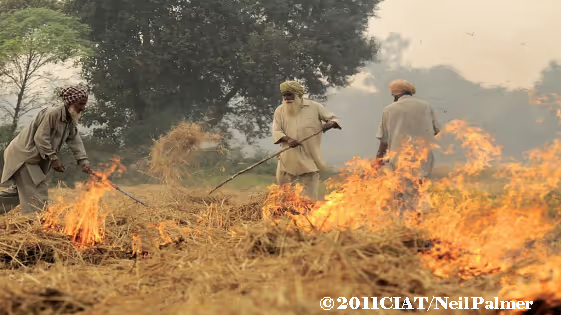
Gone with the wind: Crop-burning and the human costs of pollution
Globally, an estimated 4 million people die prematurely because of air pollution every year. This article exploits seasonal changes in air quality arising due to agricultural fires – used by farmers to clear land for planting – to estimate the causal impact of air pollution on infant mortality across India. It finds that an increase in particulate matter by 10 micrograms per cubic metre results in nearly 96,000 additional under-five deaths annually.

Sign up to our newsletter to be notified about the latest updates
.svg)
Just One Step Away!
Complete your signup to start getting the latest news, stories, and updates delivered straight to your inbox.