
.svg)
.svg)
%201.svg)
%201.svg)
.svg)

.svg)
.svg)
.svg)
India’s primary healthcare reform: Improved service delivery, reduced mortality
.svg)

.svg)
Human Development

The unintended positive consequences of India’s safe motherhood programme
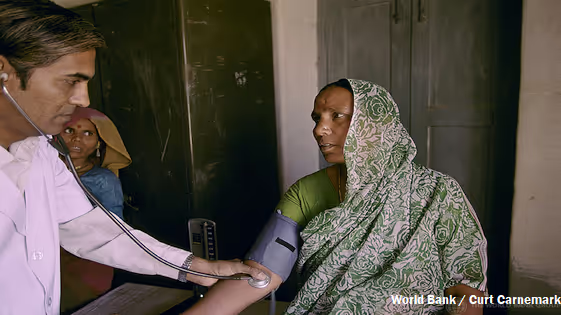
India’s flagship maternal health intervention, Janani Suraksha Yojana, provided conditional cash transfers to women opting for institutional deliveries. In this study, Chatterjee and Poddar document large positive spillovers of this programme on children’s educational outcomes. They find that these spillovers accrue to the already born elder children in the household through increased investments in human capital and changes in fertility preferences among women beneficiaries of the programme.


Low-tech and teacher support interventions during school closures
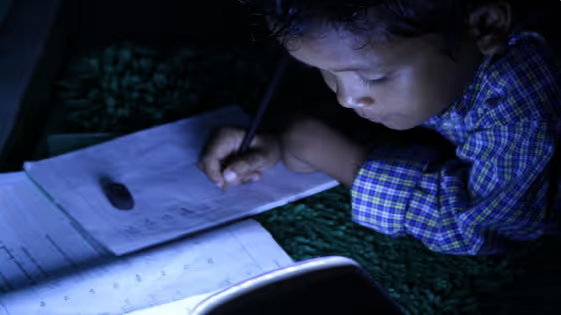
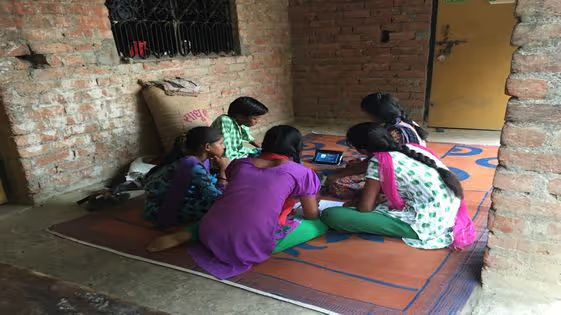
School closures during Covid-19 significantly impacted early childhood education, especially in households without sufficient parental engagement. Using data from households affiliated with Balwadis and preschools in Mumbai and Pune, Vernekar et al. find that those with access to a structured educational technology programme reported higher engagement levels. This effect was even greater for households that also received teacher support. They make a case for using such ed-tech programmes for blended schooling to minimise learning inequalities in case of future shocks.
A data story on female child marriage in India
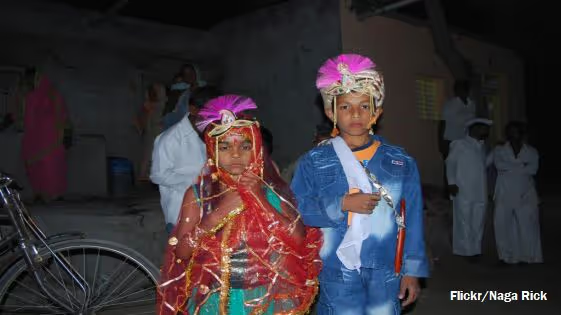
In the eighth post of I4I’s month-long campaign to mark International Women’s Day 2023, Shubham Mudgil and Swathi Rao from The Quantum Hub use a novel dataset based on NFHS-5 to present data highlights on child marriage in parliamentary constituencies across India. They trace the prevalence of female child marriage and the extent to which the situation has improved in certain states over the years. They discuss the issue of underreporting, and the need for a holistic approach of empowering women to ensure reduction in female child marriage rates.
Time poverty for girls: Implications for educational attainment and workforce participation
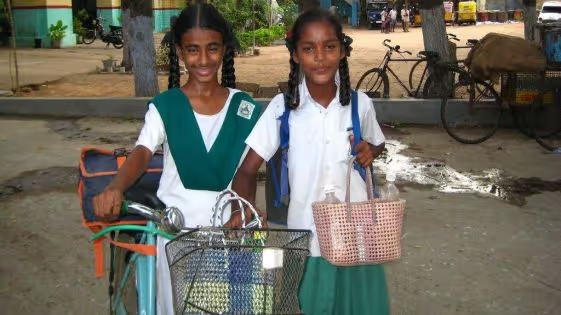
In the fifth post of I4I’s month-long campaign to mark International Women’s Day 2023, Priyadarshini et al. leverage time use data from a study in Bihar, and find that girls take on a majority of domestic duties, and spend significantly less time studying or preparing for entrance exams. However, they note that since the pandemic, male participation in unpaid household work has increased. They also present qualitative evidence which shows that attitudes towards the conventional division of work are slowly changing among some youth.
Understanding intergenerational educational mobility with conflicting evidence
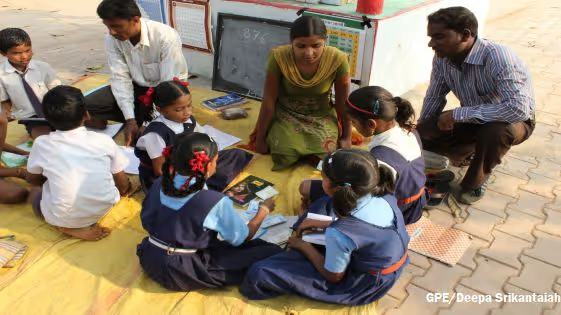
There is a growing literature on intergenerational educational mobility that explores how parental education influences the educational attainment of children. This article compares three empirical models widely used to study intergenerational educational mobility. Using data from India, China and Indonesia, it finds that conclusions regarding educational mobility vary substantially across different models. . It argues that rank-based measures are not suitable for understanding the effects of economic policy, and suggests that policy advice should focus on the measures based on years of schooling.

Is open defecation still prevalent in rural north India?
In an attempt to understand open defecation in four focus states in the aftermath of the Swachh Bharat Mission, Vyas and Gupta evaluate the findings of the NFHS-5. They note that the NFHS is likely to underestimate open defection rates due to their use of data collected at the household level, and the possibility of response bias. After adjusting the estimates, they find that about half of rural Indians in the focus states defecated in the open in 2019-21.

Phone-based assessment data: Triangulating schools’ learning outcomes
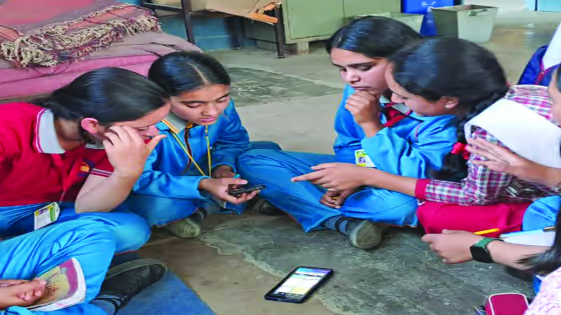
Recent research has shown that schools often report overestimated learning outcomes, as they fear adverse consequences if they report poor performance. In this post, Gupta et al. describe a pilot study to measure reliability and validity of phone-based assessments, in which they tested students in Uttar Pradesh both over the phone and in person. They reveal that students performed similarly in both modes, and put forth some recommendations to state government looking to scale phone assessments and improve data reliability.

Credit cooperatives: Promoting worker well-being during crises?
Research shows that access to alternative credit mechanisms during the pandemic enabled informal women workers to gain financial security, benefitting their mental well-being in the process. Based on the results of a survey conducted by SEWA Bharat in 2021, Devika Oberoi discusses the mechanisms through which credit cooperatives increase financial security and create networks among women, and suggests some policy interventions which can encourage financial inclusion and improve women's resilience in times of crisis.
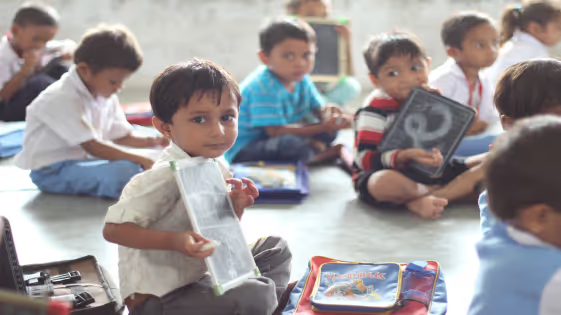
India’s early years mathematics curriculum: Continuity, discontinuity and progression
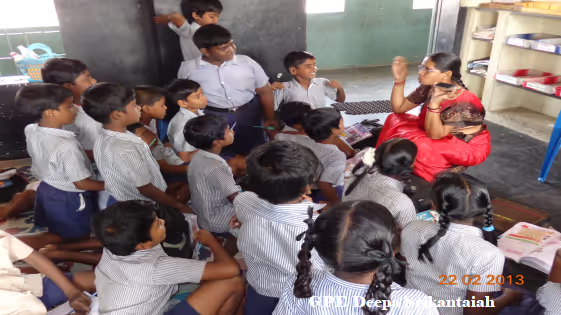
Research has shown the importance of building strong foundations for learning, as the development of cognitive skills in preschool and early primary years is predictive of later mathematical achievement. This article examines the national curriculum for mathematics and learning materials used in three states and finds that state textbooks do not always follow the prescribed content and there is a lack of continuity between the curriculum followed during preschool and early years of primary school.

Sign up to our newsletter to be notified about the latest updates
.svg)
Just One Step Away!
Complete your signup to start getting the latest news, stories, and updates delivered straight to your inbox.