
.svg)
.svg)
%201.svg)
%201.svg)
.svg)

.svg)
.svg)
.svg)
.svg)

.svg)
Poverty Inequality

Economic mobility in India: Estimation using ‘noisy’ data
There has been a dramatic rise in inequality in India post-liberalisation. This article finds economic mobility to be markedly low, with at least seven out of 10 poor households remaining poor or at-risk of being poor during 2005-2012. It also finds that Muslims, lower-caste groups, and rural households are in a more disadvantageous position in terms of escaping poverty or transitioning into poverty compared to Hindus, upper-caste groups, and urban households.


EWS reservation in higher education: Affirmative action or vote bank politics?
The Constitution (103rd Amendment) Act, 2019, provides for 10% reservation for the economically weaker sections (EWS) in higher educational institutions within the general category. In this post, Devika Malhotra Sharma argues that the reservation would adversely affect all the other oppressed categories by shrinking the competitive pool of seats accessible to them. Further, it does not seem justifiable as candidates from EWS are already well-represented in higher educational institutions.
Household-level effects of affordable housing: Evidence from Mumbai
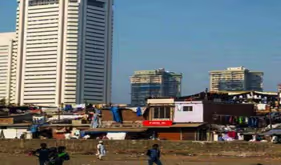
Programmes involving sale of subsidised houses to lower-middle class households have been spearheaded in all major Indian cities. This article studies the effects of one such programme implemented through lotteries in Mumbai, on winners’ attitudes. It finds that winning an apartment increases beneficiaries’ knowledge about local politics, and their reported political participation to improve neighbourhoods. It also has large positive effects on educational attainment and employment outcomes of their children.
Challenges in decentralised implementation of centrally mandated anti-poverty programmes
Even when the central government is committed to a jobs guarantee, rationing of work opportunities can arise under decentralised implementation in poor places. This article examines India’s efforts to implement such a scheme and finds that there are two main drivers of this rationing: local administrative costs and local corruption. Partial administrative reforms by the Centre can have perverse effects. Deeper policy reforms are needed to assure that stipulated rights for poor people are attained in practice.
Wealth inequality, class, and caste in India: 1961-2012
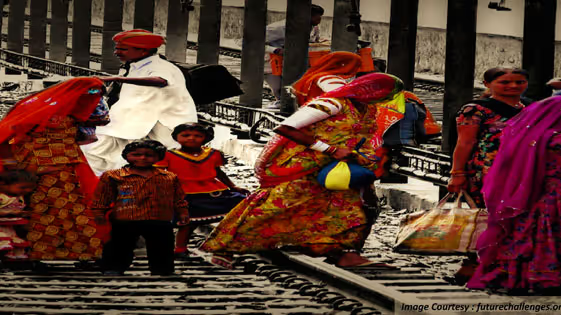
The level of wealth inequality in India is close to that of some highly unequal countries in the world. This article assesses the long-term evolution of wealth inequality in the country for the period 1961-2012, and finds a strong rise in wealth concentration within the top decile of the population. It also explores the changing relationship between class and caste and the mechanisms behind rising inequality.
What do poor people think about direct cash transfers?
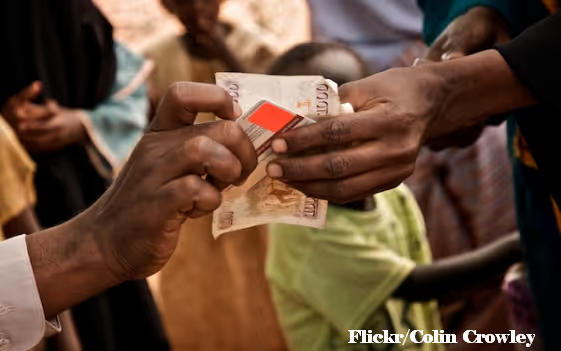
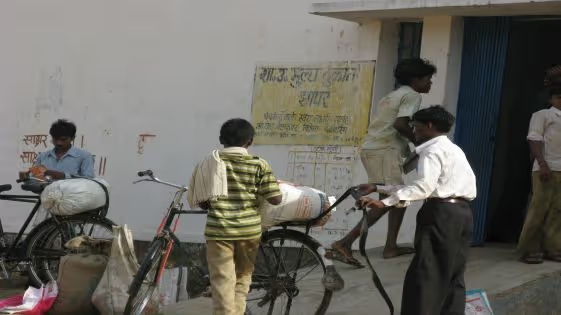
Based on a survey conducted over November-December 2018 with 3,800 respondents in rural Bihar, Khemani, Habyarimana, and Nooruddin present descriptive evidence on what the poor citizens of India think about spending public budgets on direct cash transfers rather than on other welfare programmes.
NYAY e-symposium: Tool for addressing multidimensional poverty
Ashwini Kulkarni (Director, Pragati Abhiyan) puts forth the view that an unconditional income transfer programme like NYAY can help address multidimensional poverty and enable the most vulnerable among the poor to think beyond their survival. She suggests designing a ‘special purpose vehicle’ for the implementation of NYAY.
NYAY e-Symposium: Prioritise expansion of National Social Assistance Programme
Dr Pronab Sen (Country Director, IGC India) argues that the first priority should be to expand existing social security, which covers the elderly, the handicapped, and widows – given the fact that much of poverty is due to high dependency ratios. More importantly, this would be much less divisive than how NYAY is currently being envisaged.
NYAY e-Symposium: Crucial to look into taxes for financing
Prof. S. Subramanian (National Fellow, Indian Council of Social Science Research) emphasises the importance of dealing directly with the question of enhanced taxation and some estimate of the likely order of magnitude of the required enhancement – in order to accommodate an income transfer scheme.
Sign up to our newsletter to be notified about the latest updates
.svg)
Just One Step Away!
Complete your signup to start getting the latest news, stories, and updates delivered straight to your inbox.