
.svg)
.svg)
%201.svg)
%201.svg)
.svg)

.svg)
.svg)
.svg)
.svg)

.svg)
Poverty Inequality
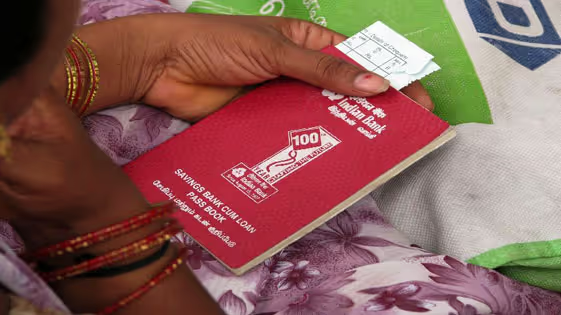
Covid-19 relief: Are women Jan Dhan accounts the right choice for cash transfers?
While the relief package announced by the Government of India for Covid-19 rightly complements food rations with cash transfers, the case for using the list of women Jan Dhan bank accounts for the latter is not clear. In this post, Anmol Somanchi estimates the coverage of these accounts, and finds that more than half of all women, andshows that a little less than half of all households are likely be excluded from cash relief and discusses other limitations of this approach.


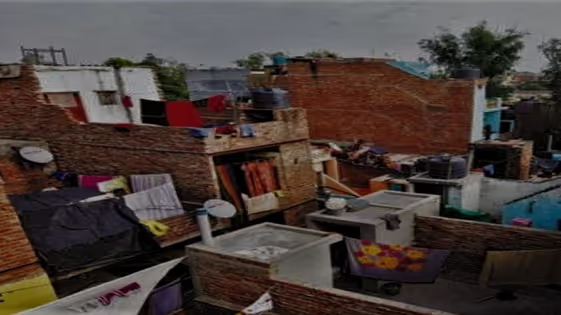
How has Covid-19 crisis affected urban poor? Findings from a phone survey - II
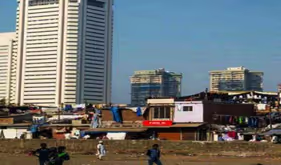
While several commentators have highlighted the plight of migrants due to the ongoing Covid-19 crisis, less is known about how low-income families living in urban shanty towns are faring. Afridi et al. began conducting a phone survey on 3 April – after the Covid lockdown was announced on 24 March – among a sample of households in the industrial areas of Delhi, to assess the impact on their livelihoods, and physical and emotional well-being. In their recent note, the researchers discussed findings from the initial, more stringent period of the lockdown (3-19 April). In this follow-up note, they report findings from Phase 2 of the lockdown, following some easing of restrictions (20 April-3 May).
Webinar: Impact of Covid-19 on informal and migrant workers in India
The International Growth Centre (IGC), in collaboration with I4I, organised a Webinar on 'The impact of Covid-19 on informal and migrant workers in India', with Jean Drèze (Ranchi University), Farzana Afridi (Indian Statistical Institute), Purnima Menon (IFPRI), and Shahid Vaziralli (IGC), on 13 May 2020.
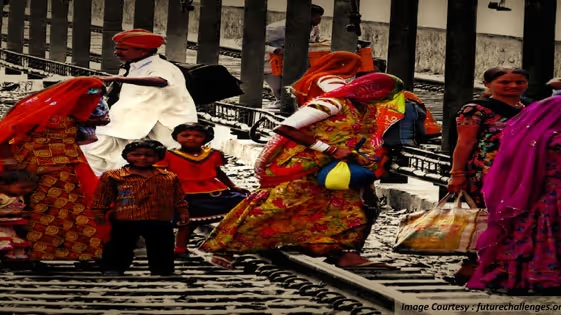
How has Covid-19 crisis affected the urban poor? Findings from a phone survey - I
While several commentators have highlighted the plight of migrants due to the ongoing Covid-19 crisis, less is known about how low-income families living in urban shanty towns are faring. In this note, Afridi et al. discuss findings from a phone survey of a sample of 413 households in the industrial areas of Delhi, on the impact on their livelihoods, and physical and emotional well-being. They also provide some insights into the gendered experience of this crisis.

Balancing corruption and exclusion: Incorporating Aadhaar into PDS
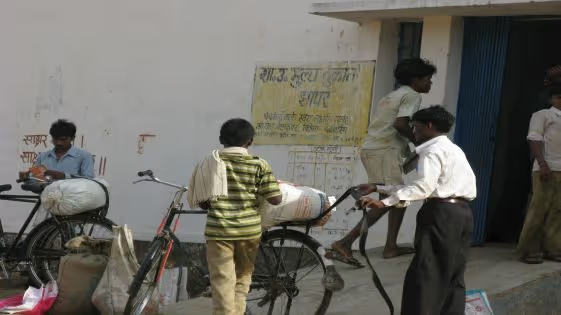
How should recipients of publicly provided goods and services prove their identity in order to access these benefits? This article reports findings from a large-scale experiment across 15 million beneficiaries to evaluate the effects of more stringent identification requirements based on biometric authentication, on the delivery of subsidised food through Public Distribution System in the state of Jharkhand. It finds that attempts to reduce corruption has cost some low-income households their benefits in the process.
Covid-19: What can be done immediately to help vulnerable population
With over 80% of India’s workforce employed in the informal sector and one-third working as casual labour, Covid-19's spread and subsequent unplanned lockdowns, have created economic havoc in the lives of millions. In this post, Reetika Khera puts forward suggestions on what can be done to help people immediately, ranging from cash and in-kind assistance to special measures for migrants in urban areas and urgent health-related measures.
Populism: Why in rich countries and in good times
Economic anxiety and insecurity are often cited as drivers of populism, so why has populism emerged over the past few years in rich countries and in good times? This article argues that when the economy is strong, everyone fares well but the rich fare especially well, fuelling inequality and resentment. Populism in the form of anti-globalisation may reduce everyone’s consumption, but it affects the rich disproportionately and thus appeals to many voters in richer countries. In poorer countries, however, voters are less willing to give up consumption for equality.
What is happening to rural welfare, poverty, and inequality in India?
An analysis of the draft National Statistical Office report that the Government has decided not to put out shows a deterioration in 2017-18 in consumption and poverty levels in rural India. The reasons may be the demonetisation of 2016 and the shoddy introduction of goods and services tax (GST) in 2017. This article carries the analysis forward with some additional results and analyses relating to trends and levels of consumer expenditure in rural India.
Sign up to our newsletter to be notified about the latest updates
.svg)
Just One Step Away!
Complete your signup to start getting the latest news, stories, and updates delivered straight to your inbox.