
.svg)
.svg)
%201.svg)
%201.svg)
.svg)

.svg)
.svg)
.svg)
Night shift bans and female employment in Indian manufacturing
.svg)

.svg)
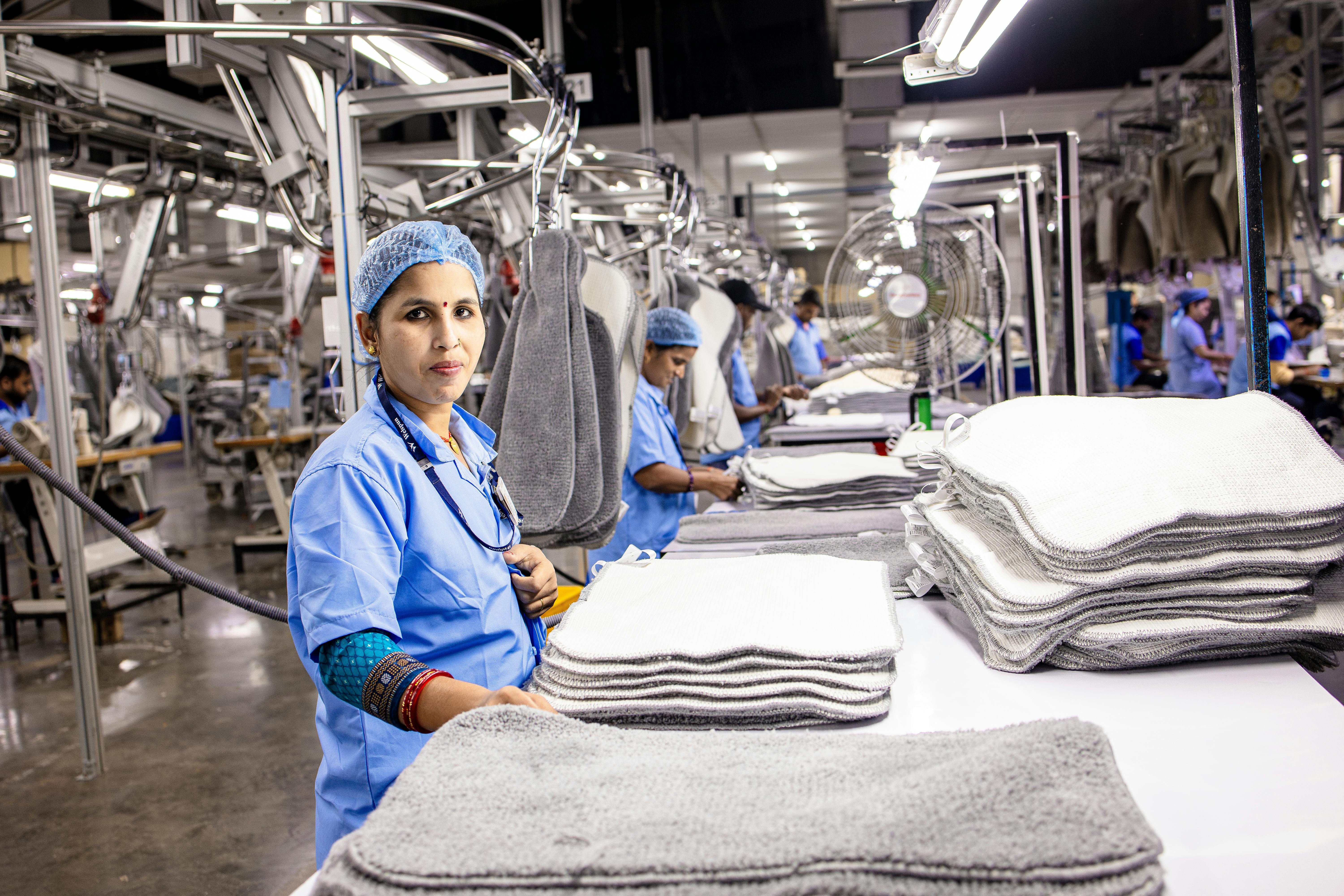



Productivity and Innovation

A review of women’s engagement with digital labour market platforms
Summarising some findings from ongoing work being done as part of the DP-WEE project, Sneha Ganguly highlights how the emergence of digital labour platforms have the potential to improve women's access to jobs, reduced gendered bias in certain roles, and allow women to flexibly monetise existing assets. She discusses the need for facilitating skilling, providing greater access to technology for women, as well as ensuring safety in the workplace and offering financial incentives to achieve a gender balanced workforce.



How worker investments can fuel productivity in India’s manufacturing sector
In the second article in the Ideas@IPF2023 series, Adhvaryu et al. synthesise some facts on India’s declining manufacturing productivity and variations across states and industries. They examine existing literature on investments in four key areas with the potential to increase worker productivity – soft skills, voice, physical environment, and managerial quality – highlighting studies conducted in both the Indian and global context. They conclude with possible reasons why firms may not be adequately investing in workers.

AI and services-led growth: Evidence from Indian job adverts
Using a new dataset of online vacancies from India’s largest jobs website, Copestake et al. document near-exponential growth in the demand for artificial intelligence-related skills in the services sector since 2016, coinciding with the take-off in developed countries. They find that the demand for AI skills by establishments has a negative impact on labour demand for non-AI roles and on the top percentile of wages, driven by the displacement of high-skilled, managerial occupations and non-routine, intellectual tasks.

Implicit costs of factor allocation for Indian firms
Looking at variations in factor misallocation across states, Chaurey et al. measure trends in factor adjustment costs incurred by firms between 1999 and 2014. They find that adjustment costs for labour and land across India fell during this period, with the decline in labour adjustment costs declining significantly faster in states with fast growing manufacturing. They discuss other factors which affect adjustment costs, including firm size and governance quality of state, and the pattern between misallocation and low growth.

The gendered employment effects of mobile internet access in developing countries
In the third post of I4I’s month-long campaign to mark International Women’s Day 2023, Goldberg and Chiplunkar look at 3G internet coverage in 14 countries, and find that access to mobile internet allows women to enter the labour force, and start small businesses and get service-sector wage jobs. However, they notice that 3G access also leads to better employment opportunities for men, who leave their unpaid agricultural jobs to be filled by women.
Bringing skilling and productive employment closer to women
On International Women’s Day, Farzana Afridi considers a key issue in the creation of good jobs for women – the provision of skilling. She discusses the lack of physical and financial access to skill training, shortage of demand-relevant and high-quality programmes, and inefficient matching with jobs post-training. While highlighting recent government proposals to address these concerns – such as launching a unified Skill India Digital Platform – she contends that a more gender-sensitive approach is needed.
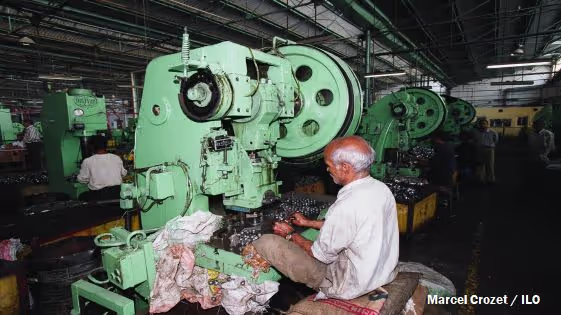
Formalisation of informal manufacturing enterprises in India
Employment in India’s organised manufacturing sector has grown rapidly since 2004. This article finds that about 15% of this growth can be attributed to the formalisation of previously informal enterprises, and expects that, as the new labour code is implemented, the output and employment of relatively bigger informal manufacturing establishments will rise significantly, with concomitant gains in productivity. The productivity potential of such informal enterprises needs to be adequately exploited with investment in ICT and other fixed assets.

I4I@10 | First Ashok Kotwal Memorial Lecture: The future of development
What is the 'fourth' fundamental law of capitalism? Will capital ‘inherit the earth’? Has the pandemic quickened the intuitive appeal of the capital-labour substitution? Should sovereign funds be based on corporate wealth, not just natural resources? Would Universal Basic Income work in a relatively poor country like India? In the first annual Ashok Kotwal Memorial Lecture, Professor Debraj Raj talks about the future of development, and the contribution of labour, capital and automation in growth. After a quick introduction, he dispels the notion of balanced growth by showing that, far from being constant, the share of labour is falling, over time, across countries, and within sectors. Presenting employment elasticities of different sectors, and labour shares for many economies, he establishes the ubiquity of capital-labour substitution. We see GDP growth has outpaced employment growth in India too, even though there is an abundance of cheap labour. ...

The promise of technology for women’s employment
The growth of digital labour platforms holds tremendous potential to improve employment outcomes for India’s young, urban population. In this post, Farzana Afridi discusses the challenges in leveraging this technology – especially for women, given their lower access to technology, skills, capital and public spaces. She calls for the creation of a data ecosystem – including public and private sources – to analyse the issues and develop suitable policies to fully realise the sector’s promise.


Sign up to our newsletter to be notified about the latest updates
.svg)
Just One Step Away!
Complete your signup to start getting the latest news, stories, and updates delivered straight to your inbox.