
.svg)
.svg)
%201.svg)
%201.svg)
.svg)

.svg)
.svg)
.svg)
Night shift bans and female employment in Indian manufacturing
.svg)

.svg)




Productivity and Innovation

Management and India’s economic growth
India has produced a well-recognised elite of managers, some of whom have demonstrated their capabilities in premier firms outside the country. In this post, Nirvikar Singh discusses existing empirical evidence from India that demonstrates the importance of managerial skills for economic growth, and recommends policy measures that can promote good management.


India’s R&D expenditure: Composition matters
While gross expenditure on R&D in India has been on the rise in recent years, it is dominated by public investment. In this post, Sanjib Pohit contends that the current system of allocating public funds for R&D is geared towards low-risk, low-return incremental research, and should instead promote innovative research. He also recommends encouraging private investment in ‘core’ R&D activities via tax incentives.

Tripura’s bamboo sector: Potential and challenges
About a third of the total area of Tripura is covered by bamboo, and bamboo has emerged as a key thrust area for the state’s industrial development. Based on a field visit that was undertaken to study skill development in Tripura’s bamboo sector, Bornali Bhandari discusses the livelihood-based approach of Tripura Bamboo Mission vis-à-vis a market-based approach adopted by a private bamboo wood manufacturing unit.
Role of private sector in the holistic skilling of India’s workforce
Low skill levels of workers are a key reason for low labour productivity in developing countries. In this article, Adhvaryu et al. discuss research that centres around two important questions in this context: who should conduct and pay for skilling, and what kind of skills does the workforce need?
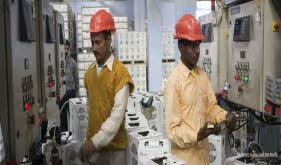
Introduction to e-Symposium: Firms and labour productivity
Eighty per cent of India’s labour force works ‘informally’. Providing employment with decent wages and benefits to this segment requires structural transformation of the economy to more high-productivity sectors. I4I Editor Farzana Afridi is hosting an e-symposium to bring together some fundamental issues around the challenge of raising labour and firm productivity in the country.

Parikshit Ghosh speaks with Debraj Ray
In this podcast, Parikshit Ghosh (Member of the I4I Editorial Board & Associate Professor, Delhi School of Economics) speaks with Debraj Ray (Julius Silver Professor, Faculty of Arts and Science, and Professor of Economics, New York University) on the rise of Trump and how it relates to the upsurge of inequality in the US and the ‘American dream’ narrative; implications of the process of automation for the relative shares of capital and labour as factors of production; the idea of committing a share of gross domestic product for the provision of a universal basic income; and the challenges involved in addressing inequality of wealth.
Let Them Buy Light: The Welfare Benefits of Electricity for Rural Households and Enterprises
This project measured the welfare effects of increased access to electricity for rural households and micro-enterprises by letting them buy light. The research design experimentally offers off-grid, solar connections through a randomized - controlled trial and measures both the willingness to pay for connections and the welfare benefits of a connection once adopted, with special focus on the productivity and education effects that bear on economic growth. Findings inform the formulation of sensible rural electrification policies and inform implementation issues.
Smart data: Can visualised administrative data help inform and hold public stakeholders accountable?
The project examined how interactive data visualisations can be used to present administrative data in a way that is easily digestible, lends itself to exploration and provides a clear link to required action for administrators. The findings from the project showed that government officials responded more to visualised data as compared to plain tabular data.
The Benefits of Solar Technology Adoption for Street Vendors in Bihar
This project evaluates the socio-economic impact of distributing solar lighting to street vendors in urban Bihar, in collaboration with a local civil society organization (NIDAN). The findings of the project showed that vendors are forced to choose between inadequate lighting and expensive power from diesel generators operated by local entrepreneurs. Vendors consider improved lighting a top priority and believe that improved lighting could expand their business and attract customers.


Sign up to our newsletter to be notified about the latest updates
.svg)
Just One Step Away!
Complete your signup to start getting the latest news, stories, and updates delivered straight to your inbox.