
.svg)
.svg)
%201.svg)
%201.svg)
.svg)

.svg)
.svg)

.svg)

.svg)
Social Identity
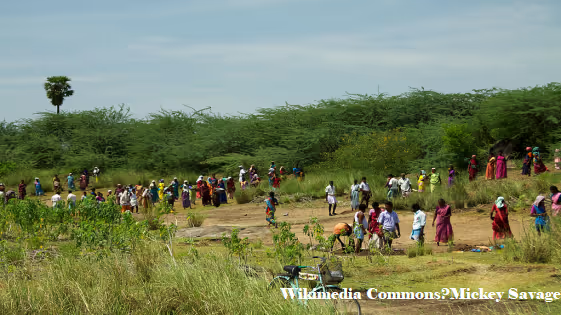
How MNREGA reduced women’s labour force participation
By guaranteeing 100 workdays annually per household in rural India, MNREGA seeks to enhance economic security and alleviate poverty. This article shows that while the programme has successfully achieved these goals, it has inadvertently reduced rural women’s labour force participation and consequently their well-being and household bargaining power. This is because it has reduced the need for women to serve as additional workers in times of male income instability.


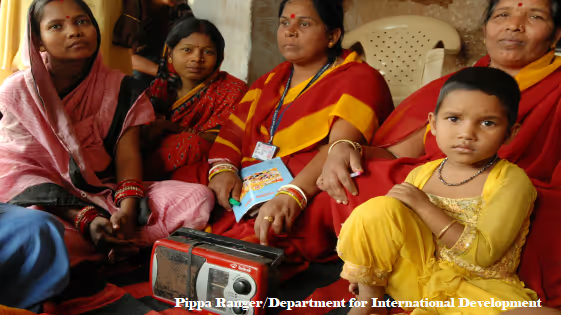
Tuning into empowerment: How community radio affects gender equality
India’s Community Radio Policy, 2006, enables educational institutions and NGOs to establish community radio stations to address local development issues via locally produced content. This article shows that exposure to community radio improves women’s outcomes in terms of education, marriage and fertility. The evidence makes a case for leveraging grassroots media to address gender inequality at scale in developing countries.
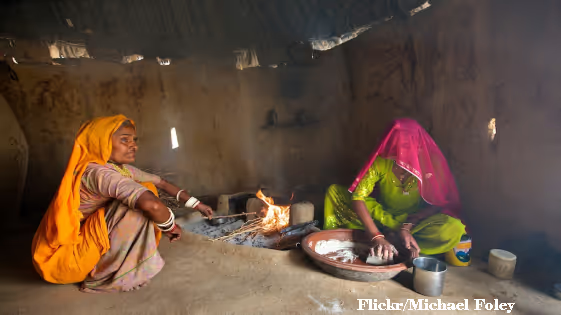
Raising the value of women’s time for a transition to clean fuels
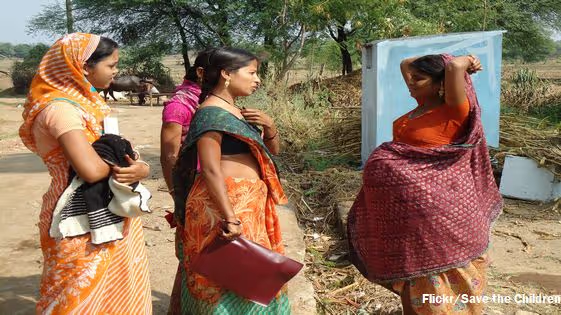
A majority of women in rural India continue to use traditional fuels, adding to the time that they devote to domestic work. In this post, Farzana Afridi discusses findings from a survey in Madhya Pradesh, showing that switching to a clean fuel leads to time saving of about 20 minutes per day on average – but no corresponding increase in women’s workforce participation. She contends that raising the value of women’s work in the labour market can incentivise clean fuel adoption
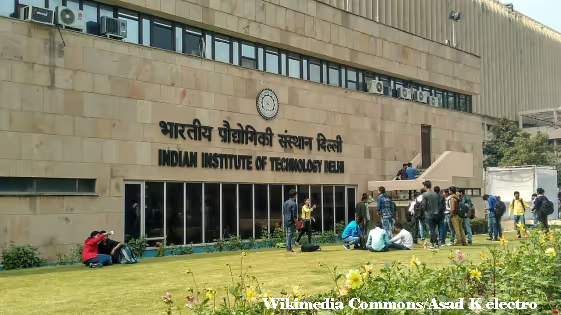
Girls in tech: Evaluating IIT’s Supernumerary Seats Scheme
Introduced in 2018, the Supernumerary Seats Scheme seeks to improve gender ratios among undergraduate engineering students at IITs, which have historically been male dominated. This article shows that the initiative has been successful in getting more females into these elite institutions. Further, on average, although girls start off with lower entry ranks, they are able to match up with their male counterparts academically over the duration of the programme

Sign up to our newsletter to be notified about the latest updates
.svg)
Just One Step Away!
Complete your signup to start getting the latest news, stories, and updates delivered straight to your inbox.