
.svg)
.svg)
%201.svg)
%201.svg)
.svg)

.svg)
.svg)

Street vending: Understanding emotional markups and market interactions
.svg)

.svg)

Urbanisation
Street vending: Understanding emotional markups and market interactions
Despite the ubiquity of street vending in urban landscapes and its significance as a livelihood choice among the poor, it is challenging to collect comprehensive data on vendors – especially children. Based on fieldwork in Delhi, this article analyses buyer-seller interactions and transactions, to understand behaviour on both sides of this informal market. Understanding the complexities of street vending and street-connected children can serve as a crucial input into building resilient and inclusive cities.


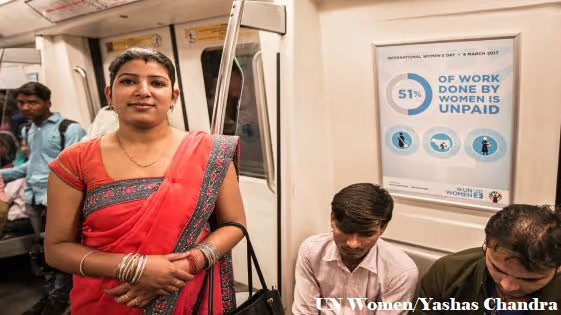
What are the effects of India’s rapid urbanisation on women’s empowerment?
Women in urban areas, compared to their rural counterparts, are thought to enjoy greater social, economic, and political opportunities and freedoms. At the same time, research shows barriers to women’s empowerment remain widespread in urban environments. Given India’s rapid urbanisation and the persistence of gender inequality, this article analyses the effect of urbanisation on women's outcomes – and finds mixed results.
Why is land expensive in India, and what can be done about it?
The price of land in India is high relative to its fundamental value, impacting economic development in the country. In this post, Gurbachan Singh explains why this is so, in terms of two broad factors – the license-permit-quota Raj in urban India, and the Land Acquisition Act, 2013 in rural India. He recommends phasing out the Raj, and eventually abolishing the pricing provisions of the Act.
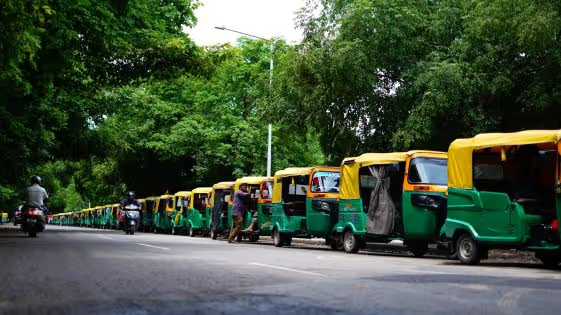
Evidence of illegal fuel use by auto rickshaws in Kolkata
In 2008, in an attempt to improve air quality, the Calcutta High Court mandated that all petrol autos in Kolkata and Greater Kolkata be replaced by liquified petroleum gas (LPG) fuelled autos. However, while investigating the effectiveness of this transition, this article finds that many auto drivers prefer to use cooking LPG – despite it being a more polluting variant – as it reduces fuel costs. This lack of compliance is exacerbated by weak law enforcement and a shortage of refuelling stations.
The role of cities in ensuring good jobs
In light of India's rapid urbanisation, Rana Hasan looks at various factors which set large cities apart from smaller cities and rural areas: more job opportunities, higher wages, large manufacturing and business sectors, and greater innovation. Although cities already attract workers and firms, he discusses what can be done to make cities even more conducive to job creation. He puts forth policy suggestions and calls for increased investment in transportation and infrastructure and better coordinated economic and urban planning.
Are cities holding India back from reaching its ambitious net zero targets?
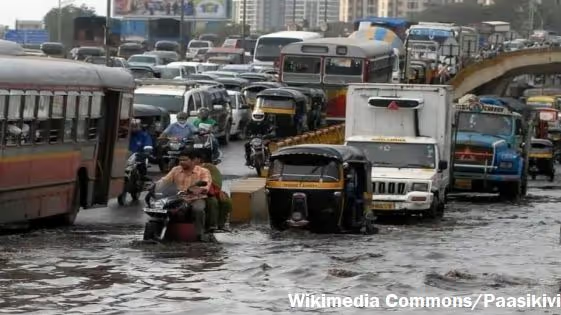
While per capita emissions in global cities are significantly lower than the national average, large Indian cities like Delhi and Kolkata emit up to double the national average. Shah and Downes look at how urbanisation in India could derail national decarbonisation efforts. They suggest a more decentralised approach, where local and national governments work together to minimise the impact of climate change.
Urban India's housing supply response to migration-induced demand
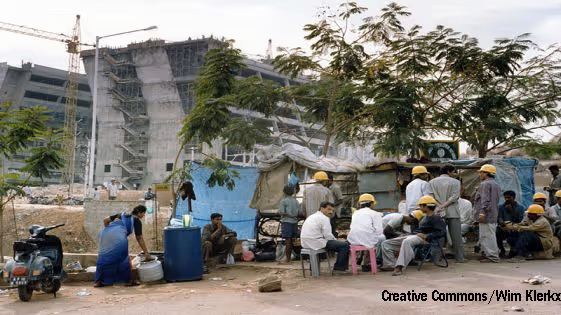
Has urban housing supply in India kept pace with rising demand? Using Census data between 2001 and 2011, this article studies the market supply of housing in response to migration-induced housing demand. It shows that exogenous events like highway investments and droughts in one state affect housing demand in another state through changes in inter-state migration. The article’s findings on housing supply are consistent with the existence of urban gentrification and speculative construction in India during the 2000s.
Making city planning democratic: Reflections from ‘Main Bhi Dilli’ campaign
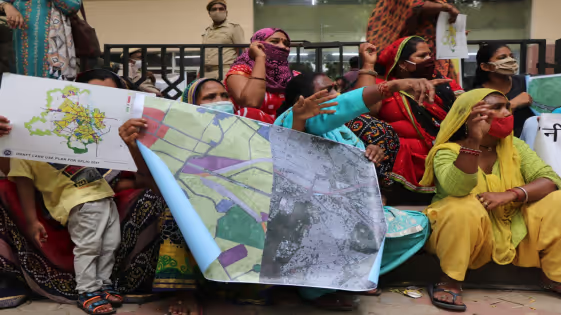
‘Main Bhi Dilli’ campaign was launched in 2018 to ensure inclusion of citizen voices in the Delhi Master Plan 2041. In this context, Shalaka Chauhan discusses the role of co-creation and citizen participation in city-planning processes, rooted in the belief that everybody can contribute to city planning when provided with adequate participatory means and tools to express themselves.
Challenges of solid waste management: The case of Patna city
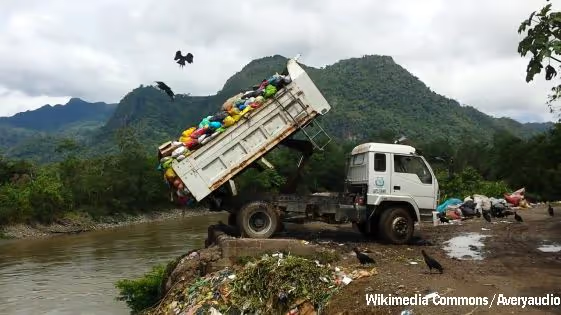
Rapid urbanisation with insufficient planning has led to problems of solid waste management in several Indian cities. In this note, Uma Sarmistha discusses preliminary findings from a field study in the city of Patna in Bihar state, which examines the present state of waste management processes, as well as the perspectives of citizens and authorities on the issue.

Sign up to our newsletter to be notified about the latest updates
.svg)
Just One Step Away!
Complete your signup to start getting the latest news, stories, and updates delivered straight to your inbox.