
.svg)
.svg)
%201.svg)
%201.svg)
.svg)

.svg)
.svg)

Street vending: Understanding emotional markups and market interactions
.svg)

.svg)

Urbanisation
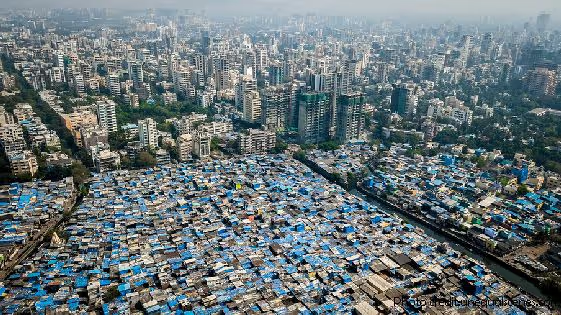
Residential segregation in urban India and persistence of caste
B.R. Ambedkar had exhorted lower-caste people to move towards cities to defy localism and benefit from the virtues of cosmopolitanism that urbanisation might provide. Using 2011 enumeration block-level Census data for five major cities in India – Bengaluru, Chennai, Delhi, Kolkata, and Mumbai – this article finds that not only are Indian cities highly segregated, but population size seems to have no association with the extent of segregation. In fact, the largest cities are some of the most segregated.



Mobility and congestion in urban India
Urban transportation in developing countries is prioritised for massive investments, yet little is known about the determinants of urban mobility in these countries. This article applies a methodology for measuring the performance of overall motor vehicle transportation in a city to the 154 largest cities in India. It finds substantial differences in mobility speeds across large Indian cities but that the variation is driven primarily by uncongested mobility, not by congestion delays.
Special purpose vehicles for smart cities: A question on governance
All 100 cities selected to become ‘smart cities’ under the Smart Cities Mission in India have Special Purpose Vehicles (SPVs) incorporated in them. In this note, Meenakshi Sinha posits that the SPV-driven mode of governance of cities is fraught with power asymmetries that are likely to bolster elite control over city’s resources and urban spaces of governance; thus, aggravating the class inequalities across cities.

Seasonal migration and health in India: Constraints for research and practice
Seasonal migrants in India engage in temporary informal work in work environments that actively flout labour laws on wages, work hours, and living conditions. The most significant impact of this is on the health outcomes of workers and their children. In this note, Varma and Ravindranath describe the roadblocks in conducting in-depth enquiries into migrants’ health status and healthcare-seeking behaviour, and designing and implementing health programmes conducive to their needs.
Rural-urban migration in Bihar
Over the last decade, Bihar has experienced rapid economic growth and increasing urbanisation. The purpose of this project was to investigate the patterns of migration in Bihar. The study found that migrants from Bihar are taking up less agricultural work than in the past and are increasingly moving to work in construction instead. The overwhelming majority of migration in Bihar is cyclical labour migration. Because the majority of migration in Bihar is cyclical, migrants are often unable to access their social entitlements when they are working away from home. This is because social entitlements are currently based on a sedentary model and can only be claimed in the jurisdiction in which an individual is registered. The government should therefore consider making social and political rights portable.
How India’s internal borders inhibit migration
Indians, particularly men seeking education and jobs, display a puzzling reluctance to cross state borders. This article explores the reasons for this migration pattern. A major culprit is India’s system of ‘fragmented entitlements’, whereby welfare benefits are administered at the state level, and state residents get preferential treatment in higher education and government employment. These administrative rules prevent more efficient allocation of labour across the country.
Urban Corridors: Strategies for economic and urban development
The aim of this project is to investigate the impact of India’s corridor model as a strategy for urbanisation and urban development through the lens of land and economic development. Research questions include: Is India’s corridor development policy a strategy for urbanisation (inter alia), or is urbanisation a by-product?
Constraints and prospects of Financing via Municipal Bonds in India: An analysis with case Studies
In order to meet the challenges created by growing urbanisation, municipal corporations in India need to incur huge expenditure to support urban infrastructure in the coming decades.

Sign up to our newsletter to be notified about the latest updates
.svg)
Just One Step Away!
Complete your signup to start getting the latest news, stories, and updates delivered straight to your inbox.