
.svg)
.svg)
%201.svg)
%201.svg)
.svg)

.svg)
.svg)

Street vending: Understanding emotional markups and market interactions
.svg)

.svg)

Urbanisation

Rapid urbanisation, rural-to-urban migration, and rural development: Evidence from 8,000 Indian towns
Rapid urbanisation and declining rural poverty are central features of many developing countries today, but there is little research on their relationship, especially on the impacts of rapid urbanisation on peri-urban and rural areas close to cities. Rural areas are expected to benefit from urban growth, but it is unclear whether these benefits take place via labour markets, goods markets, or rural-to-urban migration. There are many channels through which cities and their hinterlands are connected, but there is little research on the impact of urban growth on the rural hinterland; most of the current research focuses on structural transformation and the effects of agricultural productivity growth on cities rather than the reverse channel.


Congestion pricing to solve traffic jams? Not so fast!
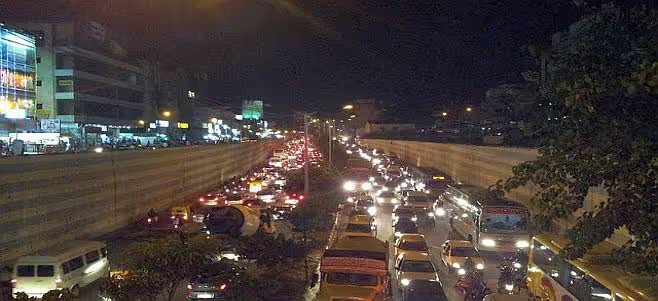
The Lieutenant Governor of Delhi recently said that the city is likely to become the first in India to have congestion charges in certain stretches. This column reports results from an experimental pilot in Bangalore that seeks to assess the effectiveness of congestion pricing as a solution to chronic traffic congestion.
Real estate cross-subsidisation for infrastructure financing: A precarious solution for urban development?
A means of urban development financing that has emerged in Indian cities is real estate cross-subsidisation, whereby land along the mass rapid transit system corridors is offered to private developers for commercial real estate projects, which can then be sold to generate revenue. Based on case studies in Karnataka and Kerala, Meenakshi Sinha provides insights into some of the governance challenges associated with such processes.
Understanding Slum Formation and Designing an Urban Housing Policy for Poor in Bihar
This project identifies the spatial pattern of the urban poor living in slums of four districts of Bihar. It also identified direct and indirect determinants of their settlement locations and understand the impact of various policies, including housing policy and market, on establishment of the informal settlement. The findings of the paper showed that people living in slums of Patna are a classic example of chronic poor.
Smart congestion pricing: Testing travel incentives to reduce congestion in Bangalore
Severe peak-time traffic congestion is endemic in large cities in developing countries, both on roads as well as in public transportation, with important negative consequences. There is a pressing need to improve understanding of how people make travel decisions, and to experiment with new technologies to realign private and social interest.
Does it matter how we assess living standards in slums?
According to the 2011 Census, 17.4% of all urban households in India reside in slums. Analysing data from a household survey of slums in Delhi, Kolkata, and Mumbai, this column assesses living standards of slum-dwellers in terms of monetary and non-monetary indicators. It argues that policy choice and design for improving living conditions in slums need to be adequately tempered according to the nature and veracity of deprivations.
India's slum leaders - I
India’s demographic shift to cities has been accompanied by a number of pressing governance and developmental challenges, among the most serious of which is the rampant spread of slum settlements. Within these poor urban neighbourhoods, certain residents rise to prominent positions of local authority. Based on resident and leader surveys conducted during 2015-2016 in Jaipur and Bhopal, this two-part column provides insights on these informal slum leaders.

Sign up to our newsletter to be notified about the latest updates
.svg)
Just One Step Away!
Complete your signup to start getting the latest news, stories, and updates delivered straight to your inbox.