
.svg)
.svg)
%201.svg)
%201.svg)
.svg)

.svg)
.svg)

Building State capacity for accelerating development through effective governance
.svg)

.svg)
Governance
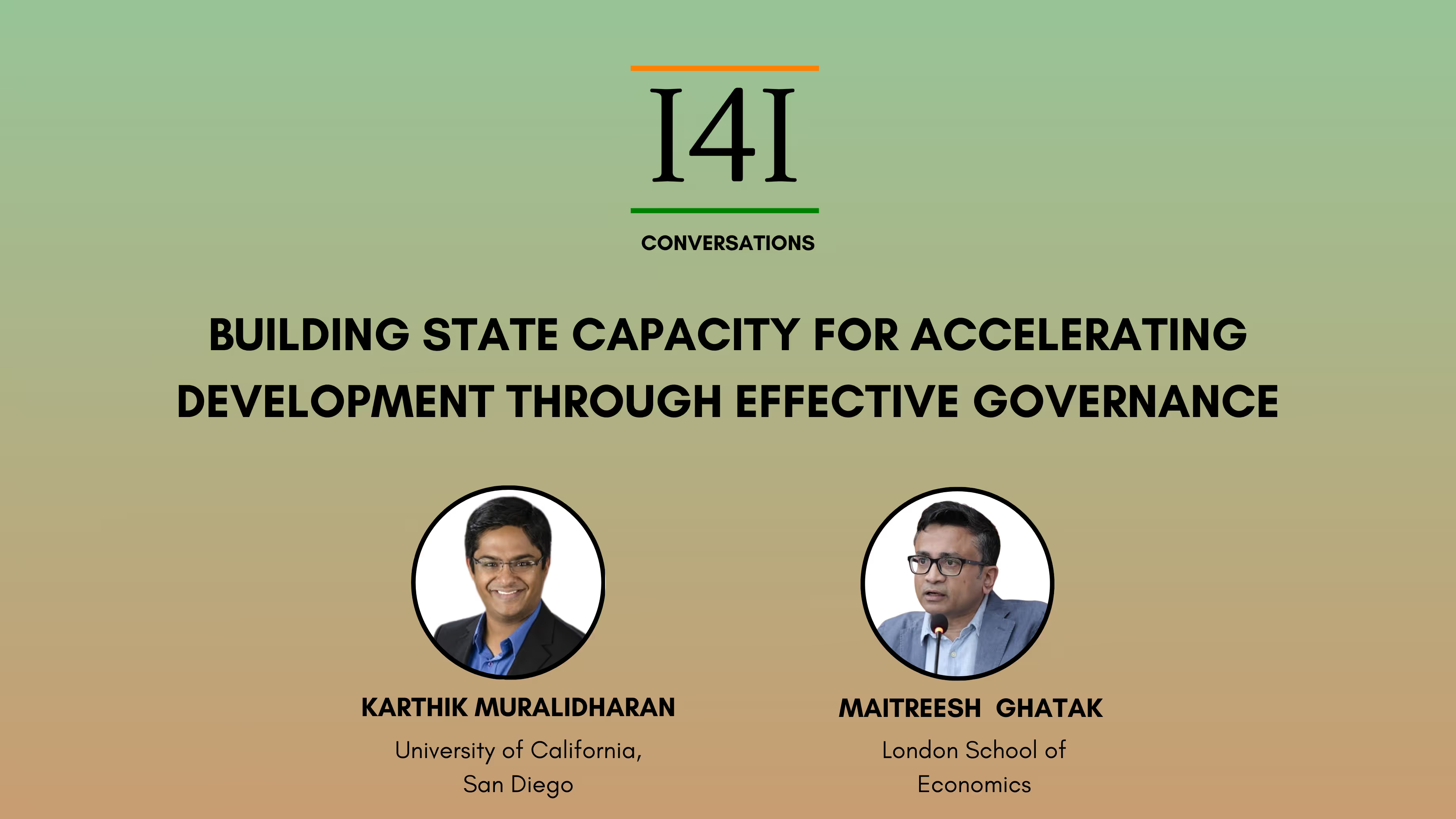
Building State capacity for accelerating development through effective governance
In a new edition of I4I conversations, Maitreesh Ghatak (London School of Economics) is joined by Karthik Muralidharan (University of California, San Diego) to discuss his new book, Accelerating India's Development: A State-Led Roadmap for Effective Governance.


Building State capacity for accelerating development through effective governance
In a new edition of I4I conversations, Maitreesh Ghatak (London School of Economics) is joined by Karthik Muralidharan (University of California, San Diego) to discuss his new book, Accelerating India's Development: A State-Led Roadmap for Effective Governance.

14th Finance Commission: A trust-based approach towards local governments
The 14th Finance Commission has been hailed as ‘path-breaking’ for recommending larger fund allocations to state governments and giving them more autonomy in spending these funds. In this article, Meera Mehta and Dinesh Mehta highlight that the Commission has also recognised the need to trust and respect local government bodies, and has allocated much larger funds to them. Will this approach work and will state governments cooperate?

Accountability and responsibility
Accountability of public institutions and employees is deemed important for them to function for the common good. In this post, Drèze and Sen argue that accountability is only one aspect of a much broader concern for responsibility. Explaining how a sense of responsibility can be an immense force for social progress, they call for bringing such ideas back to the forefront of mainstream economics.

Decentralisation and spatial (mis)allocation of irrigation water
Canal water – an important source of irrigation in India – often tends to be unequally distributed among farmers within a geographical area. Based on a survey in the state of Odisha, following the decentralisation of the management of canal irrigation systems, this article finds that the policy reform has positive impacts – but the details of the institutional design matter.

The influence of local politicians in the private education market
Private schooling has experienced rapid expansion in India – both in terms of number of schools and student enrolment. Analysing data from 2005-2017, this article shows that constituencies represented by ruling party-aligned politicians experience significantly higher growth in private schools, relative to those represented by opposition leaders, potentially through the influence exerted by the former over the bureaucracy. However, this does not translate into improvements in educational quality.

How immigration policy uncertainty affects labour markets
President Trump’s re-election has reignited debate over H-1B visa policies, a temporary high-skill work visa programme wherein 70% of visas are held by Indians. Analysing jobs data from India from the period around Trump’s first victory in 2016, this article finds that increased uncertainty around US immigration policies – without any change in visa quotas and procedures – caused firms to relocate jobs from the US to India.

Fiscal transfers and natural calamities: Does political alignment matter?
Fiscal transfers from the central government serve as an important mechanism for state governments to mitigate adverse impacts of extreme climate events. This article demonstrates that higher allocations are made to states that are politically aligned with the Centre. Further, the scope for such partisan politics is greater in case of slow onset events such as droughts, as compared to floods that manifest relatively quickly.

Is it better to be governed by an elected leader or appointed bureaucrat?
The division of governance functions and responsibilities between politicians and bureaucrats varies, both across and within political regimes. Based on an experiment in Karnataka, this article examines the impact of being governed by an elected leader versus an appointed bureaucrat. It shows that while politicians better align expenditure with citizen preferences and deliver social assistance rapidly, bureaucrats are less prone to elite capture and excel at specialised tasks


Sign up to our newsletter to be notified about the latest updates
.svg)
Just One Step Away!
Complete your signup to start getting the latest news, stories, and updates delivered straight to your inbox.