
.svg)
.svg)
%201.svg)
%201.svg)
.svg)

.svg)
.svg)

Building State capacity for accelerating development through effective governance
.svg)

.svg)


Governance

Why political competition matters when inequality is high
In a high-inequality setting, local politicians with secure positions may favour the rich by diverting resources towards them, at the cost of the poor. To test this hypothesis, this article analyses data from rural India, and demonstrates that lower political competition worsens the impact of inequality on public provisioning as well as developmental outcomes such as infant mortality.


Expected or unexpected? Strategic communication around audits to maximise deterrence
Even with evidence on how audits can be designed to be more effective in deterring corruption by bureaucrats, in practice, budget constraints restrict governments from being able to conduct audits with the quality or intensity necessary to further deter corrupt behaviour. Analysing the case of social audits for MNREGA in Jharkhand, this article shows that, with the same audit resources, providing information to bureaucrats about their audit can be more effective in lowering misappropriated expenditures than unexpected audits.

The ‘Odisha model’ for disaster resilience
From its management of the devastating Super Cyclone in 1999 to the more recent challenges posed by the Covid-19 pandemic, the state of Odisha has been a testament to the power of adaptive governance. In this post, Souryabrata Mohapatra discusses four key aspects of Odisha’s model for disaster resilience – multi-layer institutional framework, ground-up approach, capacity-building, and infrastructure and technology – reflecting the state’s ethos of valuing every life.

From numbers to impact: Learning from effective data management in Rajasthan
Access to good data is critical for evidence-based decision-making in policy. In this note, Santhosh and Kapur discuss insights from a study of Rajasthan’s experience with collecting, sharing and using data pertaining to developmental challenges. They make recommendations for improving interoperability of datasets, and institutional and legal frameworks for data in Rajasthan and other states – such that it can be used effectively by stakeholders within and outside government.
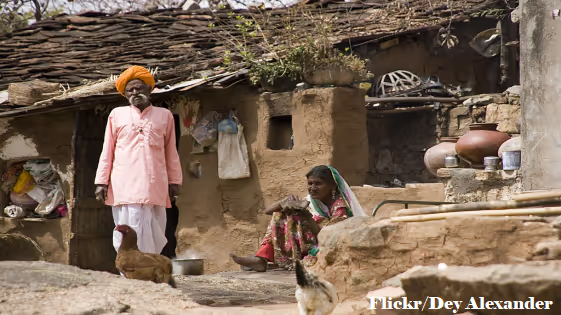
What does Mission Antyodaya data say about rural deprivation?
Public provisioning of basic facilities such as health and education, remains crucial for marginalised populations. In the context of the decentralised structure of governance and fund allocation in India, Guha, Jyotishi and Hatekar assess public provisioning at the disaggregated levels, and the gaps therein. Leveraging the Mission Antyodaya dataset, they create a ‘Rural Deprivation Index’ which can be used to examine the status of provisioning across blocks, villages, districts and states.
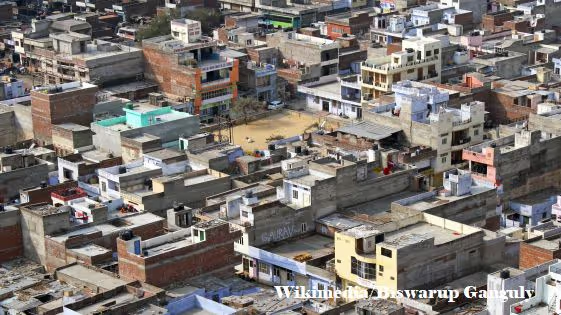
Reshaping social protection in India
As India has undergone a transformation in recent decades in terms of trends such as poverty reduction, food security and urbanisation, there is a need to also revamp the traditional social protection architecture. In this post, Ejaz Ghani proposes a four-pillar approach involving a focus on informally employed urban poor, incorporating gender differences in risks, streamlining existing schemes, and engaging the private sector

What explains policy change? Understanding the historical political economy of India
Drawing on insights from his new book, ‘History of Economic Policy in India’, Rahul De frames policy change as precipitating through three circumstances: crisis, coalitions, and contingency. He uses historical examples of policymaking in post-independent India to delineate why and under what circumstances certain policies were implemented. Using instances from the Nehruvian planning regime to the economic liberalisation in 1991, this article aims to use political economy concepts to incisively explain major economic policy changes in India.

Political determinants of newspaper markets in India
Newspapers are an important source of political information for Indian voters. This article looks at how political factors influence the newspaper market. Using the announcement of delimitation in the mid-2000s as an exogenous shock, it finds that there was an increase in newspaper circulation in districts whose electoral importance increased after the announcement. It notes that, in the short run, this change was driven by a shift in supply, as voters were still unaware of the political shock.

The growing wave of decentralisation: Comparative evidence from developing countries
Over the last few decades, decentralisation has been rapidly spreading in developing countries across the world, with around 35 countries announcing new or deepening decentralisation reforms in recent years. In a new I4I Conversation, Lakshmi Iyer (University of Notre Dame) joins Sarmistha Pal (University of Surrey) and Jean-Paul Faguet (London School of Economics), the editors of ‘Decentralised Governance: Crafting Effective Democracies Around the World’, to discuss the current global state of decentralisation. Over the conversation, they draw on theoretical and empirical insights from different chapters of the book, each featuring diverse countries – Pakistan, China, Indonesia, Kenya, India, Ghana, Bangladesh, and Colombia.


Sign up to our newsletter to be notified about the latest updates
.svg)
Just One Step Away!
Complete your signup to start getting the latest news, stories, and updates delivered straight to your inbox.